Gold price advances on geopolitical tensions, FOMC minutes eyed
- Gold price extends upside amid increasing geopolitical uncertainty.
- The US Dollar remains under presssure ahead of the publication of the FOMC minutes.
- Fed’s Goolsbee said higher interest rates for a longer period can impact labor market conditions.

Gold price (XAU/USD) extends its winning spell to a fifth day on Wednesday amid the Red Sea crisis. Also, Chicago Federal Reserve (Fed) Bank President Austan Goolsbee identifies the consequences of keeping interest rates higher for longer on the United States labor market.
While most Fed policymakers say that resilient economic indicators such as Retail Sales and Employment data have bought time to discuss more on rate cuts as these could flare up price pressures again, Chicago Fed Bank President Austan Goolsbee warned that high rates for an extended period could impact the employment side of the Fed’s dual mandate. The Fed’s dual mandate is based on achieving full employment and inflation staying at around 2%. Goolsbee and other Fed policymakers said that inflation is on track to the central bank’s target of 2% despite the acceleration seen in January.
Meanwhile, investors await the publication of the Federal Open Market Committee (FOMC) minutes for January’s monetary policy meeting. The release will likely provide more cues about when the Fed will start reducing interest rates.
Daily Digest Market Movers: Gold price holds strength while US Dollar turns subdued
- Gold price holds onto gains ahead of the FOMC minutes of the first monetary policy meeting of 2024, which will provide more insights about the timing of rate cuts.
- The near-term outlook of Gold is bullish due to deepening Middle East tensions.
- Persistent attacks from Iran-backed Houthis on commercial vessels in the Red Sea have escalated geopolitical tensions. Safe-haven assets tend to attract higher foreign inflows in times of geopolitical uncertainty.
- Signs of the Fed’s willingness to keep interest rates higher for longer in the FOMC minutes could contribute further to the positive appeal for Gold.
- The opportunity cost of holding non-yielding assets, such as Gold, increases when the Fed maintains interest rates higher.
- Meanwhile, the US Dollar Index (DXY), which measures the Greenback’s value against six major currencies, turns subdued ahead of FOMC minutes.
- The USD Index has come under pressure after the speech from Richmond Fed Bank President Thomas Barkin.
- Thomas Barkin said "January data 'made things harder' but should not put too much weight on the month's information given known seasonality issues."
- Barking added that the ease of hiring is not yet back to normal. The agenda to achieve a soft landing has a long way to go.
- Market expectations for Fed rate cuts will guide further action in safe-haven assets.
- As per the CME FedWatch tool, traders see a 54% chance for a 25 basis point (bp) rate cut in the June policy meeting.
- This week, market participants will also focus on the preliminary S&P Global PMI data for February, which will be released on Thursday.
- The Manufacturing PMI is forecasted to come out lower to 50.5 in February from 50.7 in January. The Services PMI, which represents sectors that account for two-thirds of the US economy, is expected to stand at 52.0, lower than the prior reading of 52.5.
Technical Analysis: Gold price aims to climb above $2,030
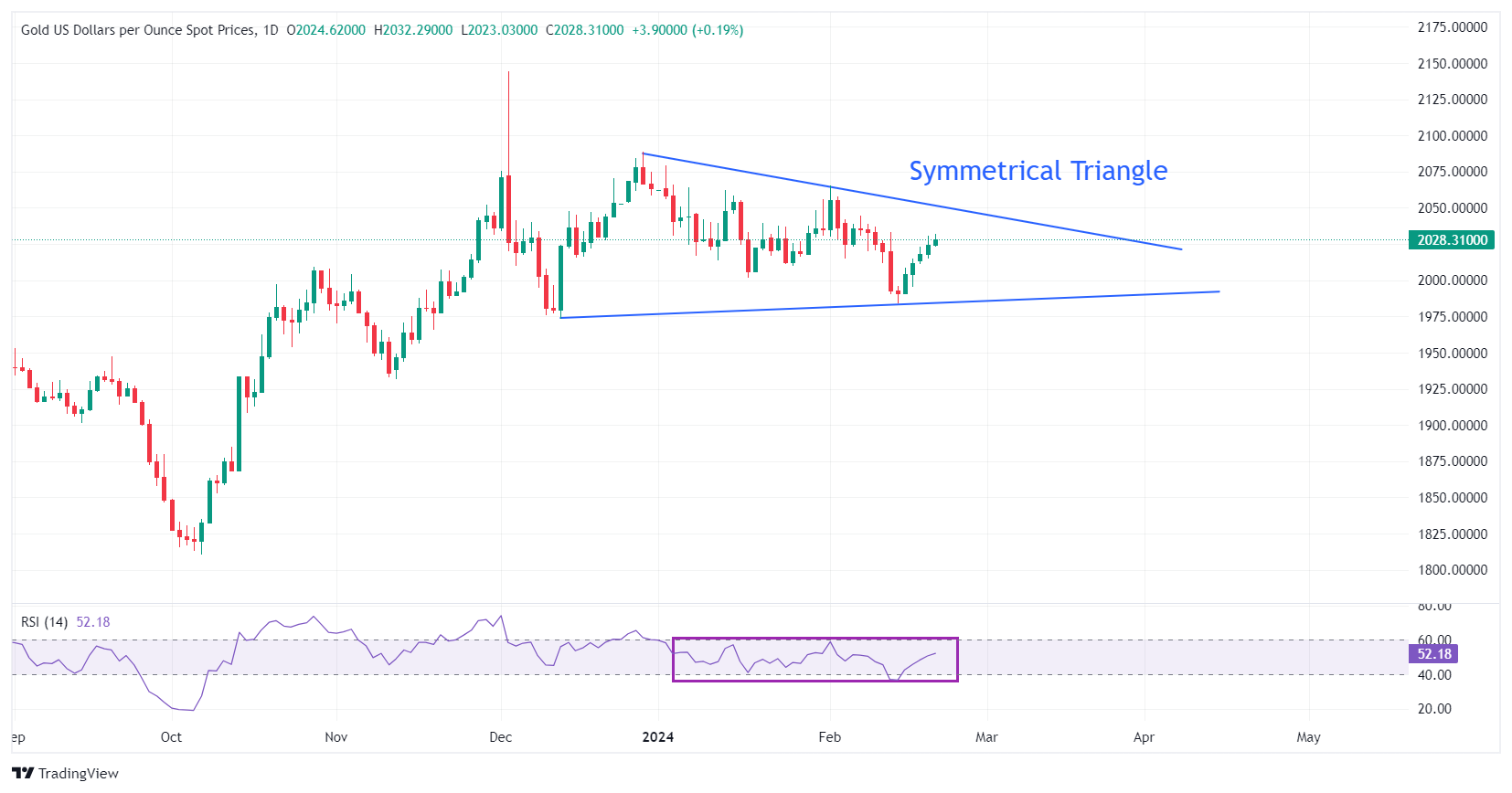
Gold price extends its winning streak for a fifth trading session but struggles to climb above its eight-day high of around $2,031 seen on Tuesday. On a daily time frame, the price is approaching the downward-sloping border of the Symmetrical Triangle chart pattern, which is plotted from December 28’s high at $2,088. The upward-sloping border of the aforementioned chart pattern is placed from December 13’s low at $1,973.
The triangle could break out in either direction. However, the odds marginally favor a move in the direction of the trend before the formation of the triangle – in this case up. A decisive break above or below the triangle boundary lines would indicate a breakout is underway.
The 14-period Relative Strength Index (RSI) has returned to the 40.00-60.00 range quickly after testing territory below 40.00, indicating a bullish reversal.
Fed FAQs
What does the Federal Reserve do, how does it impact the US Dollar?
Monetary policy in the US is shaped by the Federal Reserve (Fed). The Fed has two mandates: to achieve price stability and foster full employment. Its primary tool to achieve these goals is by adjusting interest rates.
When prices are rising too quickly and inflation is above the Fed’s 2% target, it raises interest rates, increasing borrowing costs throughout the economy. This results in a stronger US Dollar (USD) as it makes the US a more attractive place for international investors to park their money.
When inflation falls below 2% or the Unemployment Rate is too high, the Fed may lower interest rates to encourage borrowing, which weighs on the Greenback.
How often does the Fed hold monetary policy meetings?
The Federal Reserve (Fed) holds eight policy meetings a year, where the Federal Open Market Committee (FOMC) assesses economic conditions and makes monetary policy decisions.
The FOMC is attended by twelve Fed officials – the seven members of the Board of Governors, the president of the Federal Reserve Bank of New York, and four of the remaining eleven regional Reserve Bank presidents, who serve one-year terms on a rotating basis.
What is Quantitative Easing (QE) and how does it impact USD?
In extreme situations, the Federal Reserve may resort to a policy named Quantitative Easing (QE). QE is the process by which the Fed substantially increases the flow of credit in a stuck financial system.
It is a non-standard policy measure used during crises or when inflation is extremely low. It was the Fed’s weapon of choice during the Great Financial Crisis in 2008. It involves the Fed printing more Dollars and using them to buy high grade bonds from financial institutions. QE usually weakens the US Dollar.
What is Quantitative Tightening (QT) and how does it impact the US Dollar?
Quantitative tightening (QT) is the reverse process of QE, whereby the Federal Reserve stops buying bonds from financial institutions and does not reinvest the principal from the bonds it holds maturing, to purchase new bonds. It is usually positive for the value of the US Dollar.
Author

Sagar Dua
FXStreet
Sagar Dua is associated with the financial markets from his college days. Along with pursuing post-graduation in Commerce in 2014, he started his markets training with chart analysis.