Gold price clings to gains above $2,400 as traders price in Fed’s big rate cuts
- Gold price remains broadly firm on multiple tailwinds on Friday.
- Investors are divided over the size of Fed rate cuts in September.
- Fed officials acknowledge the softening of inflation and slowing labor demand.

Gold price (XAU/USD) rises to near $2,430 in Friday’s New York session. The precious metal’s near-term outlook remains firm on strong speculation that the Federal Reserve (Fed) will start reducing interest rates in September.
However, investors are divided about whether the Fed will exhibit aggressiveness in the process of pivoting to policy normalization by announcing a 50 basis point (bp) interest-rate reduction or will cut them by 25 bps.
According to the CME FedWatch tool, 30-day Federal Funds futures pricing data shows that traders see a 54.5% chance that interest rates will be reduced by 50 bps in September. For the entire year, data suggests a 100 bp reduction in interest rates by the Fed.
Meanwhile, the US Dollar (USD) and bond yields correct after failing to hold gains driven by lower-than-expected United States (US) Initial Jobless Claims for the week ending August 2. The US Dollar Index (DXY), which tracks the Greenback’s value against six major currencies, drops to nearly 103.15 from a four-day high of 103.50. The 10-year US Treasury yields slump to near 3.97%.
The data, released on Thursday, showed that the number of individuals claiming jobless benefits for the first time was lower at 233K than estimates of 240K and the prior release of 250K (upwardly revised from 249K). Though the jobless claims slowed, the data is insufficient to diminish market expectations for sooner rate cuts.
Daily digest market movers: Gold price remains firm on multiple tailwinds
- Gold price clings to gains above $2,400 on firm Fed rate-cut prospects and lingering geopolitical conflicts. Expectations for aggressive rate cuts were prompted by a recent stock market rout that was driven by fears of a potential US economic slowdown due to a sharp deceleration in job growth and the rising Unemployment Rate.
- Fed policymakers have been acknowledging cooling labor market conditions and are confident that inflation has returned to its path, leading to the bank’s target of 2%. Officials have cleared that their decisions will be based on economic data, not on stock market mayhem and political considerations.
- On Thursday, Chicago Fed Bank President Austan Goolsbee said: "We're not in the business of responding to the stock market. We're in the business of maximizing employment and stabilizing prices," Reuters reported.
- Meanwhile, escalating Middle East tensions continue to improve Gold’s appeal as a safe haven. Investors worry that Iran could retaliate for the killing of the Hamas leader by an air strike in Tehran.
- Going forward, the Gold price will be influenced by the US Consumer Price Index (CPI) data for July, which will be published on Wednesday. The inflation data will indicate whether current market expectations for rate cuts are appropriate.
US Dollar Price Today:
US Dollar PRICE Today
The table below shows the percentage change of US Dollar (USD) against listed major currencies today. US Dollar was the strongest against the Euro.
| USD | EUR | GBP | JPY | CAD | AUD | NZD | CHF | |
|---|---|---|---|---|---|---|---|---|
| USD | 0.02% | -0.18% | -0.10% | 0.00% | -0.00% | -0.17% | -0.16% | |
| EUR | -0.02% | -0.17% | -0.06% | -0.01% | -0.01% | -0.19% | -0.18% | |
| GBP | 0.18% | 0.17% | 0.09% | 0.15% | 0.16% | -0.02% | 0.01% | |
| JPY | 0.10% | 0.06% | -0.09% | 0.05% | 0.07% | -0.12% | -0.07% | |
| CAD | -0.00% | 0.01% | -0.15% | -0.05% | -0.01% | -0.17% | -0.14% | |
| AUD | 0.00% | 0.01% | -0.16% | -0.07% | 0.00% | -0.17% | -0.14% | |
| NZD | 0.17% | 0.19% | 0.02% | 0.12% | 0.17% | 0.17% | 0.03% | |
| CHF | 0.16% | 0.18% | -0.01% | 0.07% | 0.14% | 0.14% | -0.03% |
The heat map shows percentage changes of major currencies against each other. The base currency is picked from the left column, while the quote currency is picked from the top row. For example, if you pick the US Dollar from the left column and move along the horizontal line to the Japanese Yen, the percentage change displayed in the box will represent USD (base)/JPY (quote).
Technical Forecast: Gold price grips gains above $2,400
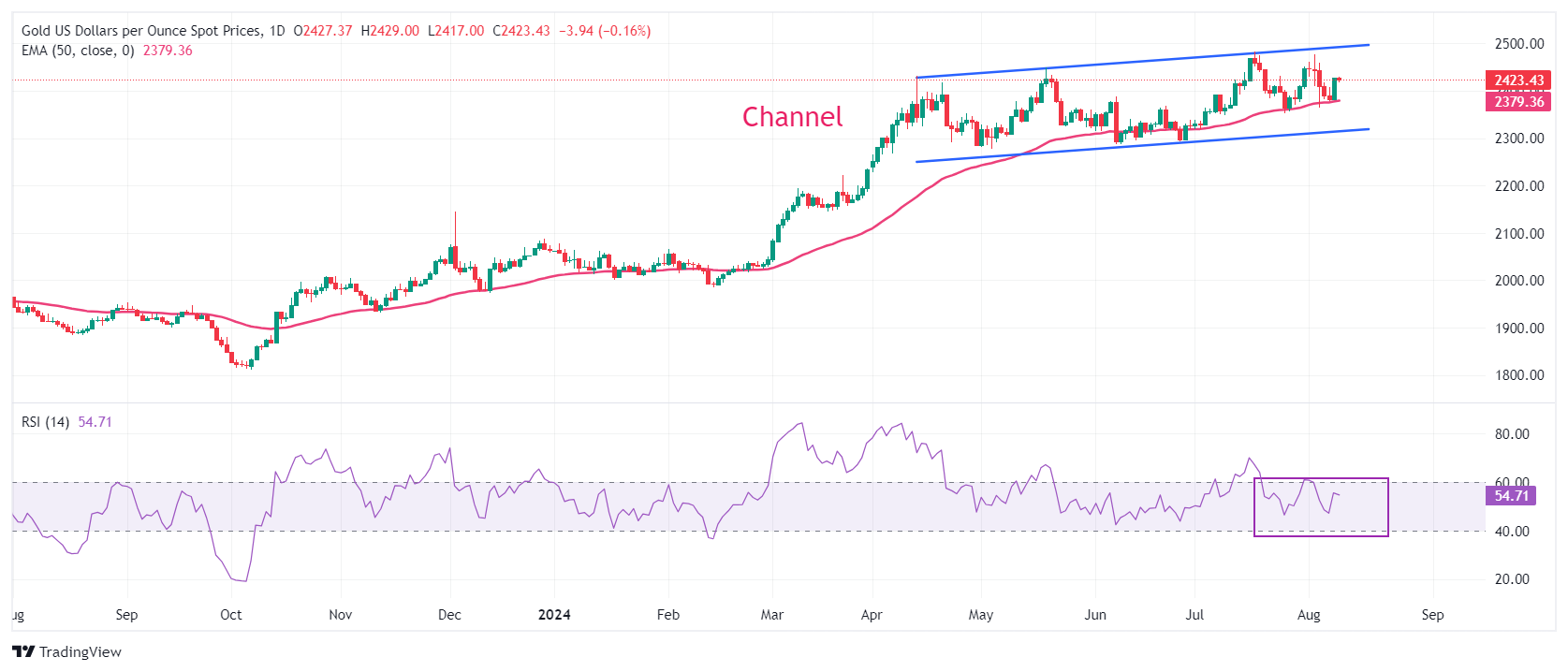
Gold price trades in a channel formation on a daily timeframe, which is slightly rising but broadly exhibited a sideways performance for more than three months. The 50-day Exponential Moving Average (EMA) near $2,370 continues to provide support to the Gold price bulls.
The 14-day Relative Strength Index (RSI) oscillates within the 40.00-60.00 range, suggesting indecisiveness among market participants.
A fresh upside would appear if the Gold price breaks above its all-time high of $2,483.75, which will send it into unchartered territory.
On the downside, the upward-sloping trendline at $2,225, plotted from the October 6 low near $1,810.50, will be a major support in the longer term.
Economic Indicator
Consumer Price Index ex Food & Energy (YoY)
Inflationary or deflationary tendencies are measured by periodically summing the prices of a basket of representative goods and services and presenting the data as the Consumer Price Index (CPI). CPI data is compiled on a monthly basis and released by the US Department of Labor Statistics. The YoY reading compares the prices of goods in the reference month to the same month a year earlier. The CPI Ex Food & Energy excludes the so-called more volatile food and energy components to give a more accurate measurement of price pressures. Generally speaking, a high reading is bullish for the US Dollar (USD), while a low reading is seen as bearish.
Read more.Next release: Wed Aug 14, 2024 12:30
Frequency: Monthly
Consensus: 3.2%
Previous: 3.3%
Source: US Bureau of Labor Statistics
The US Federal Reserve has a dual mandate of maintaining price stability and maximum employment. According to such mandate, inflation should be at around 2% YoY and has become the weakest pillar of the central bank’s directive ever since the world suffered a pandemic, which extends to these days. Price pressures keep rising amid supply-chain issues and bottlenecks, with the Consumer Price Index (CPI) hanging at multi-decade highs. The Fed has already taken measures to tame inflation and is expected to maintain an aggressive stance in the foreseeable future.
Author

Sagar Dua
FXStreet
Sagar Dua is associated with the financial markets from his college days. Along with pursuing post-graduation in Commerce in 2014, he started his markets training with chart analysis.