Gold price climbs above $2,650 on trade war concerns, sliding US bond yields and softer USD
- Gold price gains follow-through traction for the second day amid trade war concerns.
- Sliding US bond yields, softer USD and geopolitical risks further benefit the XAU/USD.
- Traders look to the US Q3 GDP print and the US PCE Price Index for fresh impetuses.

Gold price (XAU/USD) sticks to modest intraday gains near a two-day high, above the $2,650 level, through the first half of the European session as geopolitical risks and US President-elect Donald Trump's tariff plans drive haven flows for the second straight day. Furthermore, sliding US Treasury bond yields keep the US Dollar (USD) depressed near the weekly trough and assist the commodity in building on the overnight bounce from the $2,600 neighborhood, or a one-week low.
Apart from this, a weaker tone around the European equity markets turns out to be another factor that benefits the Gold price. That said, Tuesday's less dovish FOMC minutes, along with prospects for slower rate cuts by the Federal Reserve (Fed), should act as a tailwind for the USD and cap the non-yielding yellow metal. Bulls might also prefer to wait for important US macro data, including the Personal Consumption Expenditure (PCE) Price Index, before placing fresh bets.
Gold price remains supported by combination of factors, ahead of US macro data
- US President-elect Donald Trump pledged to impose tariffs on all products coming into the US from Canada, Mexico and China, driving some follow-through haven flows towards the Gold price.
- Ukraine reported the biggest Russian drone attack on its territory on Tuesday. Russia used a hypersonic missile on Ukraine last week and is advancing at the fastest rate since the 2022 invasion.
- Russia is reported to be using North Korean troops in Ukraine. Ukraine is striking targets deep inside Russia with Western-supplied missiles, raising the risk of a further escalation of the conflict.
- The long-running Middle East conflict de-escalated after US President Joe Biden announced that Lebanon and Israel agreed to a ceasefire deal effective from 02:00 GMT this Wednesday.
- The Conference Board reported on Tuesday that the US Consumer Confidence Index climbed to 111.7 in November – the highest since July 2023 – from 109.6 in the previous month.
- Minutes of the November 6-7 FOMC meeting showed that officials were divided over how much farther they may need to cut rates and were uncertain about the direction of the economy.
- The CME Group's FedWatch Tool indicates that investors are still pricing in a 63% chance that the US central bank will lower borrowing costs by 25-basis-point at the December meeting.
- President-elect Donald Trump's nominee for US Treasury secretary, Scott Bessent is expected to take a more phased approach on tariffs in an attempt to rein in the budget deficit.
- The yield on the benchmark 10-year US government bond holds steady above a two-week low touched on Monday and the US Dollar is seen consolidating near the weekly low.
- Wednesday's US economic docket features the release of the prelim Q3 GDP print and the Personal Consumption Expenditure (PCE) Price Index later during the North American session.
Gold price could appreciate further, though might face some resistance near $2,665 area
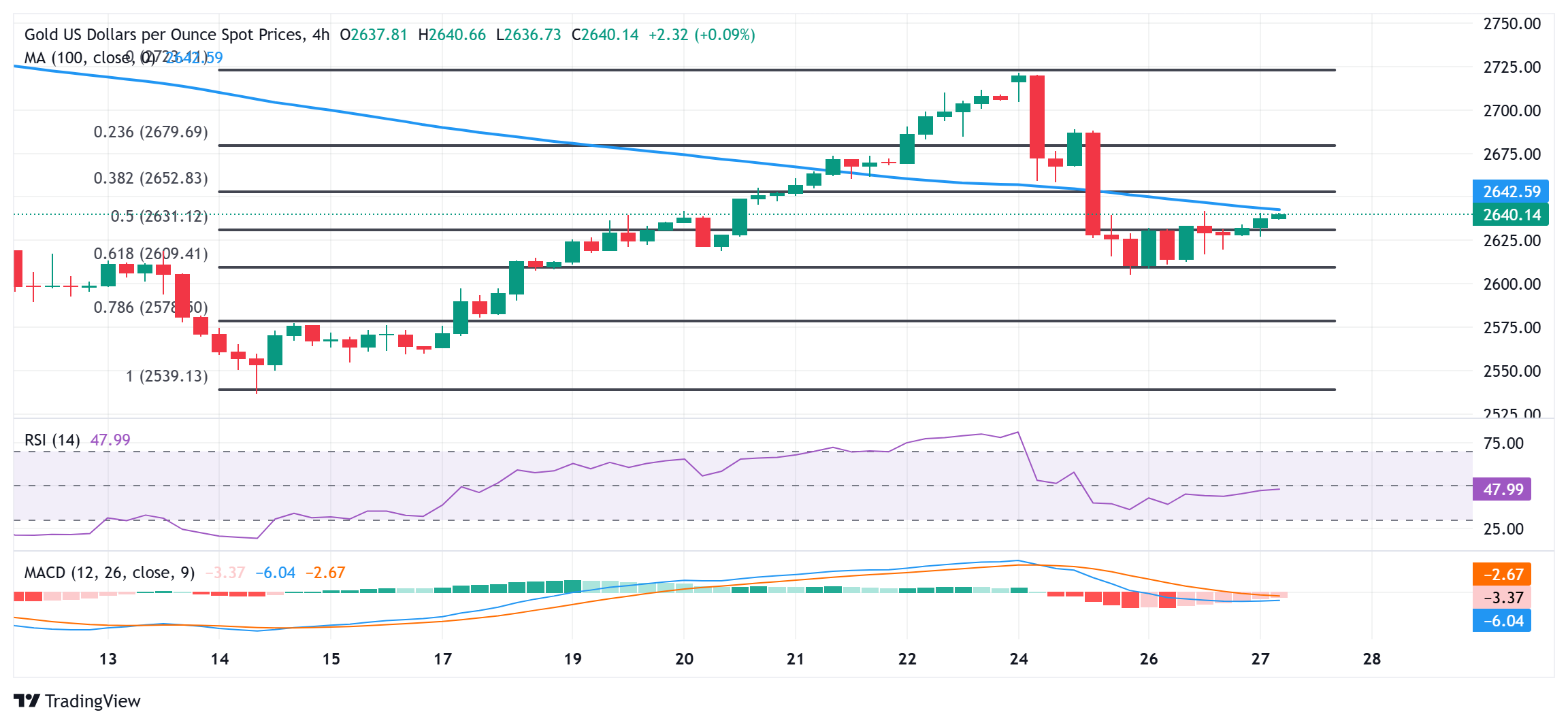
From a technical perspective, Tuesday's goodish rebound from the 61.8% Fibonacci retracement level of the recent recovery and the subsequent strength favor bullish traders. That said, oscillators on the daily chart are yet to confirm a positive bias and suggest that the move up is more likely to confront stiff resistance near the 100-period Simple Moving Average (SMA) on the 4-hour chart. The said barrier is pegged near the $2,645 region, above which the Gold price could climb further towards the $2,665 area en route to the $2,677-2,678 hurdle before aiming to reclaim the $2,700 round figure.
On the flip side, the $2,624-2,622 region could offer some support ahead of the $2,600 mark. A convincing break below the latter will be seen as a fresh trigger for bearish traders and expose the 100-day SMA, around the $2,569-2,568 zone. This is followed by the monthly swing low, around the $2,537-2,536 area. Failure to defend the said support levels will be seen as a fresh trigger for bearish traders and set the stage for the resumption of the corrective decline from the $2,800 neighborhood, or the all-time peak touched in October.
Economic Indicator
Durable Goods Orders
The Durable Goods Orders, released by the US Census Bureau, measures the cost of orders received by manufacturers for durable goods, which means goods planned to last for three years or more, such as motor vehicles and appliances. As those durable products often involve large investments they are sensitive to the US economic situation. The final figure shows the state of US production activity. Generally speaking, a high reading is bullish for the USD.
Read more.Next release: Wed Nov 27, 2024 13:30
Frequency: Monthly
Consensus: 0.5%
Previous: -0.8%
Source: US Census Bureau
Author

Haresh Menghani
FXStreet
Haresh Menghani is a detail-oriented professional with 10+ years of extensive experience in analysing the global financial markets.