Gold Price Analysis: XAU/USD remains depressed below $1,890 level, downside seems limited
- Gold price is back in the red amid the resurgent US dollar’s demand.
- Yellen’s optimism lifts the Treasury yields, rescues the greenback.
- Gold Price Forecast: XAU/USD’s upside appears capped below $1900, with all eyes on US CPI

Update: Gold struggled to capitalize on Friday's goodish rebound from the $1,855 region, or three-week lows and edged lower on the first day of a new trading week. The commodity remained depressed heading into the North American session and was last seen trading just above the $1,885 level, down nearly 0.20% for the day.
As investors looked past Friday's softer US jobs report, a goodish pickup in the US Treasury bond yields turned out to be a key factor that exerted some pressure on the non-yielding yellow metal. A disappointing headline NFP print tempered market expectations that the Fed could begin tapering its bond-purchase program. That said, concerns about rising inflationary pressure acted as a tailwind for the US bond yields.
Hence, the focus will remain on Thursday's release of the US consumer inflation figures, which will be another piece of important macro data that would set the tone for the FOMC meeting on June 15-16. In the meantime, investors seemed reluctant to place any aggressive bets amid absent relevant market moving economic releases. Apart from this, a subdued US dollar demand extended some support to dollar-denominated commodities and helped limit any further losses for gold.
Previous update: Gold price is falling from just below the $1900 area this Monday, kicking off the week on a bearish note. Resurgent US dollar demand amid a rebound in the Treasury yields, courtesy of US Secretary Janet Yellen’s optimism over the economy, weighs on gold’s appeal. Yellen said that higher interest rates would be a ‘plus’ for the Fed. Investors shrugged off dismal US NFP jobs data, as Yellen revived taper talks. Further, a tussle between the White House and Republicans over President Joe Biden’s $1.7 trillion infrastructure spending bill also adds to the downward pressure on gold price.
Looking ahead, the broader market sentiment and dynamics in the yields would continue to play out amid a lack of relevant US economic news. The US CPI report due on Thursday will be the main event to watch for fresh trading opportunities in gold price.
Read: Gold Weekly Forecast: XAU/USD snaps four-week winning streak, closes below $1,900
Gold Price: Key levels to watch
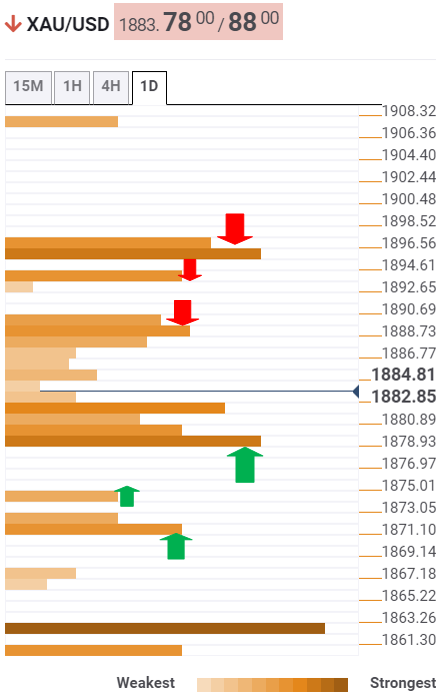
The Technical Confluences Detector shows that gold price is approaching a dense cluster of support levels stacked up around $1880.
At that point, the Fibonacci 38.2% one-month, Fibonacci 23.6% one-week and Fibonacci 38.2% one-day coincide.
If that cap gives way, a drop towards the Bollinger Band one-day Middle at $1874 cannot be ruled out.
Further south, the sellers will then test the confluence of the Fibonacci 23.6% one-week and Fibonacci 61.8% one-day at $1871.
On the flip side, gold bulls need to scale the $1888-$1890 supply zone on a sustained basis. That area is the convergence of the SMA5 four-hour, SMA10 one-hour and previous four-hour.
The Fibonacci 61.8% one-week at $1893 could test the bullish commitments.
The next stop for gold bulls is seen at $1896, where the previous day high, SMA50 four-hour and SMA200 one-hour meet.
Here is how it looks on the tool
About Technical Confluences Detector
The TCD (Technical Confluences Detector) is a tool to locate and point out those price levels where there is a congestion of indicators, moving averages, Fibonacci levels, Pivot Points, etc. If you are a short-term trader, you will find entry points for counter-trend strategies and hunt a few points at a time. If you are a medium-to-long-term trader, this tool will allow you to know in advance the price levels where a medium-to-long-term trend may stop and rest, where to unwind positions, or where to increase your position size.
Author

Dhwani Mehta
FXStreet
Residing in Mumbai (India), Dhwani is a Senior Analyst and Manager of the Asian session at FXStreet. She has over 10 years of experience in analyzing and covering the global financial markets, with specialization in Forex and commodities markets.