Gold Price Forecast: XAU/USD’s upside appears capped below $1900, with all eyes on US CPI
- Gold price sees a negative start to the week, despite the NFP disappointment.
- Yellen’s taper talk revives the Treasury yields, stalls DXY’s decline.
- All eyes remain on the US CPI this week amid a tussle over US stimulus.

Gold price (XAU/USD) rebounded firmly from two-week lows of $1856 on Friday, staging a solid comeback after the US Nonfarm Payrolls disappointed with 559K in May. Markets believed the NFP miss would lift the pressure of the Fed to hike interest rates sooner, as the data point that the economy is not overheating. The US dollar was smashed across the board alongside the Treasury yields while the dismal data buoyed the stocks and bullion. The NFP report came to the rescue of the gold bulls, who were beaten by the reports that India and China offered discounts due to a covid-related dip in consumption. Also, pre-NFP positioning in the dollar pressured gold price. Despite the stellar performance on Friday, gold price ended the week in the red, below $1900.
Gold price extended last week’s dismal performance into a fresh week this Monday, tempered by US Treasury Secretary Janet Yellen’s comments over the weekend, which revived tapering expectations and lifted the yields. The US dollar index stalled its bounce amid a mixed market mood and taper talks. Gold price also feels the heat of the tussle between the White House and Republicans over the $1.7 trillion infrastructure spending plan. Attention now turns towards the US CPI report, in order to gauge the Fed’s next monetary policy path.
Gold Price Chart - Technical outlook
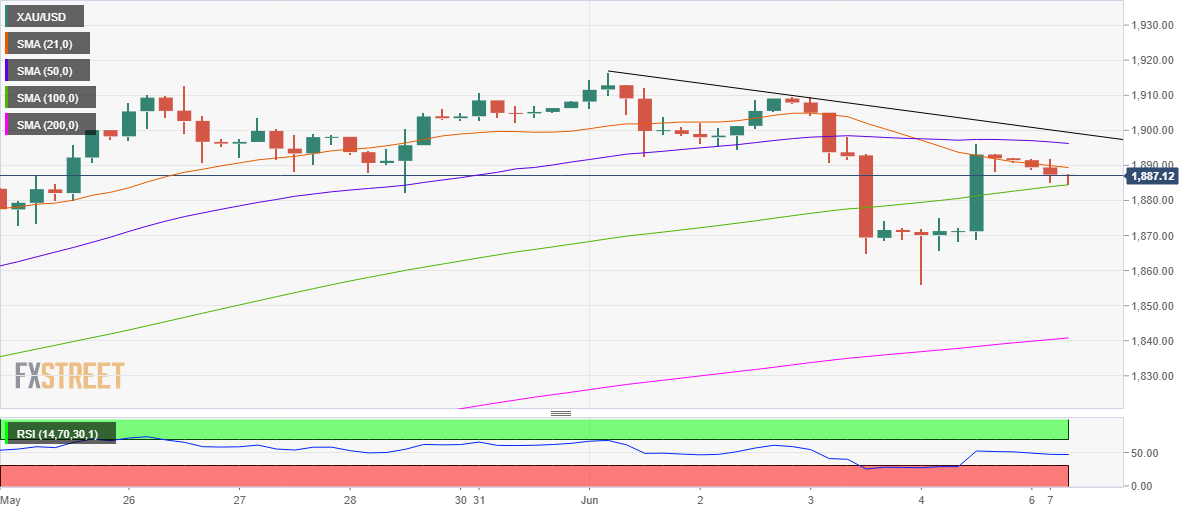
Gold: Four-hour chart
Gold’s four-hour chart shows that the price is challenging the upward-sloping 100-simple moving average (SMA) support at $1884, having faced rejection at the 50-SMA of $1896 on a couple of occasions.
Acceptance below that latter could expose the $1870 static support, below which the two-week lows could be retested.
The Relative Strength Index (RSI) edges lower below the midline, suggesting that there is additional room for declines.
Alternatively, a sustained break above the 50-SMA resistance is likely to threaten the falling trendline hurdle at $1900.
All in all, gold’s path of least resistance appears to the downside in the near term.
Author

Dhwani Mehta
FXStreet
Residing in Mumbai (India), Dhwani is a Senior Analyst and Manager of the Asian session at FXStreet. She has over 10 years of experience in analyzing and covering the global financial markets, with specialization in Forex and commodities markets.