Gold pulls back after US-data inspired drop
- Gold pauses and consolidates following a steep sell-off on Friday.
- US employment data showed more people joined the workforce in May, and wages rose higher than expected.
- The data makes it less likely the US Federal Reserve will cut interest rates in September, reducing Gold's attractiveness to investors.


Gold (XAU/USD) price takes a breather on Monday after sliding almost three and a half percentage points on Friday after the release of better-than-expected US Nonfarm Payrolls (NFP) data. The yellow metal trades just above $2,300 amid a mixed market mood.
The rosy wage-and-employment picture painted by the US employment data on Friday suggested a radical reappraisal of US interest-rate expectations, with the Federal Reserve (Fed) now expected to maintain interest rates elevated for longer. This, in turn, had an immediate bearish effect on Gold by raising the opportunity cost of holding the non-yielding precious metal, making it less attractive to investors.
Gold weakens after US employment data recalibrates interest-rate expectations
Gold price resumed its short-term bearish tone at the end of last week after the US NFP data showed a higher-than-forecast 272K rise in the number of new workers joining the economy in May, beating economists’ estimates of 185K and rising from a downwardly revised 165K in April.
Not only did payrolls beat expectations, but the data also showed Average Hourly Earnings rising by 4.1% YoY in May, more than the 3.9% forecast and the upwardly revised 4.0% in April. This suggests workers are earning more, which could push up spending and, in turn, inflation.
The market’s expectations that the Fed will cut interest rates in September fell to just over 50% after the release of the NFP from 67% previously, according to the CME FedWatch tool, which bases its estimates on 30-day US Fed Fund Futures pricing data.
That said, Gold price is supported by the different outlook for global interest-rate expectations, which remain depressed. The Bank of Canada (BoC) cut its overnight rate by 0.25% to 4.75% last week, as did the European Central Bank (ECB). The release of lower inflation data in Switzerland has prompted speculation the Swiss National Bank (SNB) could also cut interest rates at its June 20 meeting following an initial cut in March.
Gold traders will now be looking for further cues on price direction at the Federal Reserve June meeting, which concludes on Wednesday, as well as the US Consumer Price Index (CPI) data for May out earlier on the same day.
Asian passion for Gold abates
Gold was further pressured at the end of last week following the release of official data showing that the People’s Bank of China (PBoC) had halted buying of more Gold in May, ending an 18-month buying spree for the central bank.
The data followed strong buying in April that saw China Gold reserves at the PBoC hit an all-time high, accounting for 4.9% of total reserves, and following 18 consecutive months of growth.
Technical Analysis: Gold pauses during sell-off
Gold price broke below the $2,315 range low on Friday and hit an initial downside target at $2,303, generated by the original trendline break in May. This target was at the 0.618 Fibonacci ratio of the length of the move prior to the trendline break, “a,” extrapolated lower as “b” (see chart below).
The next target, which has also almost been met, is at about $2,285, the 100% extrapolation of “a”. A stronger move down could see Gold meet support at $2,279 (late April-early May swing low).
XAU/USD 4-hour Chart
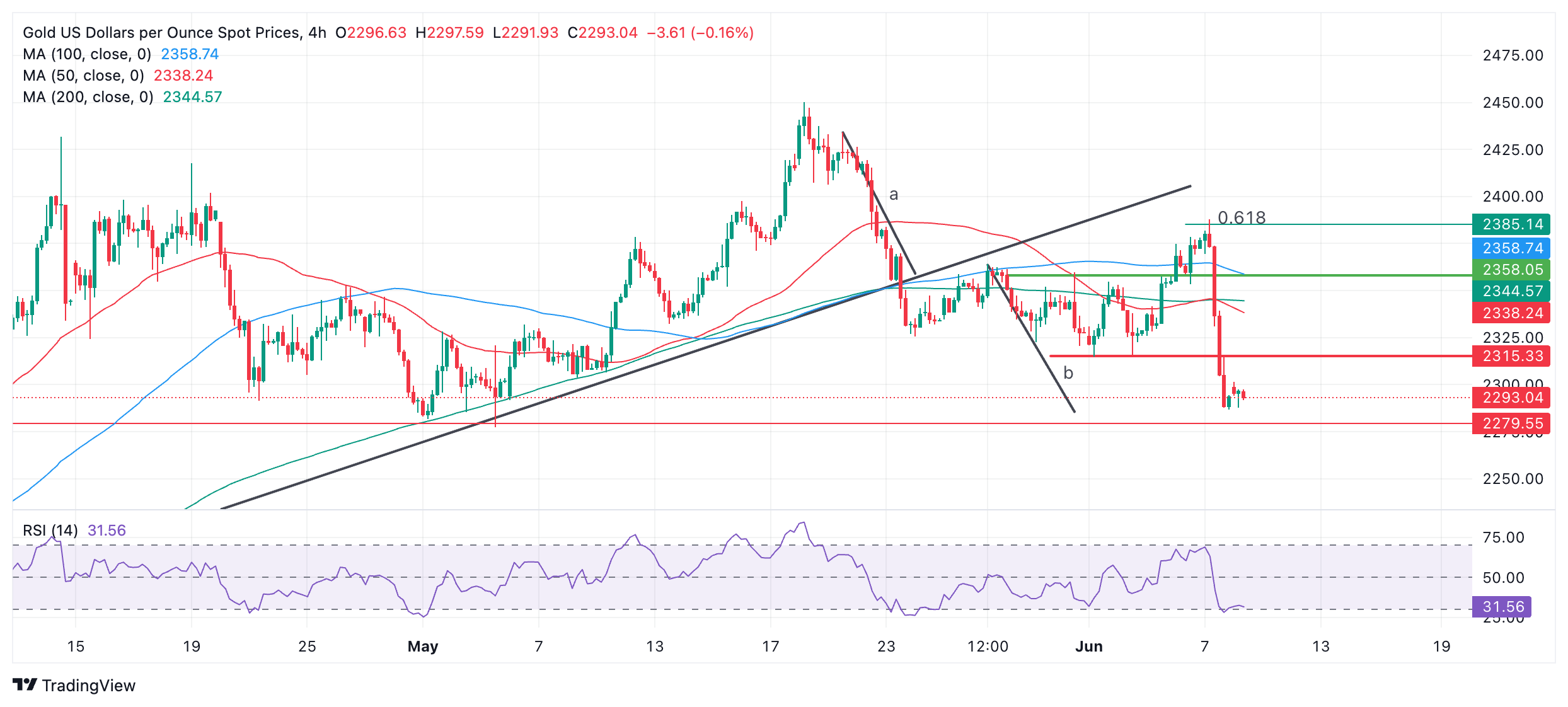
The Relative Strength Index (RSI) indicator has briefly dipped into the oversold region before exiting and rising back above 30.00, indicating the possibility Gold may pullback in the short-term. However, such is the strength of the prior down move that Gold is likely to resume moving lower once the pullback completes.
Despite short-term weakness, the precious metal’s medium and long-term trends are still bullish, and the risk of a recovery remains high.
Gold FAQs
Gold has played a key role in human’s history as it has been widely used as a store of value and medium of exchange. Currently, apart from its shine and usage for jewelry, the precious metal is widely seen as a safe-haven asset, meaning that it is considered a good investment during turbulent times. Gold is also widely seen as a hedge against inflation and against depreciating currencies as it doesn’t rely on any specific issuer or government.
Central banks are the biggest Gold holders. In their aim to support their currencies in turbulent times, central banks tend to diversify their reserves and buy Gold to improve the perceived strength of the economy and the currency. High Gold reserves can be a source of trust for a country’s solvency. Central banks added 1,136 tonnes of Gold worth around $70 billion to their reserves in 2022, according to data from the World Gold Council. This is the highest yearly purchase since records began. Central banks from emerging economies such as China, India and Turkey are quickly increasing their Gold reserves.
Gold has an inverse correlation with the US Dollar and US Treasuries, which are both major reserve and safe-haven assets. When the Dollar depreciates, Gold tends to rise, enabling investors and central banks to diversify their assets in turbulent times. Gold is also inversely correlated with risk assets. A rally in the stock market tends to weaken Gold price, while sell-offs in riskier markets tend to favor the precious metal.
The price can move due to a wide range of factors. Geopolitical instability or fears of a deep recession can quickly make Gold price escalate due to its safe-haven status. As a yield-less asset, Gold tends to rise with lower interest rates, while higher cost of money usually weighs down on the yellow metal. Still, most moves depend on how the US Dollar (USD) behaves as the asset is priced in dollars (XAU/USD). A strong Dollar tends to keep the price of Gold controlled, whereas a weaker Dollar is likely to push Gold prices up.
Author
Joaquin Monfort
FXStreet
Joaquin Monfort is a financial writer and analyst with over 10 years experience writing about financial markets and alt data. He holds a degree in Anthropology from London University and a Diploma in Technical analysis.

















