Gold marks sixth-day of losses on Powell’s slightly hawkish rhetoric
- Gold price dips below $2,570 head for an over 4% weekly decline.
- Jerome Powell indicates the Fed is cautious about cutting rates despite positive US economic indicators.
- Investors adjust expectations for a December rate cut, with likelihood dropping to 62% after Powell's comments.
- US Retail Sales show growth while Industrial Production improved, despite remaining subdued.

Gold prices extended their losses for the sixth straight day, set to achieve weekly losses of over 4%, the largest since September 2023. Federal Reserve Chair Jerome Powell's slight “hawkish” rhetoric lifted the Greenback, denting appetite for the golden metal. At the time of writing, XAU/USD trades at $2,564, down by 0.17%.
On Thursday, Fed Chair Jerome Powell said the central bank is in no rush to lower borrowing costs amid an ongoing strong economy, a solid labor market, and inflation standing above the 2% goal.
Following Powell’s words, investors trimmed the chances of a 25 basis point (bps) rate cut by the Fed at the December meeting, with odds falling from 72% to 62%.
Earlier, US Retail Sales for October expanded monthly and annually, with the former dipping slightly compared to September numbers. Recently, the Fed announced that Industrial Production for the same period improved but remained in contractionary territory.
Although US data was positive, it undermined the buck as market participants booked profits ahead of the weekend. This capped Bullion’s losses after it hit a two-month low of $2,536.
The US Dollar Index (DXY), which measures Greenback’s performance against a basket of six currencies, lost 0.10%, at 106.76.
US Treasury bond yields were also pressured ahead of the weekend, with the 10-year benchmark rate virtually unchanged at 4.43%.
In addition to Powell’s words, Boston Fed Susan Collins said the US central bank does not urgently need to lower rates. Lastly, Chicago’s Fed Austan Goolsbee kept the central bank options regarding December’s meeting, adding, “The dispute on neutral rate could support slower cuts.”
Market participants seem worried about Donald Trump’s tariff plans, which are inflation-prone at a time when the Fed is trying to control higher prices without tapping a deeper economic slowdown.
Next week, Bullion traders will look for Fed-speaking housing data, Initial Jobless Claims, and the release of S&P Global Flash PMIs.
Daily digest market movers: Gold steadies alongside strong US Dollar
- Gold prices recover as US real yields, which inversely correlate against Bullion, fall three basis points to 2.107%.
- US Retail Sales in October increased by 0.4% month-over-month, slightly above the 0.3% forecast but lower than the 0.8% rise recorded in September. Yearly, sales grew by 2.8%, up from 2% previously.
- Industrial Production contracted by -0.3% in October, in line with expectations, but showed an improvement from the -0.5% decline seen in September.
- According to data from the Chicago Board of Trade via the December fed funds futures contract, investors are pricing in 24 basis points of Federal Reserve rate cuts by the end of 2024.
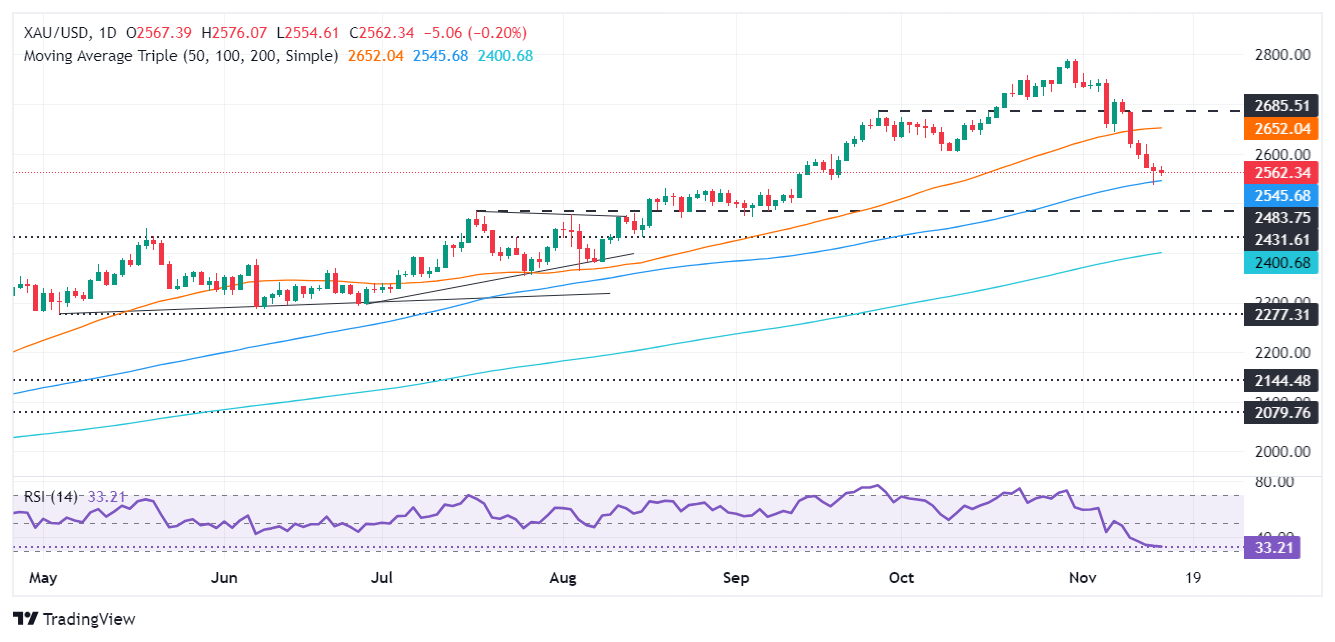
XAU/USD Technical Outlook: Gold price remains bearish; sellers target $2,550
Gold recently dipped below the October 10 swing low of $2,603, intensifying losses past the $2,600 mark and briefly touching a two-month low of $2,536, just under the 100-day Simple Moving Average (SMA) at $2,545. Nevertheless, the inability of sellers to push prices toward $2,500 has allowed for a potential rebound.
The first resistance level is $2,600. If buyers reclaim this level, they may target the 50-day SMA at $2,651, with further resistance around $2,700. Exceeding this could pave the way to the November 7 high of $2,710.
The Relative Strength Index (RSI) has moved away from its neutral line, indicating bearish momentum that could lead to further declines in XAU/USD.
Gold FAQs
Gold has played a key role in human’s history as it has been widely used as a store of value and medium of exchange. Currently, apart from its shine and usage for jewelry, the precious metal is widely seen as a safe-haven asset, meaning that it is considered a good investment during turbulent times. Gold is also widely seen as a hedge against inflation and against depreciating currencies as it doesn’t rely on any specific issuer or government.
Central banks are the biggest Gold holders. In their aim to support their currencies in turbulent times, central banks tend to diversify their reserves and buy Gold to improve the perceived strength of the economy and the currency. High Gold reserves can be a source of trust for a country’s solvency. Central banks added 1,136 tonnes of Gold worth around $70 billion to their reserves in 2022, according to data from the World Gold Council. This is the highest yearly purchase since records began. Central banks from emerging economies such as China, India and Turkey are quickly increasing their Gold reserves.
Gold has an inverse correlation with the US Dollar and US Treasuries, which are both major reserve and safe-haven assets. When the Dollar depreciates, Gold tends to rise, enabling investors and central banks to diversify their assets in turbulent times. Gold is also inversely correlated with risk assets. A rally in the stock market tends to weaken Gold price, while sell-offs in riskier markets tend to favor the precious metal.
The price can move due to a wide range of factors. Geopolitical instability or fears of a deep recession can quickly make Gold price escalate due to its safe-haven status. As a yield-less asset, Gold tends to rise with lower interest rates, while higher cost of money usually weighs down on the yellow metal. Still, most moves depend on how the US Dollar (USD) behaves as the asset is priced in dollars (XAU/USD). A strong Dollar tends to keep the price of Gold controlled, whereas a weaker Dollar is likely to push Gold prices up.
Author

Christian Borjon Valencia
FXStreet
Markets analyst, news editor, and trading instructor with over 14 years of experience across FX, commodities, US equity indices, and global macro markets.

















