Gold trades lower after decline in demand for jewelry in China
- Gold weakens after the China Gold Association highlights a drop in the consumption of Gold for jewelry.
- The rising price of Gold is posited as the main reason behind the reduction in demand.
- XAU/USD remains within the confines of a mini range, consolidating within an overall bullish trend.

Gold (XAU/USD) falls to the $2,740s on Monday but remains within the confines of the previous week’s mini range. The precious metal loses ground on reports that demand from China, its largest market, is softening.
The precious metal, however, remains underpinned by safe-haven flows due to the ongoing conflict in the Middle East, which intensified over the weekend with Israel’s bombing of Iran, although the effect was offset by the decision only to target military installations and crucially not Oil and nuclear facilities.
Gold gains a further boost from increasing uncertainty over the outcome of the US presidential election and the overall downtrend in interest rates globally, which, given it is non-interest paying, enhances the yellow metal’s attractiveness to investors vis-a-vis other assets.
Gold drops after report shows softening Chinese demand
Gold edges lower on Monday after data released by the China Gold Association (CGA) showed a fall in demand from the world’s largest Gold consumer in the first three quarters of 2024, compared to the same period a year ago.
Total consumption was 742 tons between January and September, which is 11.18% lower than the same period last year.
Consumption of Gold jewelry in China fell by 27.53%, to 400 tons when compared to the same period in 2023, the CGA reported.
Demand for Gold bars and coins, however, increased 27.14%, to 283 tons compared to 2023. Gold used in industrial processes, meanwhile, reached 59 tons, a decrease of 2.78%.
The high price of Gold was given as the main reason for the fall in demand, “In the first three quarters, the price of Gold continued to rise, and the consumption of Gold jewelry was significantly affected,” the report says.
Trading on the Shanghai Gold Exchange, however, increased by 47.49% to 46,500 tons (23,200 tons on one side), due to traders participating in the rally. Interest in ETFs also increased.
“The domestic Gold ETF holdings rose to 91.39 tons, an increase of 29.93 tons from the end of 2023, an increase of 48.69%,” added the report.
Technical Analysis: Gold continues in a sideways band
Gold trades in a mini range between $2,708 and $2,758 after peaking at the latter level and rolling over.
That said, the yellow metal is in a steady uptrend on all time frames (short, medium and long), which, given the technical principle that “the trend is your friend,” the odds favor more upside.
XAU/USD Daily Chart
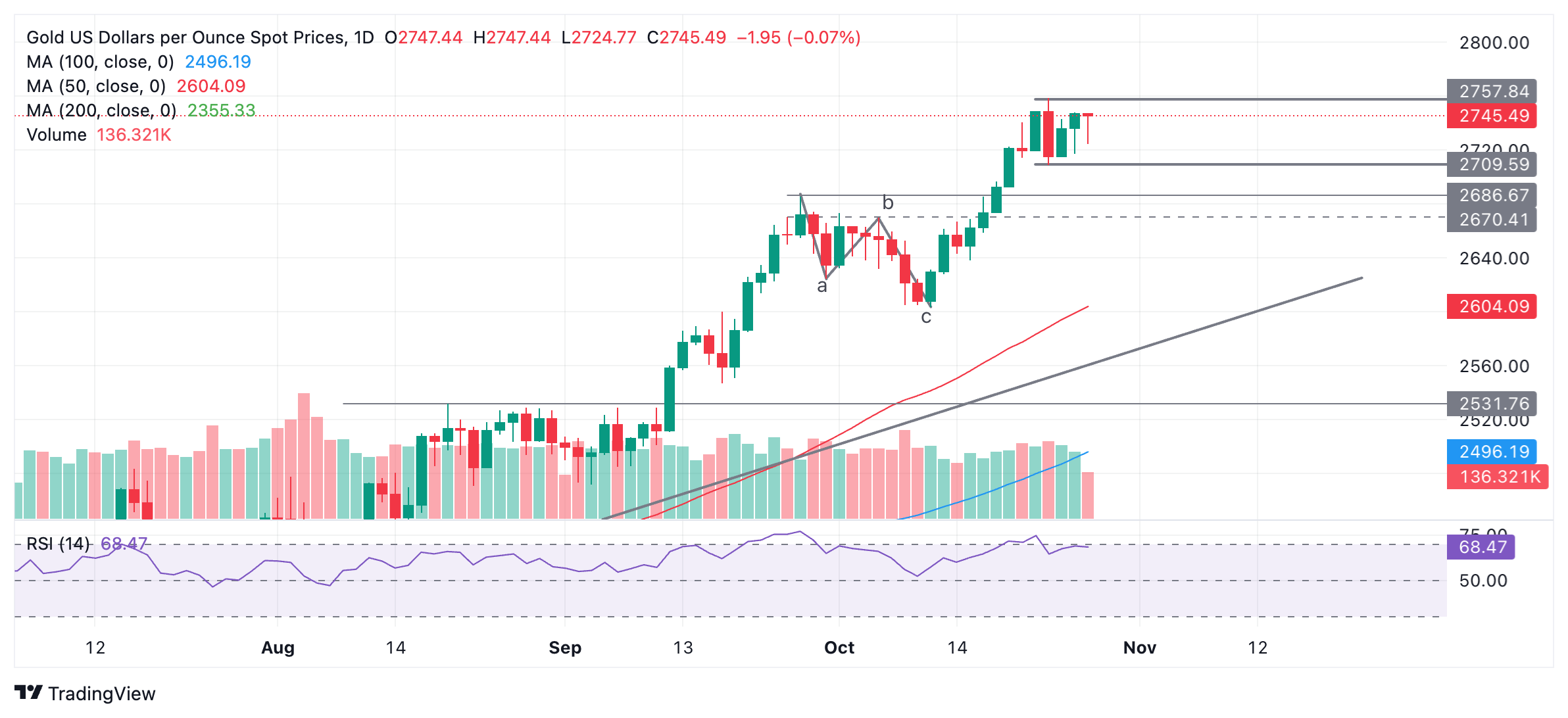
A break above the top of the range at $2,758 would help confirm a continuation up to the next big-figure target level, which lies at $3,000 (round number and psychological level).
Interest rates FAQs
Interest rates are charged by financial institutions on loans to borrowers and are paid as interest to savers and depositors. They are influenced by base lending rates, which are set by central banks in response to changes in the economy. Central banks normally have a mandate to ensure price stability, which in most cases means targeting a core inflation rate of around 2%. If inflation falls below target the central bank may cut base lending rates, with a view to stimulating lending and boosting the economy. If inflation rises substantially above 2% it normally results in the central bank raising base lending rates in an attempt to lower inflation.
Higher interest rates generally help strengthen a country’s currency as they make it a more attractive place for global investors to park their money.
Higher interest rates overall weigh on the price of Gold because they increase the opportunity cost of holding Gold instead of investing in an interest-bearing asset or placing cash in the bank. If interest rates are high that usually pushes up the price of the US Dollar (USD), and since Gold is priced in Dollars, this has the effect of lowering the price of Gold.
The Fed funds rate is the overnight rate at which US banks lend to each other. It is the oft-quoted headline rate set by the Federal Reserve at its FOMC meetings. It is set as a range, for example 4.75%-5.00%, though the upper limit (in that case 5.00%) is the quoted figure. Market expectations for future Fed funds rate are tracked by the CME FedWatch tool, which shapes how many financial markets behave in anticipation of future Federal Reserve monetary policy decisions.
Author

Joaquin Monfort
FXStreet
Joaquin Monfort is a financial writer and analyst with over 10 years experience writing about financial markets and alt data. He holds a degree in Anthropology from London University and a Diploma in Technical analysis.