Gold falls after brief spike following weak Nonfarm Payrolls figures
- Gold weakens after briefly surging higher following the release of lower-than-expected Nonfarm Payrolls data.
- The precious metal further gains from safe-haven flows after hopes of a ceasefire in the Middle East were dashed by another outbreak of hostilities.


Gold (XAU/USD) edges lower during a voltile trading day on Friday. The precious metal briefly rose to the $2,760s after the release of US Nonfarm Payrolls (NFP) data showed a decline to only 12K in October, falling well below the 113K expected and the revised-down 223K of September. However, it has since sold off to the $2,740s.
The yellow metal may have lost ground after mixed data from the US Institute of Supply Managers (ISM).
The ISM Manufacturing Purchasing Manager Index (PMI) survey showed a decline in activity and fell to 46.5 in October, from 47.2 in September and fell below the 47.6 expected.
However, the inflation-sensistive ISM Manufacturing Prices Paid Index registered a rise to 54.8 in October from 48.3 previously and was above the 48.5 forecast. The higher prices paid component may have been behind the sell-off in Gold as higher prices could reduce the odds of the Federal Reserve aggresively cutting interest rates in coming meetings.
The lower-than-expected increase in workers joining the economy reflected in the NFP data, however, will ring alarm bells for the Federal Reserve (Fed) regarding the state of the US labor market, and increases the probability it will reduce interest rates more aggresively in meetings to come. This, in turn, is positive for Gold as it lowers the opportunity cost of holding the non-interest paying asset, making it more attractive to investors.
Other data from the Bureau of Labor Statistics (BLS) NFP report showed the Unemployment Rate remained at 4.1% in October in line with expectations and the previous month; Average Hourly Earnings rose to 4.0% in line with expectations and higher than the revised-down 3.9% in September and hourly earnings on a month-over-month basis rose 0.4% versus 0.3% expected and a revised down 0.3% previously. Average Hours Worked also rose to 34.3, above expectations of 34.2, but the same as the upwardly-revised previous print.
Gold rebounds on safe-haven flows
Gold is also rebounding on the back of a revival in safe-haven demand after hopes of a ceasefire in the Middle East war were dashed by a Hezbollah rocket attack in northern Israel that killed seven people, making it the worst strike in months, according to the BBC. Overnight there was also an intensification of the bombing of Beirut by Israel resulting in over 55 deaths, according to Al Jazeera news. That, and the risk surrounding the US presidential election given how tight the race is, continue leavening demand for the yellow metal.
Technical Analysis: Gold recovers after pullback into former range
Gold is recovering after a pullback down into its former range between $2,708 and $2,758.
Overall, the precious metal remains in a steady uptrend on all time frames (short, medium and long), which, given the technical principle that “the trend is your friend,” tilts the odds in favor of more upside.
XAU/USD 4-hour Chart
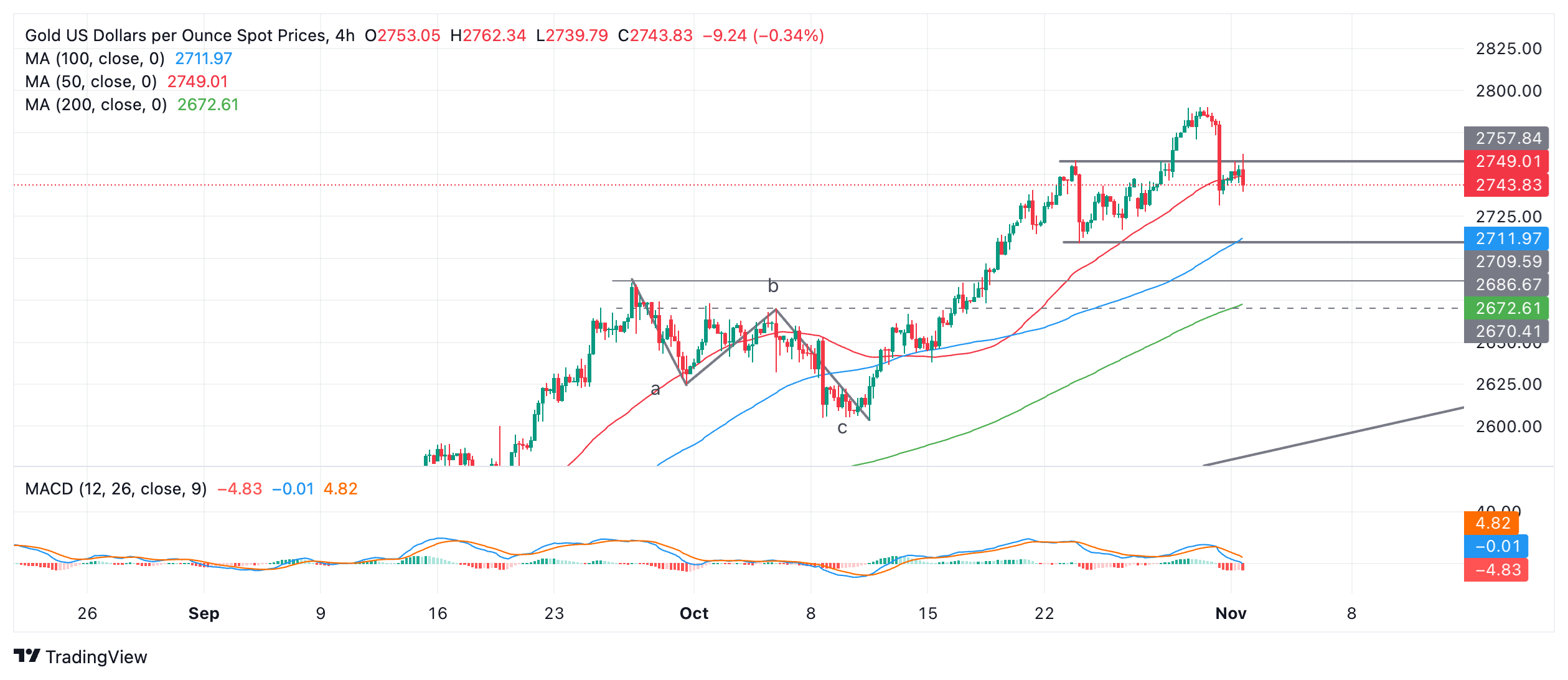
That said, the decline from Wednesday’s peak has been steep, which could augur more downside to come.
The Relative Strength Index (RSI) momentum indicator in the 4-hour chart is also showing a bearish dip in momentum accompanied by the recent sell-off, with RSI falling substantially below the 50 mark for the first time since October 10.
A deeper pullback would find support at $2,708, the floor of the range. The overall uptrend, however, is likely to resume eventually.
A break above the $2,790 high would probably lead to a move up to resistance at $2,800 (whole number and psychological number) followed by $2,850.
Economic Indicator
ISM Manufacturing Prices Paid
The Institute for Supply Management (ISM) Manufacturing Index shows business conditions in the US manufacturing sector, taking into account expectations for future production, new orders, inventories, employment and deliveries. It is a significant indicator of the overall economic condition in US. The ISM Prices Paid represents business sentiment regarding future inflation. A high reading is seen as positive for the USD, while a low reading is seen as negative.
Read more.Last release: Fri Nov 01, 2024 14:00
Frequency: Monthly
Actual: 54.8
Consensus: 48.5
Previous: 48.3
Source: Institute for Supply Management
Author
Joaquin Monfort
FXStreet
Joaquin Monfort is a financial writer and analyst with over 10 years experience writing about financial markets and alt data. He holds a degree in Anthropology from London University and a Diploma in Technical analysis.