GBP/USD tumbles on war-wary Tuesday
- GBP/USD fell back below 1.3300 on Tuesday as risk-off flows bubble over.
- Reports of Iranian missile strikes on Israel have bolstered fears of further geopolitical conflict.
- US data ahead of Friday’s NFP labor roundup did little to inspire investor confidence.

GBP/USD took a tumble on Tuesday, backsliding to its lowest bids in over a week after US ISM Purchasing Managers Index (PMI) figures misfired and broadly missed forecasts. Geopolitical tensions took center stage during the US market session, further plunging risk appetite lower following reports that Iran has fired on Israel in a clear escalation of ongoing Middle East tensions.
The economic calendar remains relatively free and clear on the Pound Sterling side, with GBP traders forced to wait until the Bank of England’s (BoE) Monetary Policy Report Hearings, due early Thursday. On the US side of things, a trickle of meaningful-in-the-aggregate yet individually meaningless economic data litters the landscape on the road to Friday’s Nonfarm Payrolls (NFP), and investors are grappling with middling releases that are routinely missing the mark.
Forex Today: The US labour market will be in the spotlight along with Fed speakers
September’s US ISM Manufacturing PMI remained stubbornly entrenched at 47.2 for a second consecutive month, entirely missing the expected uptick to 47.5. ISM Manufacturing Prices Paid also backslid more than expected over the same period, falling into contractionary territory at 48.3, down from the previous 54.0.
Looking further into US data, JOLTS Job Openings in August rose to 8.04 million, over and above the previous period’s revised 7.7 million. Still, the widening expanse of listed job openings may not translate directly into new hires after the ISM Manufacturing Employment Index for September fell to 43.9 from the previous 46.0, entirely missing the forecast upswing to 47.0.
Investor attention has swung around to focus entirely on Middle East geopolitical tensions after early reports that Iran has executed a first missile barrage against Israel in response to Israel’s recent invasion of Lebanon. The US has declared it will retaliate on Israel’s behalf, and investors are balking at the prospect of a rapid escalation of the ongoing conflict.
GBP/USD price forecast
Cable’s backslide on Tuesday has dragged the pair back below the 1.3300 handle. Price action is now poised for a downside extension back into the 50-day Exponential Moving Average (EMA) near 1.3100. However, the way is anything but straightforward for an extended bearish push into the previous swing low just north of 1.3000.
GBP/USD daily chart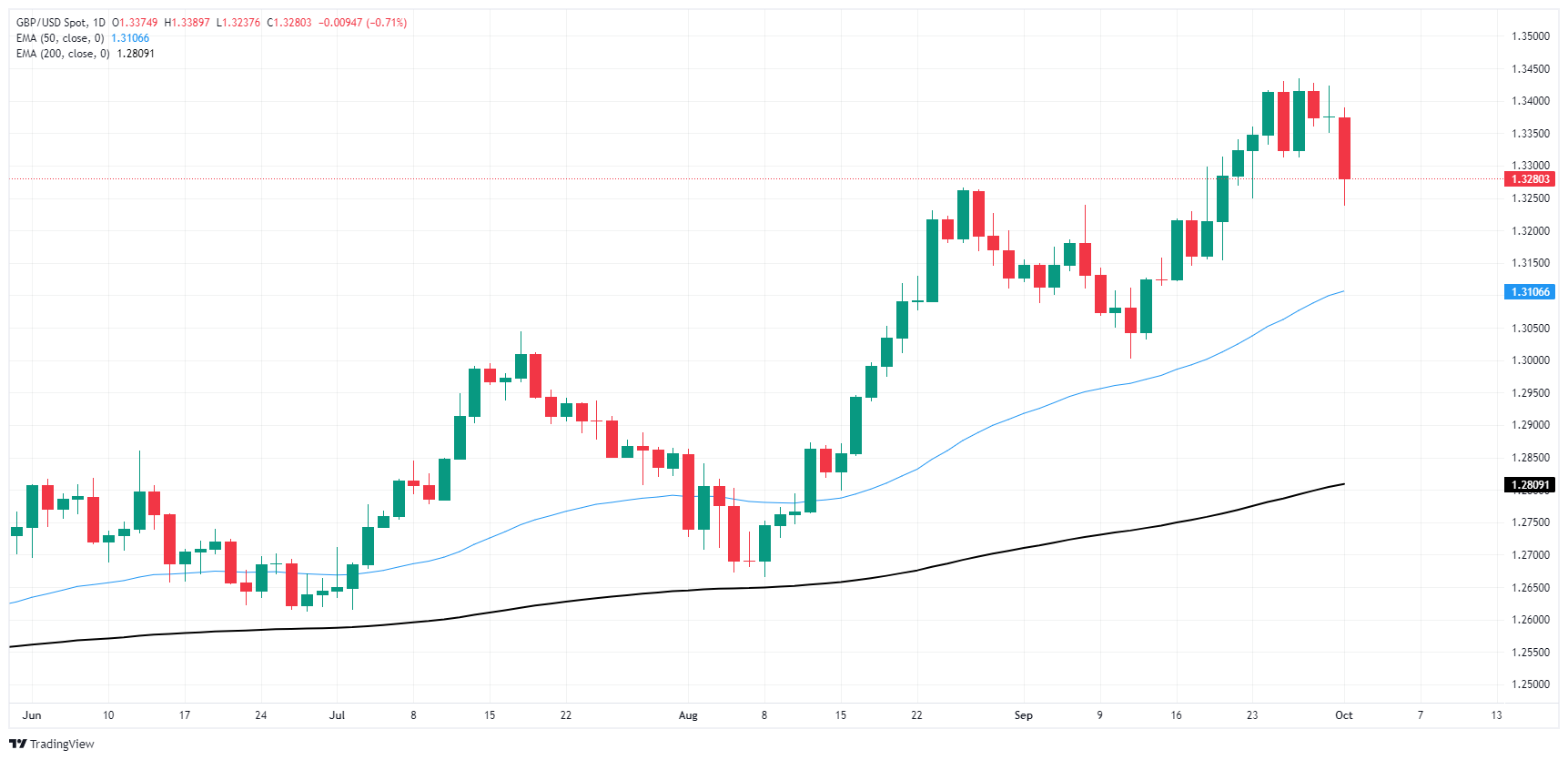
Pound Sterling FAQs
The Pound Sterling (GBP) is the oldest currency in the world (886 AD) and the official currency of the United Kingdom. It is the fourth most traded unit for foreign exchange (FX) in the world, accounting for 12% of all transactions, averaging $630 billion a day, according to 2022 data. Its key trading pairs are GBP/USD, also known as ‘Cable’, which accounts for 11% of FX, GBP/JPY, or the ‘Dragon’ as it is known by traders (3%), and EUR/GBP (2%). The Pound Sterling is issued by the Bank of England (BoE).
The single most important factor influencing the value of the Pound Sterling is monetary policy decided by the Bank of England. The BoE bases its decisions on whether it has achieved its primary goal of “price stability” – a steady inflation rate of around 2%. Its primary tool for achieving this is the adjustment of interest rates. When inflation is too high, the BoE will try to rein it in by raising interest rates, making it more expensive for people and businesses to access credit. This is generally positive for GBP, as higher interest rates make the UK a more attractive place for global investors to park their money. When inflation falls too low it is a sign economic growth is slowing. In this scenario, the BoE will consider lowering interest rates to cheapen credit so businesses will borrow more to invest in growth-generating projects.
Data releases gauge the health of the economy and can impact the value of the Pound Sterling. Indicators such as GDP, Manufacturing and Services PMIs, and employment can all influence the direction of the GBP. A strong economy is good for Sterling. Not only does it attract more foreign investment but it may encourage the BoE to put up interest rates, which will directly strengthen GBP. Otherwise, if economic data is weak, the Pound Sterling is likely to fall.
Another significant data release for the Pound Sterling is the Trade Balance. This indicator measures the difference between what a country earns from its exports and what it spends on imports over a given period. If a country produces highly sought-after exports, its currency will benefit purely from the extra demand created from foreign buyers seeking to purchase these goods. Therefore, a positive net Trade Balance strengthens a currency and vice versa for a negative balance.
Author

Joshua Gibson
FXStreet
Joshua joins the FXStreet team as an Economics and Finance double major from Vancouver Island University with twelve years' experience as an independent trader focusing on technical analysis.