GBP/USD rallies on resurgence of Fed rate cut hopes
- GBP/USD pushed back into the high end after Fed nods at inflation progress.
- BoE rate cut expectations also tick higher.
- Key US inflation data looms ahead.

GBP/USD rallied on Wednesday, clipping into a four-week peak after broad-market expectations of future rate cuts reignited following Federal Reserve (Fed) Chairman Jerome Powell’s wrap-up of the two-day Semi-Annual Monetary Policy Report. UK data is limited to mid-tier Industrial Production figures on Thursday, but looming US Consumer Price Index (CPI) inflation will draw plenty of investor eyes during Thursday’s American market session.
Forex Today: Gearing up for US CPI
Rate-cut-hungry markets decided that Fed Chair Powell’s appearances before Congressional committees was close enough to dovish this week, with Powell giving a cautious nod to recent progress on inflation. Risk appetite has recovered as investors lean back into hopes for a September rate cut, and investors will be looking for an undershoot of US CPI inflation on Thursday, with median market forecasts expecting annualized core CPI inflation in June to hold steady at 3.4%.
Powell speech: We see current Fed policy as restrictive
GBP traders are leaning into bets of an August rate cut from the Bank of England (BoE) despite cautious tones from several BoE policymakers on Wednesday, and UK Industrial Production figures earlier Thursday will be a key bellwether for rate cut hopes. UK Industrial Production is expected to recover to 0.2% MoM from the previous decline of -0.9%.
BoE's Mann: We need to see sustained slower service inflation
Further US inflation data is due on Friday, with core US Producer Price Index (PPI) wholesale inflation expected to tick upwards to 2.5% YoY from the previous 2.3%, which could pose a stumbling block to broad-market rate cut hopes.
British Pound PRICE Today
The table below shows the percentage change of British Pound (GBP) against listed major currencies today. British Pound was the strongest against the US Dollar.
| USD | EUR | GBP | JPY | CAD | AUD | NZD | CHF | |
|---|---|---|---|---|---|---|---|---|
| USD | -0.04% | -0.04% | -0.06% | -0.03% | -0.07% | -0.12% | -0.04% | |
| EUR | 0.04% | 0.02% | -0.04% | 0.02% | -0.02% | -0.07% | 0.00% | |
| GBP | 0.04% | -0.02% | -0.02% | 0.00% | -0.03% | -0.08% | 0.01% | |
| JPY | 0.06% | 0.04% | 0.02% | 0.03% | -0.00% | -0.09% | 0.03% | |
| CAD | 0.03% | -0.02% | -0.01% | -0.03% | -0.06% | -0.10% | -0.01% | |
| AUD | 0.07% | 0.02% | 0.03% | 0.00% | 0.06% | -0.06% | 0.04% | |
| NZD | 0.12% | 0.07% | 0.08% | 0.09% | 0.10% | 0.06% | 0.10% | |
| CHF | 0.04% | -0.01% | -0.01% | -0.03% | 0.00% | -0.04% | -0.10% |
The heat map shows percentage changes of major currencies against each other. The base currency is picked from the left column, while the quote currency is picked from the top row. For example, if you pick the British Pound from the left column and move along the horizontal line to the US Dollar, the percentage change displayed in the box will represent GBP (base)/USD (quote).
GBP/USD technical outlook
Cable’s bullish resurgence on Wednesday has left bids buried deep in a supply zone priced in above the 1.2800 handle, and price action is stretched thin on the high side. A downside recovery could send price back to the 200-day Exponential Moving Average (EMA) near 1.2600, and the burden of preventing a swing low into familiar technical levels will see bulls working double duty to try and chalk in a meaningful higher low on daily candlesticks.
GBP/USD hourly chart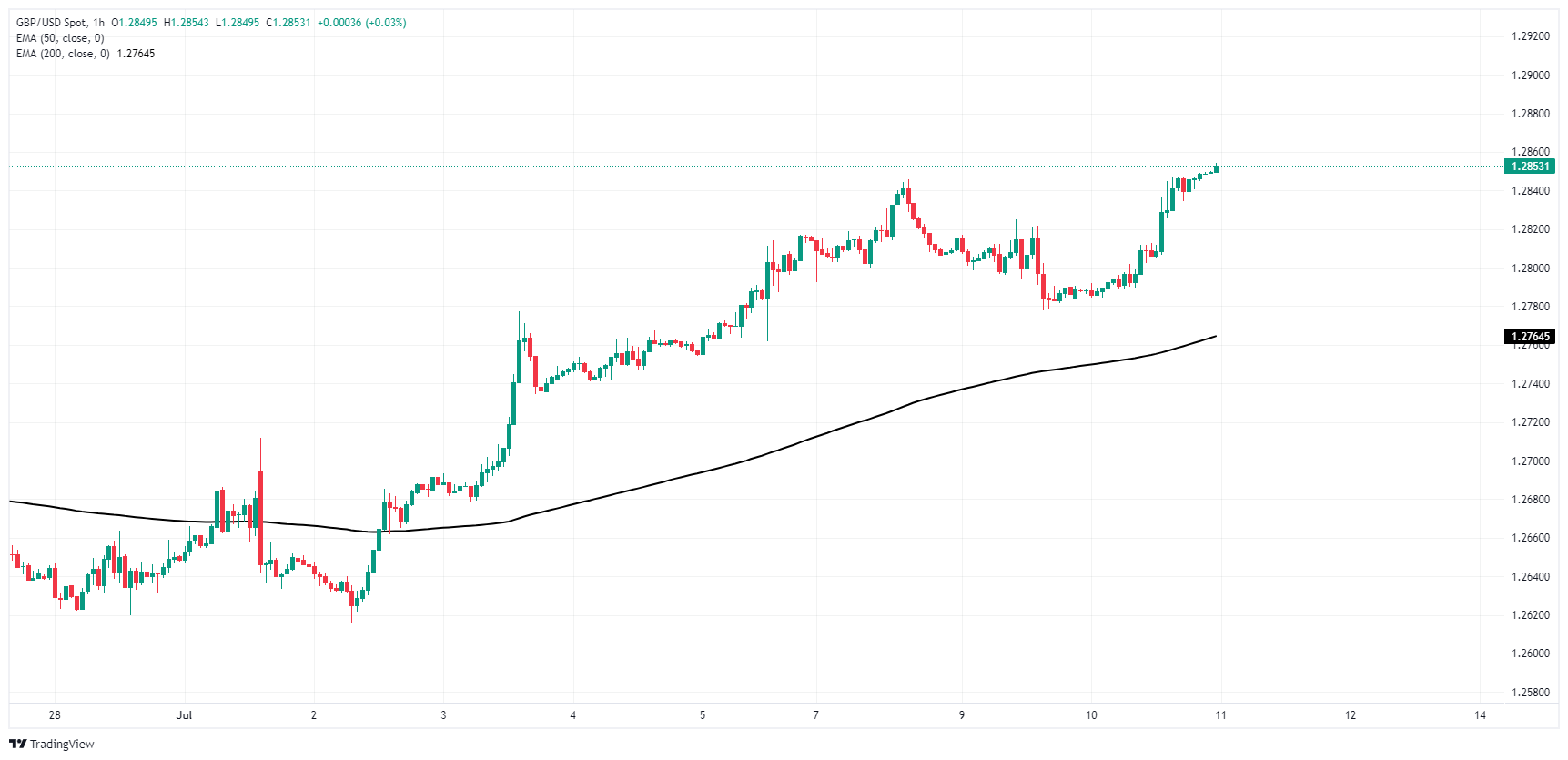
GBP/USD daily chart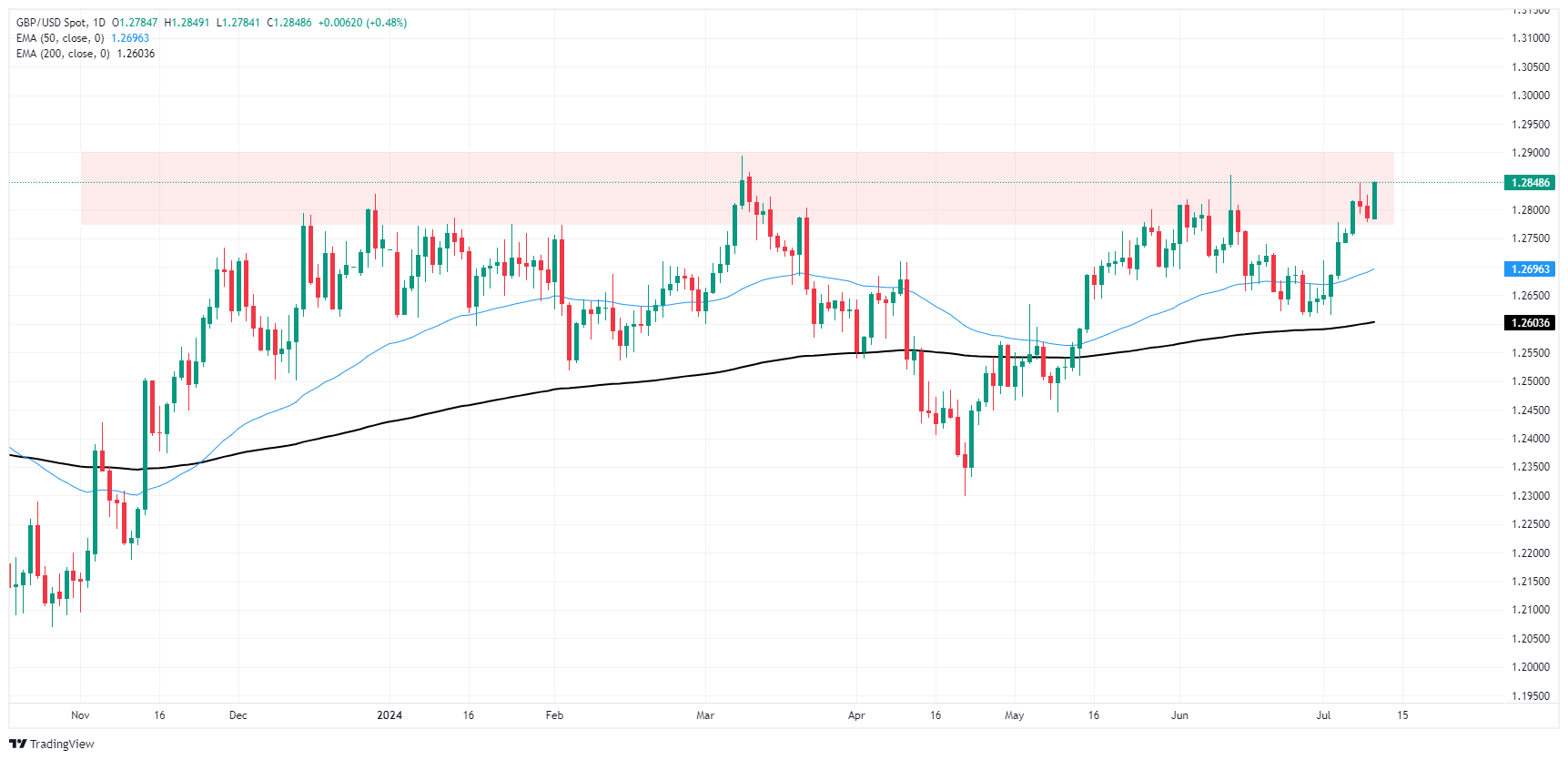
Pound Sterling FAQs
The Pound Sterling (GBP) is the oldest currency in the world (886 AD) and the official currency of the United Kingdom. It is the fourth most traded unit for foreign exchange (FX) in the world, accounting for 12% of all transactions, averaging $630 billion a day, according to 2022 data. Its key trading pairs are GBP/USD, aka ‘Cable’, which accounts for 11% of FX, GBP/JPY, or the ‘Dragon’ as it is known by traders (3%), and EUR/GBP (2%). The Pound Sterling is issued by the Bank of England (BoE).
The single most important factor influencing the value of the Pound Sterling is monetary policy decided by the Bank of England. The BoE bases its decisions on whether it has achieved its primary goal of “price stability” – a steady inflation rate of around 2%. Its primary tool for achieving this is the adjustment of interest rates. When inflation is too high, the BoE will try to rein it in by raising interest rates, making it more expensive for people and businesses to access credit. This is generally positive for GBP, as higher interest rates make the UK a more attractive place for global investors to park their money. When inflation falls too low it is a sign economic growth is slowing. In this scenario, the BoE will consider lowering interest rates to cheapen credit so businesses will borrow more to invest in growth-generating projects.
Data releases gauge the health of the economy and can impact the value of the Pound Sterling. Indicators such as GDP, Manufacturing and Services PMIs, and employment can all influence the direction of the GBP. A strong economy is good for Sterling. Not only does it attract more foreign investment but it may encourage the BoE to put up interest rates, which will directly strengthen GBP. Otherwise, if economic data is weak, the Pound Sterling is likely to fall.
Another significant data release for the Pound Sterling is the Trade Balance. This indicator measures the difference between what a country earns from its exports and what it spends on imports over a given period. If a country produces highly sought-after exports, its currency will benefit purely from the extra demand created from foreign buyers seeking to purchase these goods. Therefore, a positive net Trade Balance strengthens a currency and vice versa for a negative balance.
Author

Joshua Gibson
FXStreet
Joshua joins the FXStreet team as an Economics and Finance double major from Vancouver Island University with twelve years' experience as an independent trader focusing on technical analysis.