GBP/USD resumes downside bias after release of US Retail Sales
- GBP/USD retreats on Friday after the release of US Retail Sales leads to an appreciation of the US Dollar.
- Weak UK GDP growth data further adds to negative fundamentals to the pair and clouds the outlook.
- Some analysts remain positive about the outlook for the UK despite the data – a positive for Sterling.

GBP/USD edges lower on Friday, falling to the 1.2660s as markets digest the latest data release, US Retail Sales in October, and its positive implications for the US Dollar (USD).
US Retail Sales rose by 0.4% MoM, beating estimates of 0.3% but below the previous month's revised-up 0.8%, according to data from the Bureau of Labor Statistics (BLS). Retail Sales ex Autos, however, registered a 0.1% rise, falling below estimates of 0.3% and the previous month's revised-up 1.0% rise.
The data indicates that US consumers continue to spend freely and given the importance of consumption to the US economy this is likely to be positive for growth. It backs up the Chariman of the Federal Reserve Jerome Powell's remark on Thursday that the US economy is doing "remarkably well" and sugegsts he and his Fed colleagues will not cut interest rates as aggresively as previous feared. Higher interest rates are positive for the USD (but bearish for GBP/USD) as they attract more capital inflows to the US.
GBP/USD failed to recover much ground on Friday morning despite edging higher, after the release of negative UK Gross Domestic Product (GDP) growth data showed the economy shrank by 0.1% in September. This was lower than the 0.2% expected and 0.2% of the previous month. It was remarkable the Pound Sterling (GBP) managed to outperform the Dollar at all following the release, an oddity, perhaps explained by traders taking profits on USD longs after the recent rally.
What’s more, in Q3, UK preliminary GDP rose by 0.1% QoQ – decelerating from the 0.5% recorded in Q2 and undershooting the 0.2% estimate. Ordinarily, this would be expected to be accompanied by a sell-off in the Pound. However, due to an overbought Dollar trade and the market’s continued faith in the outlook for growth in the UK, it has not.
For advisory service Capital Economics, for example, the data has not materially changed its views on the outlook for Bank of England (BoE) policy or interest rates – a key driver of FX valuations. Lower interest rates are generally negative for Sterling as they reduce capital inflows and vice versa for higher rates. Yet, despite the poor economic data, they do not see the BoE cutting interest rates in December.
According to Capital’s Deputy Chief UK Economist Ruth Gregory, the GDP data means the economy grew at “..a snail’s pace (in Q3). However, this doesn’t mean the UK is on the cusp of another recession. And while today’s data raises the chances the Bank (BoE) will cut rates again in December, we are sticking to our view that the Bank will keep rates unchanged at 4.75% in December before cutting rates by 25 basis points again in February,”
GBP/USD touches five-month lows after Chairman Powell remarks
GBP/USD recapitulates after making a temporary recovery from over four-month lows reached on Thursday when US data showed an above-expectations rise in factory-gate prices, as measured by the Producer Price Index (PPI), in October and US Jobless Claims falling below estimates in the week ending November 8, driving the Dollar higher and the Cable pair to a new low.
The two data points are particularly relevant to Fed policy given its dual mandate of keeping inflation under control and fostering full employment. Later in the day, Fed Chair Powell drove the USD to an even higher high after he said that the US economy was in relatively good shape and the Fed would not need to cut interest rates as aggressively as he had previously thought.
Technical Analysis: GBP/USD trends lower
GBP/USD retreats to support in the mid-1.2600s (red dashed line in the chart below), makes a half-hearted stand then gives way.
The pair is in a downtrend on a short and medium-term trend basis, and given the technical principle that “the trend is your friend,” the odds favor bears pushing prices even lower.
GBP/USD Daily Chart
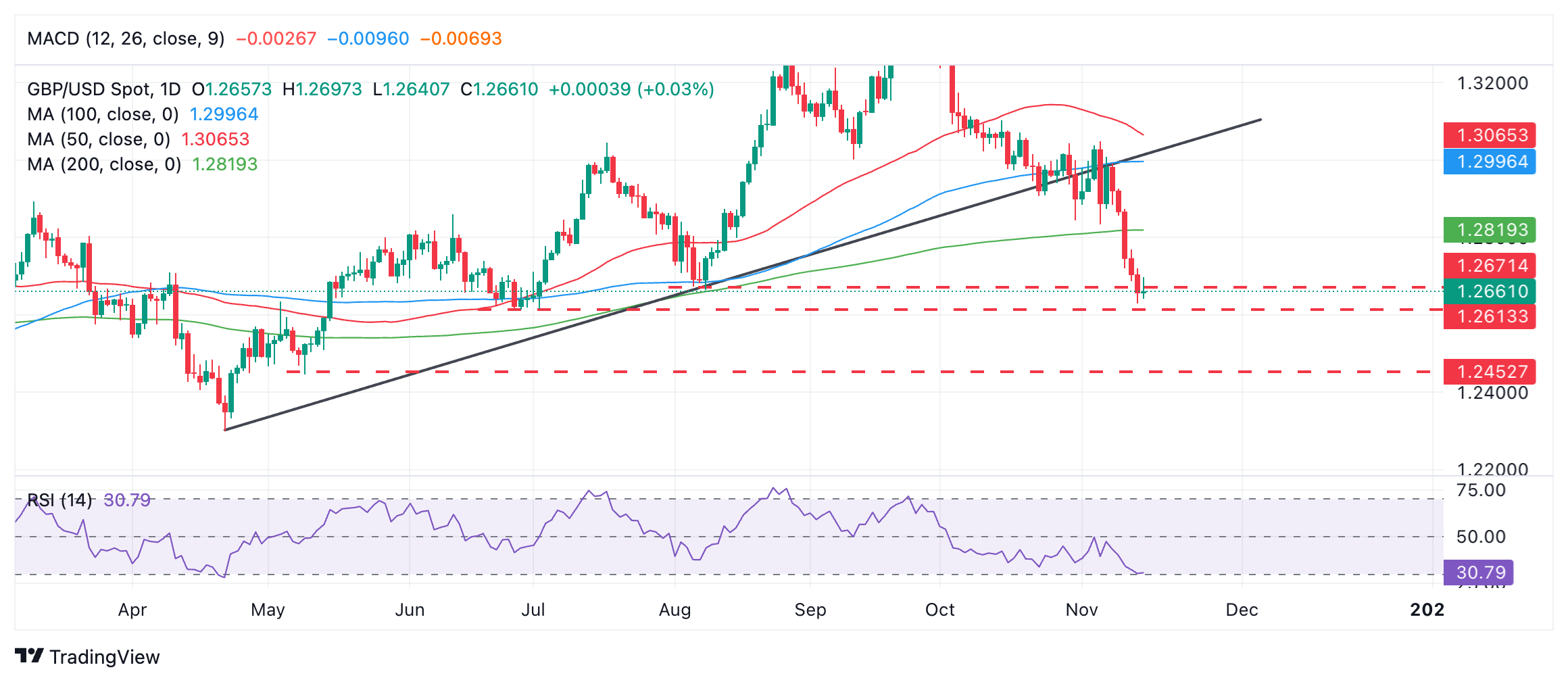
Assuming a break below the 1.2630 Thursday low, GBP/USD will probably start descending to the next downside target at around 1.2613, the late June lows (red dashed line). Below that, the next target lies at 1.2500 (round number and psychological level), followed by 1.2452 (early May lows).
The Relative Strength Index (RSI) momentum indicator is nearly oversold but not quite. If it enters oversold territory, it will advise short-holders not to add to their positions.
The longer-term trend, it could be argued, is still bullish, indicating the risk and possibility of GBP/USD recovering if a longer-term upcycle kicks in.
Economic Indicator
Retail Sales (MoM)
The Retail Sales data, released by the US Census Bureau on a monthly basis, measures the value in total receipts of retail and food stores in the United States. Monthly percent changes reflect the rate of changes in such sales. A stratified random sampling method is used to select approximately 4,800 retail and food services firms whose sales are then weighted and benchmarked to represent the complete universe of over three million retail and food services firms across the country. The data is adjusted for seasonal variations as well as holiday and trading-day differences, but not for price changes. Retail Sales data is widely followed as an indicator of consumer spending, which is a major driver of the US economy. Generally, a high reading is seen as bullish for the US Dollar (USD), while a low reading is seen as bearish.
Read more.Last release: Fri Nov 15, 2024 13:30
Frequency: Monthly
Actual: 0.4%
Consensus: 0.3%
Previous: 0.4%
Source: US Census Bureau
Retail Sales data published by the US Census Bureau is a leading indicator that gives important information about consumer spending, which has a significant impact on the GDP. Although strong sales figures are likely to boost the USD, external factors, such as weather conditions, could distort the data and paint a misleading picture. In addition to the headline data, changes in the Retail Sales Control Group could trigger a market reaction as it is used to prepare the estimates of Personal Consumption Expenditures for most goods.
Author

Joaquin Monfort
FXStreet
Joaquin Monfort is a financial writer and analyst with over 10 years experience writing about financial markets and alt data. He holds a degree in Anthropology from London University and a Diploma in Technical analysis.