GBP/USD inches toward 1.30 after US CPI inflation runs hot
- GBP/USD churned on Thursday, giving up a tenth of a percent.
- US CPI inflation data came in above expectations, vexing rate cut hopes.
- Coming up on Friday: UK GDP and production figures, US PPI and UoM sentiment.

GPB/USD roiled on Thursday, battling just north of the 1.3000 handle before trimming 0.1% for the day. The Greenback was bolstered by a misfire in US Consumer Price Inflation (CPI) inflation figures, which printed hotter than markets expected. A raft of UK and US data is due on Friday, giving the Cable a tense finish to an otherwise quiet week.
Headline US CPI inflation fell less than expected through the year ended in September, declining from 2.5% to 2.4%. Median market forecasts had called for a print of 2.4% YoY. On the other hand, core US CPI inflation ticked higher YoY in September, rising to 3.3% from the previous 3.2%.
US Initial Jobless Claims unexpectedly rose for the week ended October 4, climbing to 258K week-on-week and clipping the highest rate of new jobless benefits seekers since June of 2023.
Mixed rate-impacting data flummoxed rate markets on Thursday. Rising unemployment figures bolster hopes for rate cuts as the Federal Reserve (Fed) looks to keep the US labor market afloat, while still-hot inflation makes it harder for investors to expect a faster pace and depth of rate trims.
Friday delivers a packed data docket for Cable traders. UK Gross Domestic Product (GDP) figures for August will kick things off, expected to increase to 0.2% MoM in August from the previous month’s flat print of 0.0%. UK Manufacturing and Industrial Production are both expected to rebound in August. Manufacturing Production is expected to recover to 0.2% MoM compared to the previous -1.0% contraction, while Industrial Production is forecast to bounce to 0.2% MoM from the previous -0.8%.
US Producer Price Index (PPI) inflation will follow up during the US market session. September’s core PPI print for the year ended in September is expected to accelerate to 2.7% YoY from last month’s 2.4%.
GBP/USD price forecast
The GBP/USD pair is currently trading at 1.3056, showing a minor drop of 0.11% for the day. The price action suggests a bearish trend emerging after a period of consolidation near the 50-day Exponential Moving Average (EMA), currently at 1.3108. The pair recently broke below this key technical level, indicating further downside momentum. The 200-day EMA, at 1.2840, acts as a crucial support zone, which could be tested if selling pressure continues to mount. The bearish candlestick patterns in recent sessions support the view that sellers are in control.
The Moving Average Convergence Divergence (MACD) indicator further supports the bearish outlook. The MACD line has crossed below the signal line, with the histogram showing increasing negative bars. This suggests that the downside momentum is picking up strength. The pair may struggle to break above the 50-day EMA in the short term, which has now become a resistance level. Should the current downward trend persist, the next area of interest for traders would likely be the psychological 1.3000 mark, followed by the 1.2840 support level near the 200-day EMA.
In the broader context, GBP/USD’s price action appears to be in a corrective phase after its significant uptrend from July to early September. The pair's recent highs around 1.3400 now look increasingly distant as downside risks dominate. With the MACD reinforcing the bearish signal and the price failing to hold above the 50-day EMA, further declines seem likely unless a significant reversal occurs. Key upcoming economic data, including inflation reports and central bank decisions, could play a pivotal role in determining the pair’s next move.
GBP/USD daily chart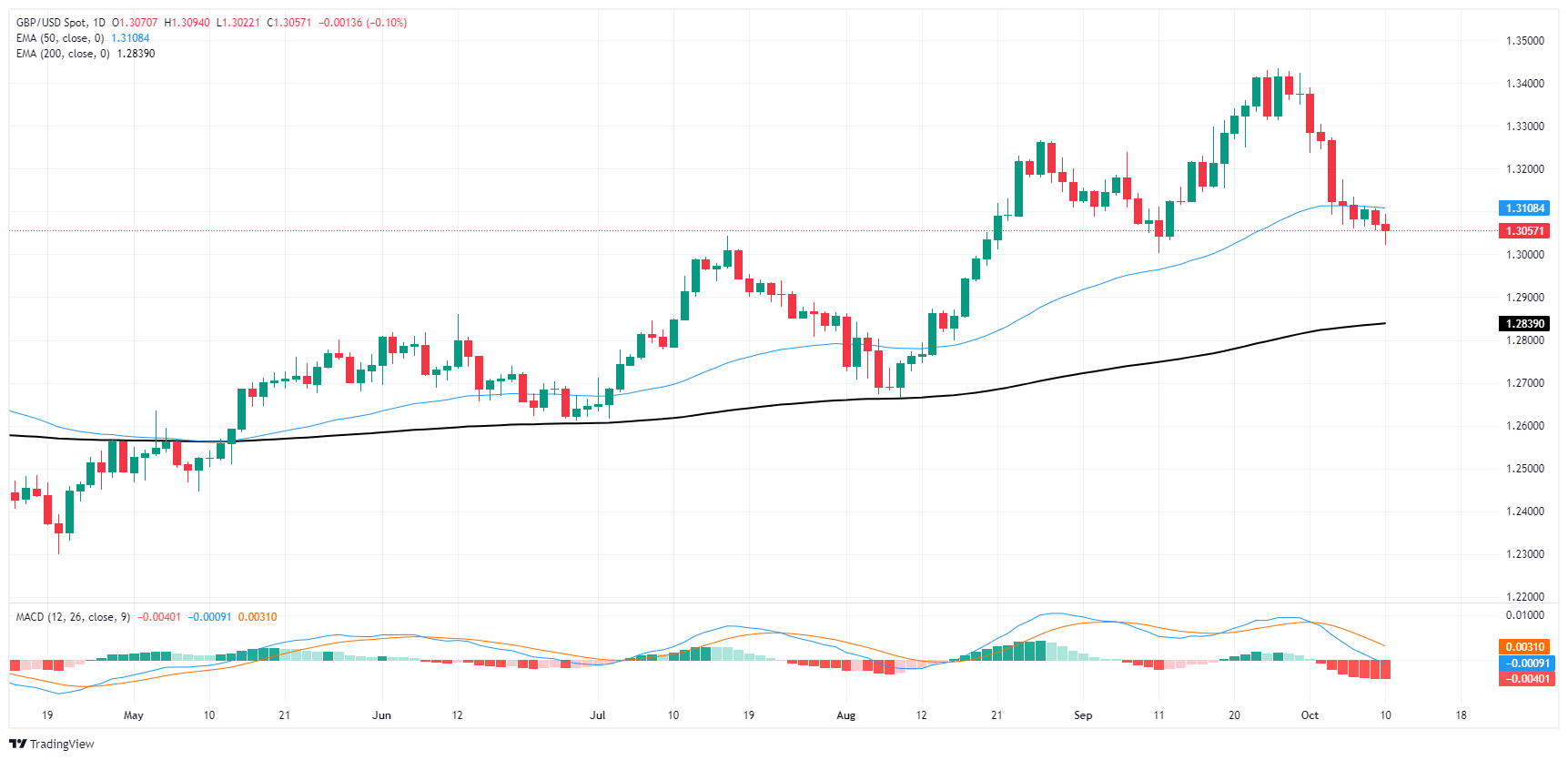
Pound Sterling FAQs
The Pound Sterling (GBP) is the oldest currency in the world (886 AD) and the official currency of the United Kingdom. It is the fourth most traded unit for foreign exchange (FX) in the world, accounting for 12% of all transactions, averaging $630 billion a day, according to 2022 data. Its key trading pairs are GBP/USD, also known as ‘Cable’, which accounts for 11% of FX, GBP/JPY, or the ‘Dragon’ as it is known by traders (3%), and EUR/GBP (2%). The Pound Sterling is issued by the Bank of England (BoE).
The single most important factor influencing the value of the Pound Sterling is monetary policy decided by the Bank of England. The BoE bases its decisions on whether it has achieved its primary goal of “price stability” – a steady inflation rate of around 2%. Its primary tool for achieving this is the adjustment of interest rates. When inflation is too high, the BoE will try to rein it in by raising interest rates, making it more expensive for people and businesses to access credit. This is generally positive for GBP, as higher interest rates make the UK a more attractive place for global investors to park their money. When inflation falls too low it is a sign economic growth is slowing. In this scenario, the BoE will consider lowering interest rates to cheapen credit so businesses will borrow more to invest in growth-generating projects.
Data releases gauge the health of the economy and can impact the value of the Pound Sterling. Indicators such as GDP, Manufacturing and Services PMIs, and employment can all influence the direction of the GBP. A strong economy is good for Sterling. Not only does it attract more foreign investment but it may encourage the BoE to put up interest rates, which will directly strengthen GBP. Otherwise, if economic data is weak, the Pound Sterling is likely to fall.
Another significant data release for the Pound Sterling is the Trade Balance. This indicator measures the difference between what a country earns from its exports and what it spends on imports over a given period. If a country produces highly sought-after exports, its currency will benefit purely from the extra demand created from foreign buyers seeking to purchase these goods. Therefore, a positive net Trade Balance strengthens a currency and vice versa for a negative balance.
Author

Joshua Gibson
FXStreet
Joshua joins the FXStreet team as an Economics and Finance double major from Vancouver Island University with twelve years' experience as an independent trader focusing on technical analysis.