GBP/USD falls into the mark-down stage on dovish Bank of England, firmer US dollar
- GBP/USD bears are on control below critical hourly supports on dovish MPC member Saunders.
- US dollar gets a lift at the start of the week as markets digest NFP implications.

At the time of writing, GBP/USD is consolidating the sell-off below hourly distribution, a sell-off that came at the start of the London session.
GBP/USD trades some 0.35% down on the day in a strong US dollar environment, travelling between a high of 1.3856 and a low of 1.3767 on the day.
The dollar is getting some traction. DXY is up today for the first time after six straight down days and has recouped its post-NFP losses to trade near 92.50.
With full markets engaged again following the North American Labour day holidays, investors are still digesting last week's Nonfarm Payrolls disappointment.
The Federal Reserve is fixated on maximum employment as the trigger for the timing of starting to taper down their qualitative easing programme.
This matters for the pound because it has been regarded as a risk currency due to the nations twin deficits.
Those make sterling a least favourable investment for investors at times of risk-off among other currencies of those nations with opposing fundamentals.
Markets are conducting themselves with risk-on or risk-off approaches according to the Fed narrative at any given day and subsequent changes in sentiment. These can be poles apart from one day to the next at the moment.
This is creating higher volatility in forex, which is a bonus for traders seeking to capitalise on larger intraday price movements.
For instance, The Deutsche Bank Currency Volatility Index DBCVIX, which hit its lowest level since February 2020 in June at 5.48, has risen, albeit marginally to oscillate near 5.61 today.
Meanwhile, the US dollar is higher at the start of this week on the basis that while the jobs market has soured in August, it may only be a short-term contraction following a very strong series of months of data.
The Federal Reserve is still expected to taper at some stage. Moreover, there are growing fears of an overall slowdown in global growth, so relatively, the US may stand up in better shape than many other nations.
Additionally, at least the job additions, while weak, were still additions and not losses.
The delta variant is highly contagious and has knocked the confidence out of the US population. US Consumer Confidence fell to a six-month low in August when the spread peaked.
Should we see a reduction in the spread, it will make for a strong case for an improvement in the jobs market over the next couple of months. However, the situation is fluid and highly uncertain.
In any case, this is a global pandemic and the US is not alone in its latest struggle with the highly contagious variant, which can play into the hands of the US dollar bulls as well. Investors seek out the greenback at times of global uncertainty and risk-off.
Overall, markets are of the mind that despite the poor result in the jobs market for August, that the Federal Reserve will likely depend on the next jobs data to make a decision as to whether to taper this year, either in October or December.
If the jobs data is poor again, it will likely mean the Fed will wait until further jobs data arrive and make a decision in January instead.
''Because of this uncertainty, we have moved back the Fed’s expected tapering announcement from the September 21-22 FOMC meeting to the November 2-3 meeting,'' analysts at Brown Brothers Harriman said.
''By that time, the Fed will have gotten the September jobs report. Unfortunately for the Fed, the October jobs report comes on November 5, two days after the FOMC decision.
There will be some debate in the market about whether the Fed will actually start tapering at the December 14-15 meeting or wait until January 25-26. Does one month really make much difference?'' the analysts argued.
BoE 23 Sep will be closely watched
Domestically, the Bank of England and MPC member Michael Saunders said that the BoE may need to raise interest rates next year if growth continues and inflation becomes stickier.
However, he struck a more dovish tone this speech around.
He said that they won’t rise by much if the economy evolves as the bank forecasts and the current inflation spike is indeed temporary.
The market has paid attention to him today as he was the lone dissent at the last policy meeting in favour of reducing QE.
''Market expectations may have to be dialled down a bit if the dovish talk out of the BOE continues,'' the analysts at BBH explained.
They said that the next BOE decision is on September 23 and it will be closely watched.
GBP/USD technical analysis
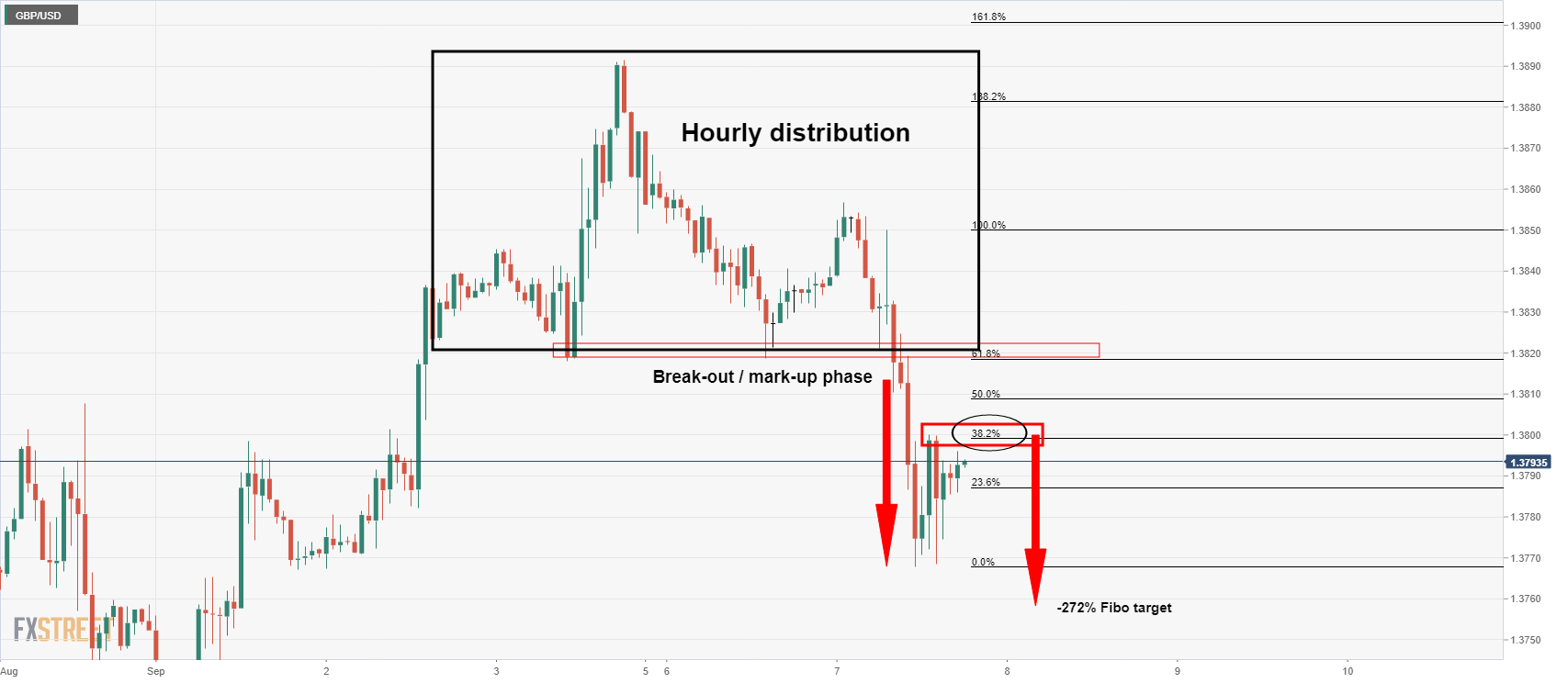
As per the Wyckoff Method, the price has broken out of the distribution phase and below the head and shoulder's neckline, falling into the mark-down territory from which bears capitalised upon during London hours.
The price has since made a 38.2% Fibonacci retracement and would be expected to continue the southerly trajectory to at least a -272% Fibonacci retracement of the current correction's range to test 1.3750 territories.
Author

Ross J Burland
FXStreet
Ross J Burland, born in England, UK, is a sportsman at heart. He played Rugby and Judo for his county, Kent and the South East of England Rugby team.

















