GBP/CAD Price Prediction: Signs that a counter-trend decline may be developing
- GBP/CAD is showing signs that it may be about to reverse lower.
- The pair formed a bearish candlestick pattern and has since declined.

GBP/CAD is threatening to reverse its uptrend after testing the upper channel line of its long-term rising channel and forming a bearish reversal candlestick pattern (orange rectangle on chart below).
GBP/CAD 4-hour Chart
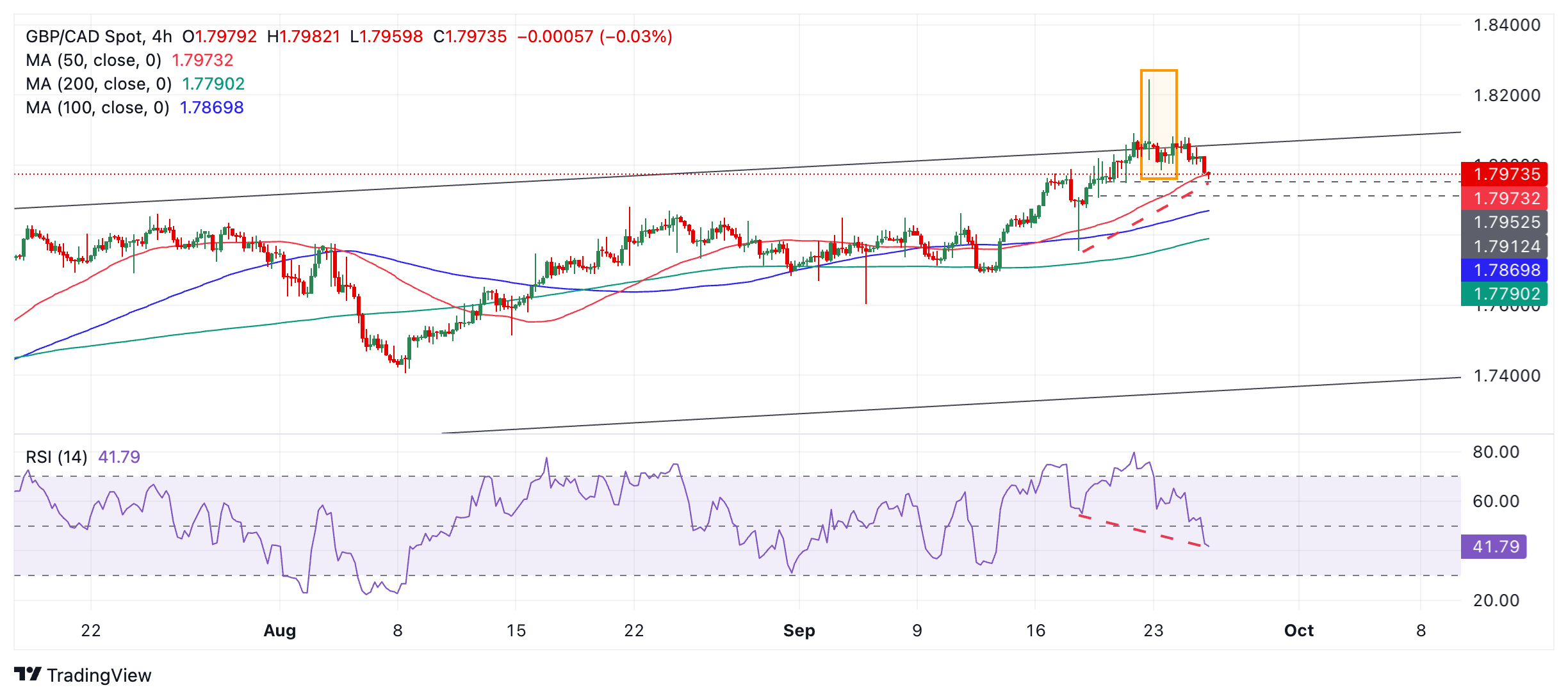
GBP/CAD formed a bearish Shooting Star Japanese candlestick pattern on both the Daily and 4-hour charts on September 20 after a false break above the upper channel line. The subsequent weakness suggests this candlestick may mark a top of the pair.
Although GBP/CAD is in a strong uptrend on all time frames, it is rising and falling within a channel and there is a growing chance the pair may be entering one of its counter-trend bear phases.
A break below 1.7949 (September 19 low) might confirm a reversal of the short-term trend and lower prices to come. A break below 1.7907 would provide stronger confirmation. Downside targets lie at 1.7754 (September 17 low and 50-day SMA), 1.7694 (September 16 low) and 1.7603 (September 4 low) and 1.7407 (August 8 low).
The Relative Strength Index (RSI) is also forming a bearish divergence with price compared to the September 17 low (red dashed line on chart above). Although the price was much lower on September 17 momentum was not, rather it is lower now. This suggests underlying weakness could push prices down.
A break above the high of the Shooting Star at 1.8245 would probably confirm that price is going even higher. If so, it might reach a target at 1.8278, the 61.8% extrapolation of the prior move higher.
Any further bullishness beyond the confines of the channel is likely to be short-lived, however. Such moves are signs of “exhaustion” and are a precursor to deeper corrections on the horizon.
Author

Joaquin Monfort
FXStreet
Joaquin Monfort is a financial writer and analyst with over 10 years experience writing about financial markets and alt data. He holds a degree in Anthropology from London University and a Diploma in Technical analysis.