Forex Today: Markets remain on edge on US election day

Here is what you need to know on Tuesday, November 5:
Financial markets remain on edge as the US presidential election takes center stage, with latest polls pointing to a tight race. On Tuesday, the US economic calendar will feature Goods Trade Balance data for September and the ISM Services PMI report for October. Later in the day, the US Treasury will hold a 10-year note auction.
US Dollar PRICE This week
The table below shows the percentage change of US Dollar (USD) against listed major currencies this week. US Dollar was the weakest against the Australian Dollar.
| USD | EUR | GBP | JPY | CAD | AUD | NZD | CHF | |
|---|---|---|---|---|---|---|---|---|
| USD | -0.41% | -0.35% | 0.17% | -0.23% | -0.67% | -0.05% | -0.35% | |
| EUR | 0.41% | 0.02% | 0.15% | -0.22% | 0.05% | -0.04% | -0.33% | |
| GBP | 0.35% | -0.02% | -0.14% | -0.24% | 0.02% | -0.06% | -0.36% | |
| JPY | -0.17% | -0.15% | 0.14% | -0.39% | -0.28% | -0.01% | -0.21% | |
| CAD | 0.23% | 0.22% | 0.24% | 0.39% | -0.23% | 0.16% | -0.12% | |
| AUD | 0.67% | -0.05% | -0.02% | 0.28% | 0.23% | -0.09% | -0.38% | |
| NZD | 0.05% | 0.04% | 0.06% | 0.01% | -0.16% | 0.09% | -0.29% | |
| CHF | 0.35% | 0.33% | 0.36% | 0.21% | 0.12% | 0.38% | 0.29% |
The heat map shows percentage changes of major currencies against each other. The base currency is picked from the left column, while the quote currency is picked from the top row. For example, if you pick the US Dollar from the left column and move along the horizontal line to the Japanese Yen, the percentage change displayed in the box will represent USD (base)/JPY (quote).
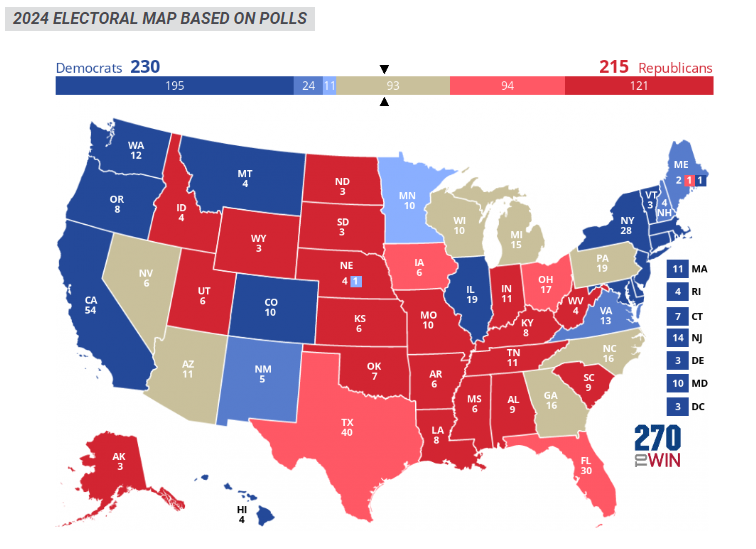
The TIPP poll has Donald Trump and Kamala Harris tied at 48, the Ipsos poll has Harris leading by 2 points, 50 vs 48, and the Atlas Intel poll has Trump having a one point lead, 50 vs 49, as per RealClearPolling. In some swing states, such as Arizona and North Carolina, Trump seems to be staying on top, while Harris seems to have closed the gap in others, such as Nevada, Georgia and Pennsylvania. Experts think that it might take at least a few days before there is a clear winner. In the meantime, US stock index futures trade marginally higher in the European morning and the US Dollar Index fluctuates in a tight range slightly below 104.00 after closing deep in negative territory on Monday.
The Reserve Bank of Australia (RBA) announced on Tuesday that it left the policy rate unchanged at 4.35%, as expected. In its policy statement, the RBA reiterated that the policy will need to be sufficiently restrictive until the board is confident that inflation is moving sustainably towards the target range and added that they do not see inflation returning sustainably to the midpoint of the target until 2026. In the post-meeting press conference, RBA Governor Michele Bullock noted that they remain ready to act if the economy were to turn down more than expected. AUD/USD gained traction following the RBA event and was last seen trading in positive territory at around 0.6600.
During the Asian trading hours, the data from China showed the Caixin Services PMI improved to 52 in October from 50.3 in September. This reading came in better than the market expectation of 50.5.
EUR/USD climbed to its highest level in over two weeks above 1.0900 on Monday but erased its gains to close the day flat. Early Tuesday, the pair moves sideways near 1.0880.
GBP/USD met resistance near 1.3000 after opening the week with a bullish gap and went into a consolidation phase. At the time of press, the pair was fluctuating in a narrow channel slightly above 1.2950.
USD/JPY holds steady above 152.00 in the European morning on Tuesday after posting losses on Monday.
Gold failed to make a decisive move in either direction and ended the day virtually unchanged on Monday. XAU/USD stays relatively quiet to begin the European session and remains below $2,750.
Risk sentiment FAQs
In the world of financial jargon the two widely used terms “risk-on” and “risk off'' refer to the level of risk that investors are willing to stomach during the period referenced. In a “risk-on” market, investors are optimistic about the future and more willing to buy risky assets. In a “risk-off” market investors start to ‘play it safe’ because they are worried about the future, and therefore buy less risky assets that are more certain of bringing a return, even if it is relatively modest.
Typically, during periods of “risk-on”, stock markets will rise, most commodities – except Gold – will also gain in value, since they benefit from a positive growth outlook. The currencies of nations that are heavy commodity exporters strengthen because of increased demand, and Cryptocurrencies rise. In a “risk-off” market, Bonds go up – especially major government Bonds – Gold shines, and safe-haven currencies such as the Japanese Yen, Swiss Franc and US Dollar all benefit.
The Australian Dollar (AUD), the Canadian Dollar (CAD), the New Zealand Dollar (NZD) and minor FX like the Ruble (RUB) and the South African Rand (ZAR), all tend to rise in markets that are “risk-on”. This is because the economies of these currencies are heavily reliant on commodity exports for growth, and commodities tend to rise in price during risk-on periods. This is because investors foresee greater demand for raw materials in the future due to heightened economic activity.
The major currencies that tend to rise during periods of “risk-off” are the US Dollar (USD), the Japanese Yen (JPY) and the Swiss Franc (CHF). The US Dollar, because it is the world’s reserve currency, and because in times of crisis investors buy US government debt, which is seen as safe because the largest economy in the world is unlikely to default. The Yen, from increased demand for Japanese government bonds, because a high proportion are held by domestic investors who are unlikely to dump them – even in a crisis. The Swiss Franc, because strict Swiss banking laws offer investors enhanced capital protection.
Author

Eren Sengezer
FXStreet
As an economist at heart, Eren Sengezer specializes in the assessment of the short-term and long-term impacts of macroeconomic data, central bank policies and political developments on financial assets.