EUR/USD hovers around 1.04 after earlier gains are being dialed back post-European inflation release
- EUR/USD is back to square one this Tuesday after a failed attempt to break higher in European trading earlier.
- European inflation came in hot in several core countries, ending the disinflationary path for now.
- Markets remain focused in rumors and pushbacks on President-elect Donald Trump’s tariff schemes and ongoing court cases.

The Euro (EUR) sees earlier attempts to break higher against the US Dollar (USD) failing on Tuesday, after inflation numbers for the Eurozone as a whole revealed that disinflation has ended for now. Earlier expectations got already revised after the preliminary German Harmonized Index of Consumer Prices (HICP) data for December, released on Monday, showed that the monthly headline HIPC inflation jumped by 0.7%, above the 0.5% estimate. On a yearly basis, headline HICP rose by 2.9%, compared to 2.4% in November.
Meanwhile, markets are on edge over the whipsaw reactions and knee-jerk moves over the tariff plans from President-elect Donald Trump. The Washington Post published a piece mentioning that Trump was considering simplifying his tariff schemes by imposing a single universal tariff on critical imports and goods. Hours later, Trump himself came out to refute the rumors and confirm that the schemes and plans would remain in place as earlier announced.
Daily digest market movers: Nothing to see here
- The French preliminary HICP for December has already been released earlier on Tuesday. The monthly gauge snapped the previous disinflationary print by jumping 0.2%, below the 0.4% expectation and above the -0.1% from November. The yearly gauge came in at 1.8%, which is 0.1% higher than the 1.7% from November.
- The preliminary Eurozone HICP for December has been released.
- The monthly headline HICP jumped to 0.4%, snapping the disinflationary -0.3% from the month before.
- The yearly headline HICP came in at 2.4% as expected, against the 2.2% from November.
- The monthly core HICP rallied to 0.5%, beating the -0.6% from November.
- The yearly core HICP came a touch higher than expected at 2.8% against 2.7% consensus view and the previous reading.
- For now, the European Central Bank (ECB) is projected to cut its policy rate by 25 basis points on January 30.
- Italian inflation saw a similar pattern is seen as in Germany, with the preliminary December monthly HICP heading to 0.1% from -0.1%.
- German Bunds ticked up quite a bit last week and stretched up to 2.47% on Monday. This Tuesday, rates are starting to ease, with the Bund currently trading around 2.45%.
- European equities are having a change of heart after the European inflation data, and are heading into green numbers.
Technical Analysis: End of the line for now?
EUR/USD is in a perfect technical bounce, though where to go next is becoming blurry. The geopolitical developments from Monday have helped the Euro find support at 1.0294 and rally all the way to nearly 1.0448. The question now will be whether the Euro has enough room left to head above 1.0450. This will not be the case if those European bonds start to fade from their Monday high points and need more upside to pull the Euro further up towards 1.05.
The first big level to break is 1.0448, the low of October 3, 2023. Once through that level, the 55-day Simple Moving Average (SMA) at 1.0558 comes into play. Another catalyst will be needed for this kind of move, as it could squeeze the Dollar bulls.
On the downside, ahead of the current two-year low at 1.0224, the 1.0294 level is now acting as the new first line of defence. It was a pivotal point on Monday, offering room for buyers in EUR/USD to get involved and push price action higher. Further down, the round level at 1.02 would mean a fresh two-year low. Breaking below that level would open up the room to head to parity, with 1.0100 as the last man standing before that magical 1.00 level.
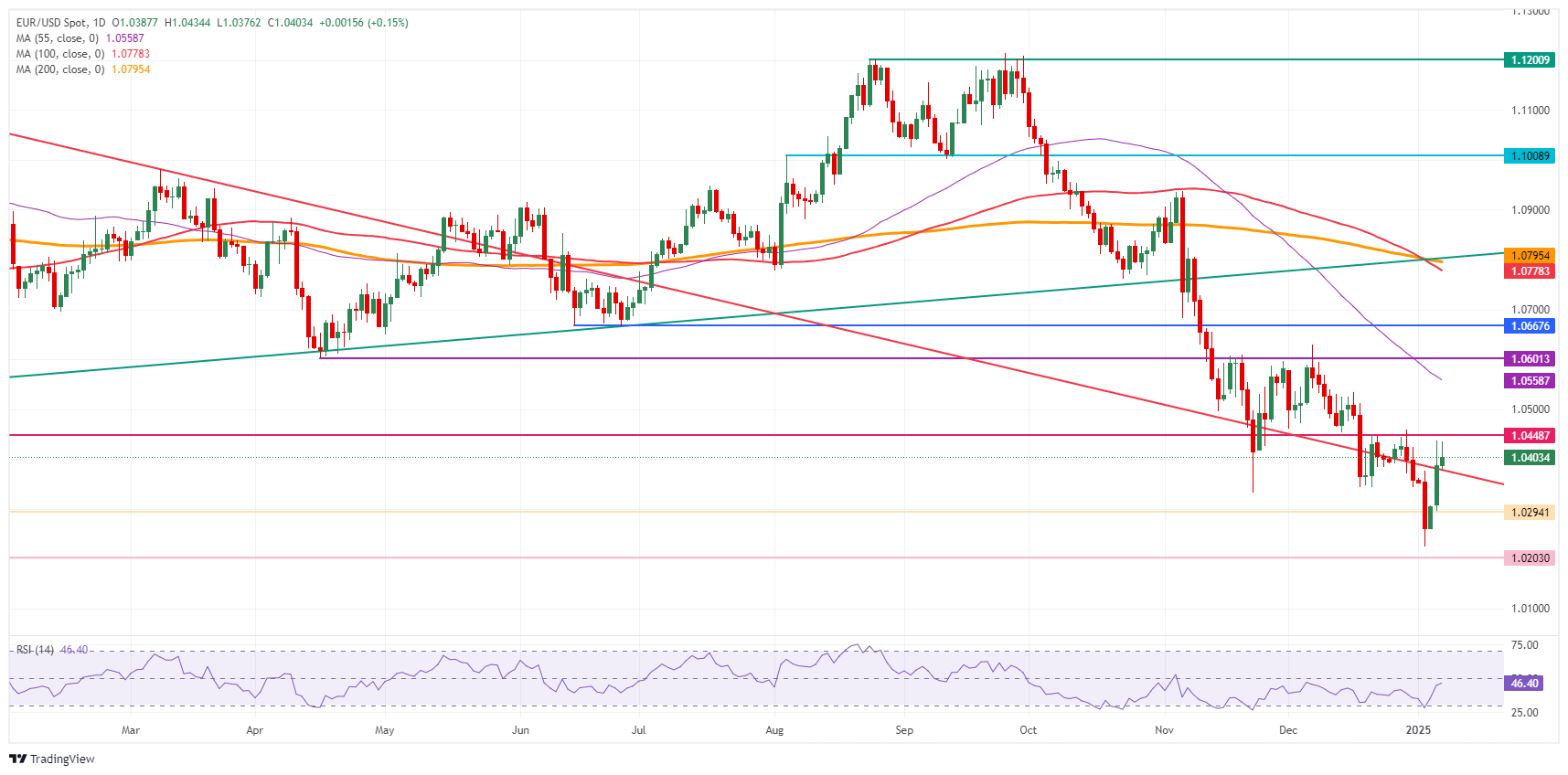
EUR/USD: Daily Chart
Inflation FAQs
Inflation measures the rise in the price of a representative basket of goods and services. Headline inflation is usually expressed as a percentage change on a month-on-month (MoM) and year-on-year (YoY) basis. Core inflation excludes more volatile elements such as food and fuel which can fluctuate because of geopolitical and seasonal factors. Core inflation is the figure economists focus on and is the level targeted by central banks, which are mandated to keep inflation at a manageable level, usually around 2%.
The Consumer Price Index (CPI) measures the change in prices of a basket of goods and services over a period of time. It is usually expressed as a percentage change on a month-on-month (MoM) and year-on-year (YoY) basis. Core CPI is the figure targeted by central banks as it excludes volatile food and fuel inputs. When Core CPI rises above 2% it usually results in higher interest rates and vice versa when it falls below 2%. Since higher interest rates are positive for a currency, higher inflation usually results in a stronger currency. The opposite is true when inflation falls.
Although it may seem counter-intuitive, high inflation in a country pushes up the value of its currency and vice versa for lower inflation. This is because the central bank will normally raise interest rates to combat the higher inflation, which attract more global capital inflows from investors looking for a lucrative place to park their money.
Formerly, Gold was the asset investors turned to in times of high inflation because it preserved its value, and whilst investors will often still buy Gold for its safe-haven properties in times of extreme market turmoil, this is not the case most of the time. This is because when inflation is high, central banks will put up interest rates to combat it. Higher interest rates are negative for Gold because they increase the opportunity-cost of holding Gold vis-a-vis an interest-bearing asset or placing the money in a cash deposit account. On the flipside, lower inflation tends to be positive for Gold as it brings interest rates down, making the bright metal a more viable investment alternative.
Author

Filip Lagaart
FXStreet
Filip Lagaart is a former sales/trader with over 15 years of financial markets expertise under its belt.

















