EUR/USD recovers as US Dollar declines after mix US flash PMI
- EUR/USD rebounds from 1.0825 despite weak preliminary Eurozone PMI.
- The ECB is expected to cut interest rates two times more by the year-end.
- Investors await the US core PCE inflation for fresh guidance on interest rates.

EUR/USD rebounds to near 1.0850 as the US Dollar (USD) corrects after a mixed preliminary S&P Global PMI report for July in Wednesday's American session. The Composite PMI came in higher at 55.0 than the former release of 54.8 due to robust activity growth in the service sector. The Service PMI surprisingly expanded at a faster pace to 56.0. Economists estimated the data to remain lower at 54.4 than the prior reading of 55.3. The Manufacturing PMI unexpectedly contracted to 49.5, while it was expected to advance higher to 51.7. A figure below the 50.0 threshold is considered a contraction in manufacturing activities.
Meanwhile, the market sentiment remains downbeat amid expectations that Donald Trump will come victorious in the United States (US) presidential elections in November and the uncertainty ahead of the Personal Consumption Expenditures Price Index (PCE) data for June, which will be published on Friday.
The US Dollar Index (DXY), which tracks the Greenback’s value against six major currencies, falls from a fresh weekly high of 104.50. Expectations for Trump's return to power rose after an assassination attack on him. Meanwhile, Democrats have nominated Vice President Kamala Harris as leader to fight against Republicans.
On the economic front, investors will keenly focus on the US core PCE inflation data as it would provide fresh cues about when the Federal Reserve (Fed) will start reducing interest rates. The report is expected to show that core PCE inflation, the Fed’s preferred inflation measure, decelerated to 2.5% from May’s figure of 2.6%, with the monthly figure growing steadily by 0.1%.
The scenario in which price pressures decline expectedly or at a faster pace will boost expectations of early rate cuts by the Fed. On the contrary, stubborn figures would weaken rate-cut bets. According to the CME FedWatch tool, 30-day Federal Fund futures show the central bank will begin lowering its key borrowing rates from their current levels in the September meeting.
Daily digest market movers: EUR/USD rebounds as US Dollar slides further
- EUR/USD recovers the majority of intraday losses after correcting to near 1.0825 in Wednesday’s New York session. The major currency pair bounces back even though the preliminary Eurozone Hamburg Commercial ank (HCOB) Purchasing Managers’ Index (PMI) report for July showed that Composite numbers unexpectedly eased due to a slowdown in activities in the manufacturing as well as the service sectors.
- The HCOB Composite PMI decreased to 50.1, just above the 50 threshold that separates expansion from contraction. Investors expected the Composite PMI to have expanded at a faster pace to 51.1 from the former release of 50.9. The HCOB Manufacturing PMI contracted to 45.6, while the Services PMI expanded at a slower pace of 51.9.
- The comments from Dr. Cyrus de la Rubia, Chief Economist at Hamburg Commercial Bank, on flash PMI indicated that weak demand in the Eurozone’s largest economy has weighed heavily on the manufacturing sector. De la Rubia said, “French service providers increased their business activity in July due to the preparation for the Olympic Games. In contrast, demand in the German manufacturing sector seems to have dragged down overall private sector output.”
- The Eurozone’s weak economic activity is expected to boost expectations of more rate cuts by the European Central Bank (ECB). However, price data didn’t offer any relief to ECB policymakers. According to the preliminary PMI report, input prices in the services sector increased at a faster rate, and selling prices rose at a pace similar to the previous survey period.
- Currently, traders see the ECB delivering two more rate cuts this year. Also, a few ECB officials see market expectations of two more rate cuts as appropriate.
Technical Analysis: EUR/USD drops inside Triangle formation
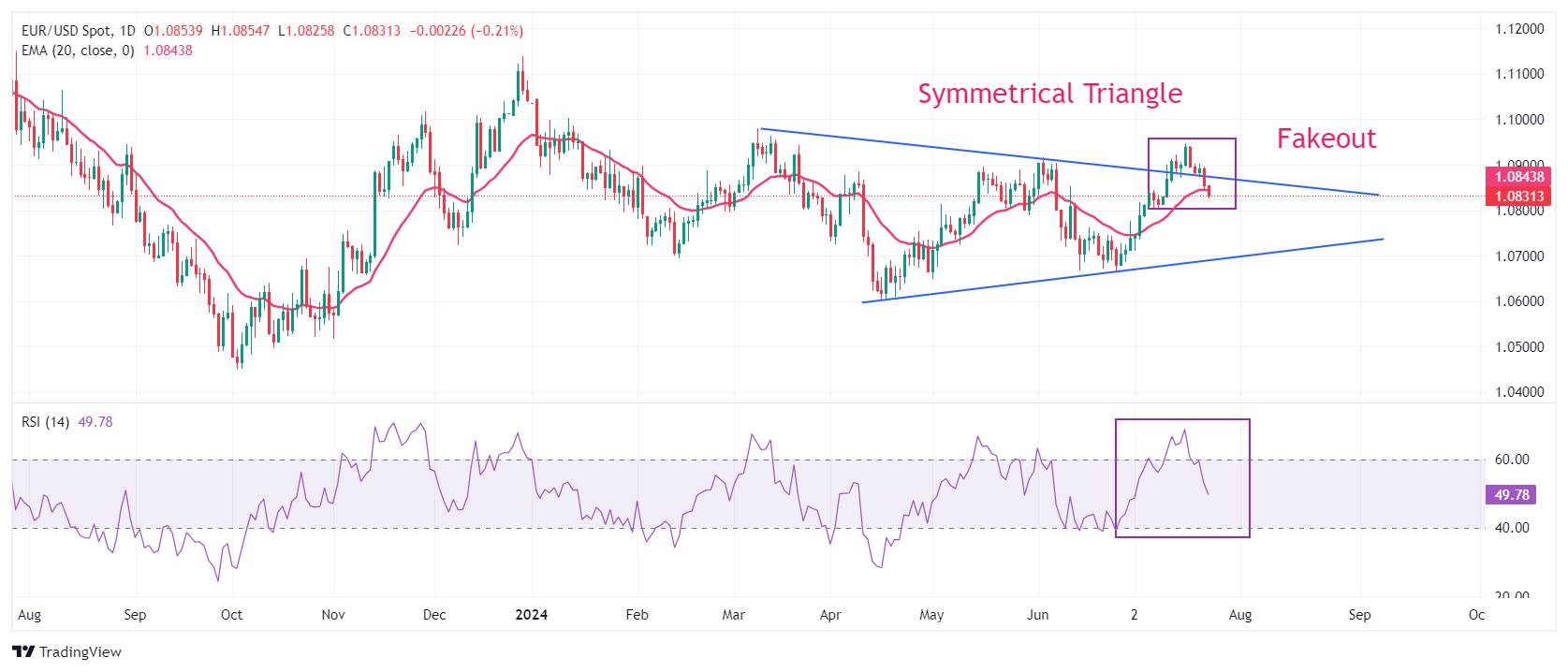
EUR/USD returns inside the Symmetrical Triangle formation on a daily timeframe after failing to hold the breakout. The major currency pair extends its downside below the 20-day Exponential Moving Average (EMA), which trades around 1.0840. The shared currency pair could slide further towards round-level supports near 1.0800 and 1.0700.
The 14-day Relative Strength Index (RSI) returns within the 40.00-60.00 range, suggesting the bullish momentum has faded.
On the upside, the round-level resistance at 1.0900 will be a key barrier for the Euro bulls.
Economic Indicator
S&P Global Composite PMI
The S&P Global Composite Purchasing Managers Index (PMI), released on a monthly basis, is a leading indicator gauging US private-business activity in the manufacturing and services sector. The data is derived from surveys to senior executives. Each response is weighted according to the size of the company and its contribution to total manufacturing or services output accounted for by the sub-sector to which that company belongs. Survey responses reflect the change, if any, in the current month compared to the previous month and can anticipate changing trends in official data series such as Gross Domestic Product (GDP), industrial production, employment and inflation. The index varies between 0 and 100, with levels of 50.0 signaling no change over the previous month. A reading above 50 indicates that the private economy is generally expanding, a bullish sign for the US Dollar (USD). Meanwhile, a reading below 50 signals that activity is generally declining, which is seen as bearish for USD.
Read more.Last release: Wed Jul 24, 2024 13:45 (Prel)
Frequency: Monthly
Actual: 55
Consensus: -
Previous: 54.8
Source: S&P Global
Author

Sagar Dua
FXStreet
Sagar Dua is associated with the financial markets from his college days. Along with pursuing post-graduation in Commerce in 2014, he started his markets training with chart analysis.