EUR/USD falls to six-week low near 1.0670 on Fed's hawkish update
- EUR/USD declines below 1.0700 as the Euro weakens amid uncertainty over the French elections.
- ECB policymakers see a bumpy inflation path towards the 2% target.
- Fed’s maintenance of a hawkish outlook offsets the impact of soft US inflation data.

EUR/USD extends its downside below the round-level support of 1.0700 to 1.0670, touching the lowest level in more than a month during Friday’s New York session. The major currency pair weakens as the Euro remains under pressure due to deepening French political uncertainty ahead of the upcoming legislative elections.
The Euro has faced turmoil this week after French President Emmanuel Macron's called for a snap election on Sunday after suffering a defeat from Marine Le Pen's far-right National Rally (RN) in parliamentary elections. There is a slight possibility that the Centralist’s alliance could make a coalition government as the RN party misses an absolute majority, according to recent polls.
On the monetary policy front, European Central Bank (ECB) policymakers continue to push back expectations of subsequent rate cuts as the path towards the 2% inflation target looks bumpy amid concerns over sustained wage growth.
On Thursday, ECB Governing Council member Bostjan Vasle said that more rate cuts are possible if the disinflation process continues. However, Vasle also warned that the process could slow down as wage momentum is relatively strong. In Friday's European session, ECB Governing Council member Mario Centeno said, “ Disinflation process will resume after August.”
Daily digest market movers: EUR/USD weakens as French political uncertainty dampens Euro's appeal
- EUR/USD faces intense selling pressure and declines below the round-level support of 1.0700 as the US Dollar (US) strengthens. The US Dollar Index (DXY), which tracks the Greenback’s value against six major currencies, prints a fresh monthly high at 105.55.
- The US Dollar remains firm as the latest interest rate projections from Federal Reserve (Fed) policymakers indicate that there will be only one rate cut this year against the three cuts forecasted in March. Also, expectations for the core Personal Consumption Expenditure Price Index (PCE) reading, which is the Fed’s preferred inflation measure, were upwardly revised to 2.8% from 2.6%.
- In Wednesday’s press conference, Fed Chair Jerome Powell acknowledged that soft Consumer Price Index (CPI) report for May is encouraging and indicated that inflation is heading in the right direction. However, to build confidence for rate cuts policymakers want to see inflation declining for months.
- Contrary to Fed’s communication of one rate cut for this year, market participants expect that there will be two. Investors’ expectations for the Fed lowering interest rates twice this year have strengthened due to the soft CPI and Producer Price Index (PPI) report for May.
- According to the CME FedWatch tool, 30-day Federal Funds futures pricing data show that the Fed will start reducing interest rates from the September meeting and there will be one more cut in either November or December. The probability of the Fed cutting rates from September has increased to 65% from 50.5% a week ago.
- The US PPI report showed on Thursday that headline producer inflation unexpectedly contracted by 0.2% on month, while the core reading – which strips off volatile food and energy prices – was unchanged. Annually, headline and core PPI decelerated to 2.2% and 2.3%, respectively.
EUR/USD Price Today:
Euro PRICE This week
The table below shows the percentage change of Euro (EUR) against listed major currencies this week. Euro was the strongest against the British Pound.
| EUR | USD | GBP | JPY | CAD | AUD | NZD | CHF | |
|---|---|---|---|---|---|---|---|---|
| EUR | -0.83% | -0.50% | -0.69% | -0.81% | -1.27% | -1.26% | -1.44% | |
| USD | 0.83% | 0.23% | 0.13% | 0.02% | -0.46% | -0.43% | -0.62% | |
| GBP | 0.50% | -0.23% | -0.06% | -0.30% | -0.77% | -0.76% | -0.95% | |
| JPY | 0.69% | -0.13% | 0.06% | -0.10% | -0.67% | -0.67% | -0.70% | |
| CAD | 0.81% | -0.02% | 0.30% | 0.10% | -0.45% | -0.46% | -0.65% | |
| AUD | 1.27% | 0.46% | 0.77% | 0.67% | 0.45% | 0.01% | -0.18% | |
| NZD | 1.26% | 0.43% | 0.76% | 0.67% | 0.46% | -0.01% | -0.19% | |
| CHF | 1.44% | 0.62% | 0.95% | 0.70% | 0.65% | 0.18% | 0.19% |
The heat map shows percentage changes of major currencies against each other. The base currency is picked from the left column, while the quote currency is picked from the top row. For example, if you pick the Euro from the left column and move along the horizontal line to the US Dollar, the percentage change displayed in the box will represent EUR (base)/USD (quote).
Technical Analysis: EUR/USD declines towards 1.0636
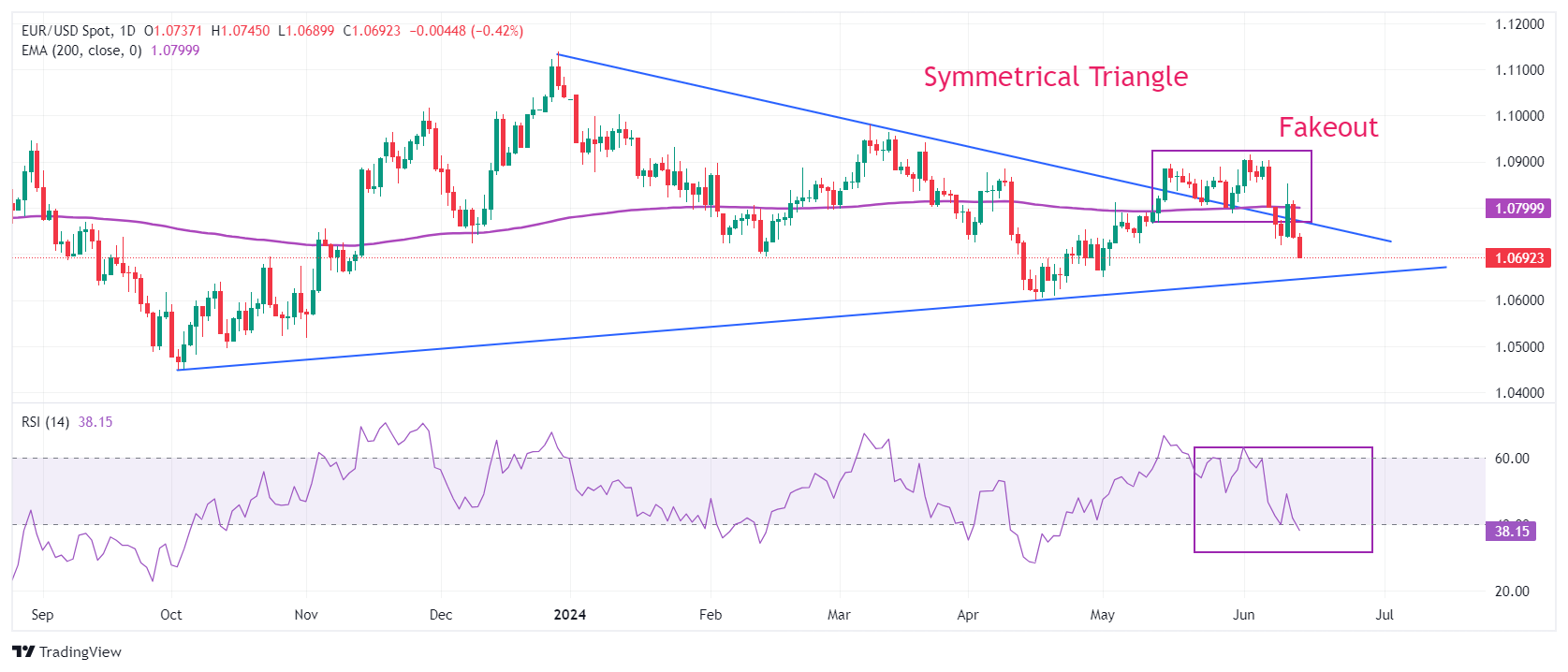
EUR/USD slumps below the round-level support of 1.0700. The major currency pair weakens after failing to hold the Symmetrical Triangle breakout formed on a daily time frame, suggesting that the overall trend has turned bearish. The shared currency pair has now returned inside the triangle formation and is expected to find support at 1.0636, near the upward-sloping order of the chart pattern plotted from 3 October 2023 low at 1.0448.
The long-term outlook of the pair has also turned negative as prices dropped below the 200-day Exponential Moving Average (EMA), which trades around 1.0800.
The 14-day Relative Strength Index (RSI) falls below 40.00. Momentum could turn bearish if the RSI sustains below this level.
Economic Indicator
Producer Price Index (MoM)
The Producer Price Index released by the Bureau of Labor statistics, Department of Labor measures the average changes in prices in primary markets of the US by producers of commodities in all states of processing. Changes in the PPI are widely followed as an indicator of commodity inflation. Generally speaking, a high reading is seen as positive (or bullish) for the USD, whereas a low reading is seen as negative (or bearish).
Read more.Last release: Thu Jun 13, 2024 12:30
Frequency: Monthly
Actual: -0.2%
Consensus: 0.1%
Previous: 0.5%
Source: US Bureau of Labor Statistics
Author

Sagar Dua
FXStreet
Sagar Dua is associated with the financial markets from his college days. Along with pursuing post-graduation in Commerce in 2014, he started his markets training with chart analysis.

















