EUR/USD declines to near 1.1050 after soft Eurozone, US inflation
- EUR/USD falls to near 1.1050 as the Eurozone inflation declines in line with estimates.
- Soft German inflation already boosted hopes of another ECB interest-rate cut in September.
- US PCE inflation for July rose steadily and remains softer than estimates.

EUR/USD edges lower and remains below 1.1100 in Friday's North American session. The major currency rises as the US Dollar (USD) adds little gains despite the United States (US) Personal Consumption Expenditure Price Index (PCE) report showing that price pressures rose slower than expected in July. The US Dollar Index (DXY), which tracks the Greenback’s value against six major currencies, rises to near a fresh weekly high of 101.58.
The PCE report showed that year-over-year core inflation rose steadily by 2.6%, slower than estimates of 2.7%. Month-on-month inflation grew in line with estimates, and the former release of 0.2%. The Federal Reserve (Fed) is almost certain to start reducing interest rates from the September meeting. However, signs of stickiness in the inflation data has weighed on market expectations for pivoting to policy normalization aggressively.
According to the CME FedWatch tool, 30-day Federal Funds Futures pricing data shows that the likelihood of a probability of 50-basis points (bps) interest rate reduction in September is 30.5%, down from 36% recorded a week ago.
The likelihood of a bigger rate cut is also diminished by the upwardly revised Q2 Gross Domestic Product (GDP) estimates. The US Bureau of Economic Analysis (BEA) reported on Thursday that the pace at which the economy grew in the second quarter was higher than preliminary estimates. The agency reported that the economy grew at a robust pace of 3% on an annualized basis, against the flash projections of 2.8%.
Daily digest market movers: EUR/USD falls on soft Eurozone inflation
- EUR/USD stays below 1.1100 in Friday’s New York session as the Eurozone flash annual Harmonized Index of Consumer Prices (HICP) declines expectedly in August. A preliminary HICP report showed that the headline inflation decelerated to 2.2% from 2.6% in July due to lower energy prices. In the same period, the core HICP – which excludes volatile components like food, energy, alcohol, and tobacco – grew by 2.8%, slower than the former release of 2.9%.
- The preliminary inflation data is expected to strengthen market speculation for the European Central Bank's (ECB) September interest rate cuts and, more broadly, the policy-easing path for the remainder of the year.
- Financial market participants already seem to be confident that the ECB will cut its key borrowing rates in September again. The ECB pivoted to policy-normalization in June but left interest rates unchanged in August. Market expectations for ECB September rate cuts increased sharply after data released on Thursday showed that price pressures in the Eurozone’s largest nation, Germany, returned to 2% for the first time in more than three years. Also, the economy is exposed to a technical recession as it contracted by 0.1% in the second quarter of this year and its economic outlook is vulnerable. Other Eurozone economies, such as France or Spain, have also seen a significant inflation decline in August.
- "Fading inflationary pressure combined with fading growth momentum offers an almost perfect macro backdrop for another rate cut," said Carsten Brzeski, global head of macro at ING, in a note on Thursday.
- The ECB is also expected to deliver an additional interest rate cut somewhere in the last quarter of this year.
Technical Analysis: EUR/USD falls to near 1.1050
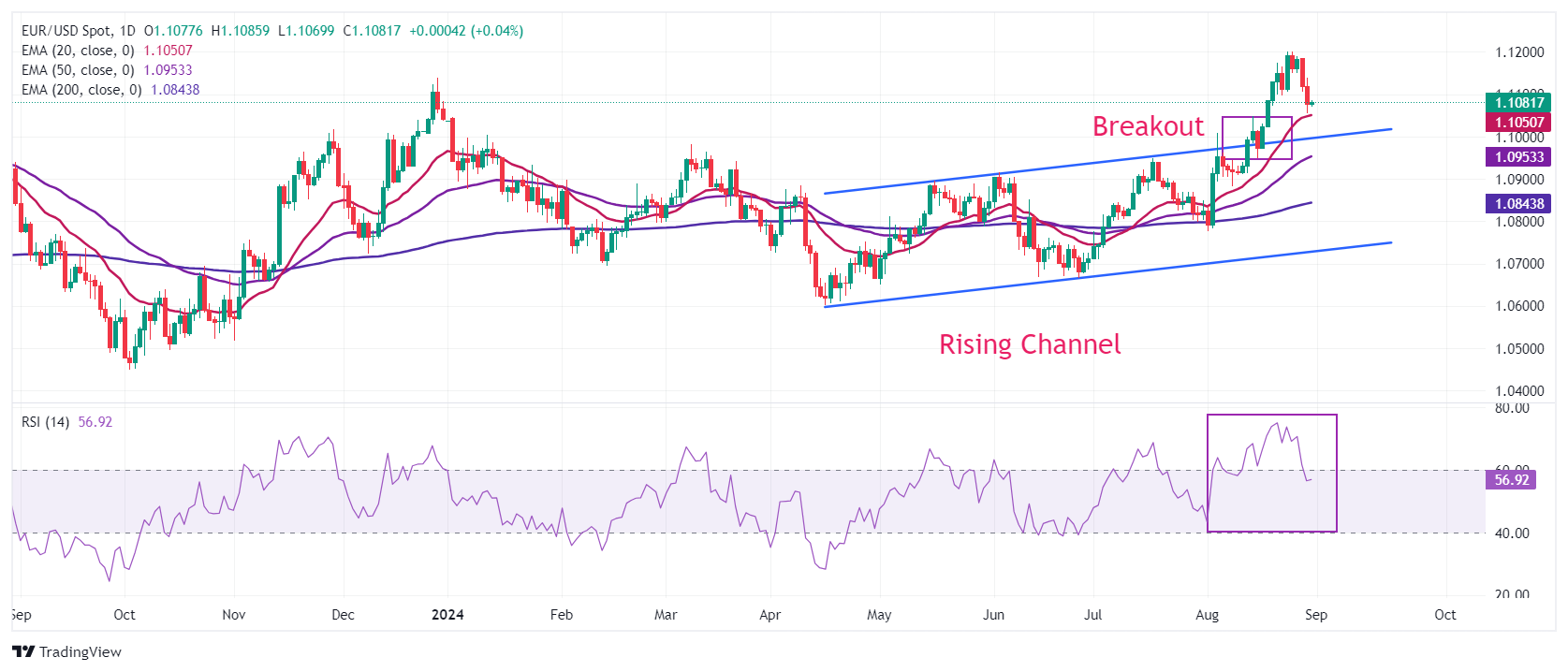
EUR/USD trades inside Thursday’s trading range after steading below the crucial resistance of 1.1100. The near-term outlook of the major currency pair is still firm as all short-to-long-term Exponential Moving Averages (EMAs) are sloping higher. Also, the major currency pair holds the breakout of the Rising Channel formation on a daily timeframe.
The 14-day Relative Strength Index (RSI) has declined below 60.00 after turning overbought near 75.00.
On the upside, a recent high of 1.1200 and the July 2023 high at 1.1275 will be the next stop for the Euro bulls. The downside is expected to remain cushioned near the psychological support of 1.1000.
Interest rates FAQs
Interest rates are charged by financial institutions on loans to borrowers and are paid as interest to savers and depositors. They are influenced by base lending rates, which are set by central banks in response to changes in the economy. Central banks normally have a mandate to ensure price stability, which in most cases means targeting a core inflation rate of around 2%. If inflation falls below target the central bank may cut base lending rates, with a view to stimulating lending and boosting the economy. If inflation rises substantially above 2% it normally results in the central bank raising base lending rates in an attempt to lower inflation.
Higher interest rates generally help strengthen a country’s currency as they make it a more attractive place for global investors to park their money.
Higher interest rates overall weigh on the price of Gold because they increase the opportunity cost of holding Gold instead of investing in an interest-bearing asset or placing cash in the bank. If interest rates are high that usually pushes up the price of the US Dollar (USD), and since Gold is priced in Dollars, this has the effect of lowering the price of Gold.
The Fed funds rate is the overnight rate at which US banks lend to each other. It is the oft-quoted headline rate set by the Federal Reserve at its FOMC meetings. It is set as a range, for example 4.75%-5.00%, though the upper limit (in that case 5.00%) is the quoted figure. Market expectations for future Fed funds rate are tracked by the CME FedWatch tool, which shapes how many financial markets behave in anticipation of future Federal Reserve monetary policy decisions.
Author

Sagar Dua
FXStreet
Sagar Dua is associated with the financial markets from his college days. Along with pursuing post-graduation in Commerce in 2014, he started his markets training with chart analysis.