EUR/USD clings to gains as US wage growth decelerates expectedly
- EUR/USD refreshes a three-week high near 1.0830 due to multiple tailwinds.
- The Euro strengthens as the far right may fail to gain an outright majority in French elections.
- The US Dollar weakens as Fed rate-cut bets for September soar.

EUR/USD holds gains above the round level of 1.0800 in Friday's New York as the United States (US) Nonfarm Payrolls (NFP) report showed that Average Hourly Earnings declines expectedly in June. Average Hourly Earnings data is a measure of wage growth that has been a major driving factor behind high inflation in the service sector. Annually, the wage growth measure declined to 3.9%, as expected, from May's reading of 4.1%. On month, the economic data grew at an expected pace of 0.3%, slower than the former release of 0.4%. This has diminished fears of price pressures remaining stubborn.
Meanwhile, the number of individuals hired by employers in June came in at 206K, higher than estimates of 190K but lower than the prior release of 272K. The Unemployment Rate rose to 4.1% from expectations and the prior release of 4.0%. Higher-than-expected payrolls and the expected decline in the wage growth measure would less likely influence market speculation for Federal Reserve (Fed) rate cuts.
The US Dollar (DXY) was already under pressure amid growing speculation that the Federal Reserve (Fed) will start reducing interest rates from the September meeting. The US Dollar Index (DXY), which tracks the Greenback’s value against six major currencies, has extended its losing spell for the seventh trading session and has posted a fresh three-week low near 105.00.
Traders raised rate-cut bets for September heavily due to various factors, such as Fed Chair Jerome Powell's sheer confidence that the central bank has made considerable progress in inflation, easing labor market strength, and contraction in the Services PMI.
The June ADP Employment Change report showed unexpectedly slowing private sector hiring. In the same period, the Services PMI showed a contraction in the sector and dropped to its lowest level in four years.
Daily digest market movers: EUR/USD rises higher as Far Right could fail to gain absolute majority
- EUR/USD posts a fresh three-week high near 1.0830 in Friday’s European session. The major currency pair strengthens as the Euro’s outlook improves ahead of the second round of French elections, scheduled for Sunday, and sheer weakness in the US Dollar (USD).
- The appeal for the Euro improves amid expectations that the Marine Le Pen-led far-right National Rally would fail to convert its victory of the first round into an absolute majority due to the tactical withdrawal of at least 200 candidates from Sunday’s legislative elections by a coalition of French President Emmanuel Macron-led entrist alliance and the left-wing.
- On the monetary policy front, speculation for the European Central Bank (ECB) delivering subsequent rate cuts on July 18 has diminished as disinflation in the Eurozone appears to be stalling. The preliminary core Harmonized Index of Consumer Prices (HICP) that excludes volatile items grew steadily by 2.9% year-on-year in June.
- Meanwhile, the Eurozone Retail Sales data has turned out mixed in May. Annually, Retail Sales expanded strongly by 0.3%, while economists expected spending at retail stores to have barely increased. On monthly, Retail Sales expanded by 0.1% after contracting 0.2% in April but missed expectations of 0.2% growth.
Technical Analysis: EUR/USD steadies above all short-to-long daily EMAs
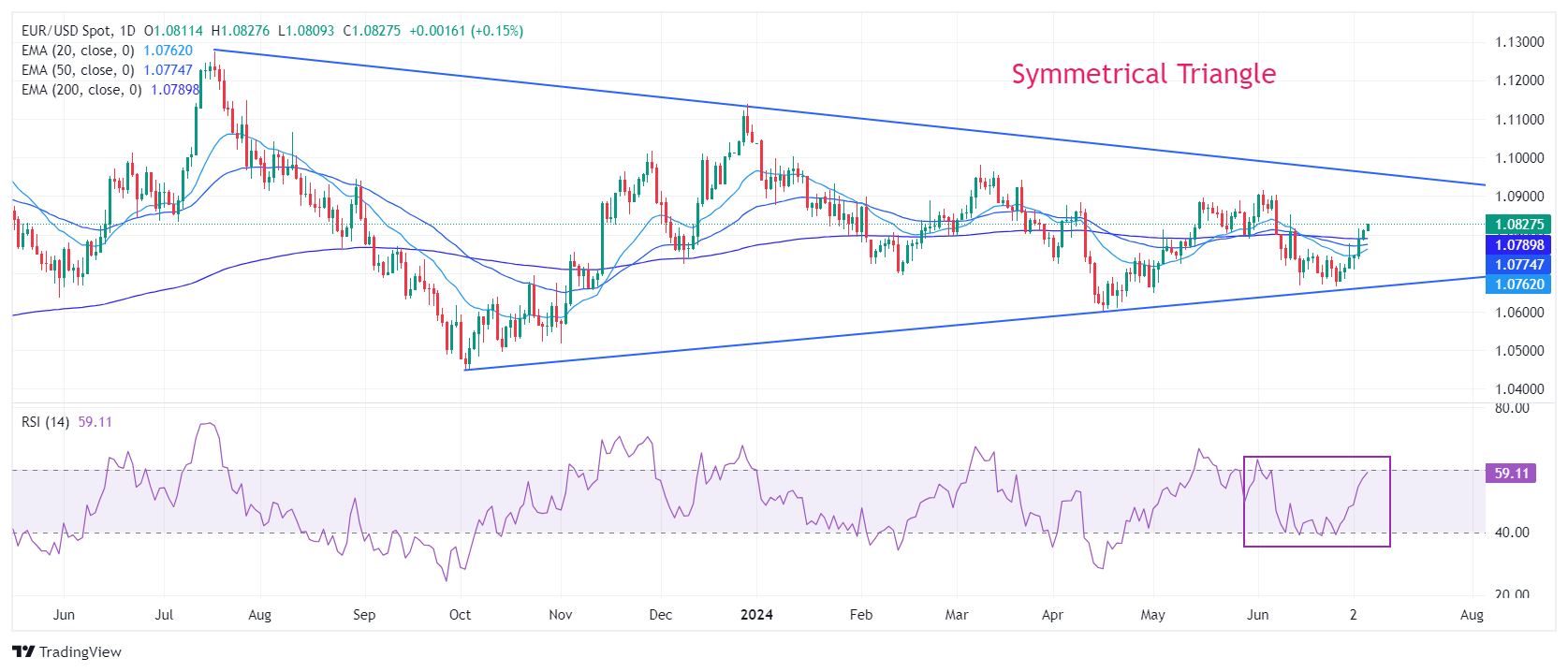
EUR/USD extends its winning spell for the seventh day on Friday. The major currency pair strengthens after stabilizing above the 20-day and 50-day Exponential Moving Averages (EMAs), which trade around 1.0750 and 1.0770, respectively. The overall trend of the shared currency pair has also strengthened as it has jumped above the 200-day EMA, which trades around 1.0800.
The Symmetrical Triangle formation on the daily timeframe exhibits a sharp volatility contraction, which indicates low volume and narrow ticks.
The 14-day Relative Strength Index (RSI) reaches 60.00. Should the bullish momentum be triggered if it breaks above this level?
Economic Indicator
Nonfarm Payrolls
The Nonfarm Payrolls release presents the number of new jobs created in the US during the previous month in all non-agricultural businesses; it is released by the US Bureau of Labor Statistics (BLS). The monthly changes in payrolls can be extremely volatile. The number is also subject to strong reviews, which can also trigger volatility in the Forex board. Generally speaking, a high reading is seen as bullish for the US Dollar (USD), while a low reading is seen as bearish, although previous months' reviews and the Unemployment Rate are as relevant as the headline figure. The market's reaction, therefore, depends on how the market assesses all the data contained in the BLS report as a whole.
Read more.Last release: Fri Jul 05, 2024 12:30
Frequency: Monthly
Actual: 206K
Consensus: 190K
Previous: 272K
Source: US Bureau of Labor Statistics
America’s monthly jobs report is considered the most important economic indicator for forex traders. Released on the first Friday following the reported month, the change in the number of positions is closely correlated with the overall performance of the economy and is monitored by policymakers. Full employment is one of the Federal Reserve’s mandates and it considers developments in the labor market when setting its policies, thus impacting currencies. Despite several leading indicators shaping estimates, Nonfarm Payrolls tend to surprise markets and trigger substantial volatility. Actual figures beating the consensus tend to be USD bullish.
Author

Sagar Dua
FXStreet
Sagar Dua is associated with the financial markets from his college days. Along with pursuing post-graduation in Commerce in 2014, he started his markets training with chart analysis.