EUR/USD faces pressure as FOMC minutes signal slowdown in US disinflation trend
- EUR/USD drops to near 1.0300 after the FOMC minutes dropped hints of a slowdown in the US inflation progress towards the Fed’s target of 2%.
- The USD Index is on track to revisit the two-year high of 109.53 ahead of the US NFP data due on Friday.
- The ECB is expected to reach the neutral rate by summer.

EUR/USD faces selling pressure near 1.0300 but stays inside Wednesday’s trading range in Thursday’s North American session. The major currency pair drops as the US Dollar (USD) moves higher, with the US Dollar Index (DXY), which tracks the Greenback’s value against six major currencies, aiming to revisit the two-year high of 109.53. The US Dollar rises as Federal Open Market Committee (FOMC) minutes for the December policy meeting signaled that policymakers are cautious about further policy-easing since the disinflation trend progress has stalled.
“Participants expected inflation to keep moving toward 2%, but effects of potential trade and immigration policy changes suggested that the process could take longer than previously anticipated,” FOMC minutes showed.
Meanwhile, Boston Federal Reserve (Fed) Bank President Susan Collins also calls for a gradual and patient approach to rate cuts. Collins added that the Fed is not on a "preset path" amid an "uneven trajectory" back to 2% inflation. She refrained from commenting about the impact of President-elect Donald Trump's policies on the economy. "Too soon to say what impact election will have on economy," Collins said.
Going forward, the shared currency pair will be guided by President-elect Donald Trump’s plan to declare a national economic emergency, aiming to provide legal reasoning for the possible increase in import tariffs on the nation’s allies and adversaries.
On the economic front, investors will focus on the United States (US) Nonfarm Payrolls (NFP) data release for December, which will be published on Friday. The official employment data will influence market expectations about when the Fed will deliver its first interest rate cut of the year.
US Dollar PRICE Today
The table below shows the percentage change of the US Dollar (USD) against listed major currencies today. The US Dollar was the strongest against the British Pound.
| USD | EUR | GBP | JPY | CAD | AUD | NZD | CHF | |
|---|---|---|---|---|---|---|---|---|
| USD | 0.08% | 0.53% | -0.36% | 0.12% | 0.29% | 0.23% | -0.01% | |
| EUR | -0.08% | 0.43% | -0.44% | 0.03% | 0.20% | 0.14% | -0.08% | |
| GBP | -0.53% | -0.43% | -0.89% | -0.40% | -0.23% | -0.28% | -0.49% | |
| JPY | 0.36% | 0.44% | 0.89% | 0.47% | 0.65% | 0.54% | 0.38% | |
| CAD | -0.12% | -0.03% | 0.40% | -0.47% | 0.18% | 0.10% | -0.10% | |
| AUD | -0.29% | -0.20% | 0.23% | -0.65% | -0.18% | -0.07% | -0.26% | |
| NZD | -0.23% | -0.14% | 0.28% | -0.54% | -0.10% | 0.07% | -0.20% | |
| CHF | 0.00% | 0.08% | 0.49% | -0.38% | 0.10% | 0.26% | 0.20% |
The heat map shows percentage changes of major currencies against each other. The base currency is picked from the left column, while the quote currency is picked from the top row. For example, if you pick the US Dollar from the left column and move along the horizontal line to the Japanese Yen, the percentage change displayed in the box will represent USD (base)/JPY (quote).
Daily digest market movers: EUR/USD drops as ECB likely continues easing interest rates
- EUR/USD stays under pressure, mainly due to USD strength. However, the Euro (EUR) exhibits a mixed performance against other peers as an expected growth in the Eurozone preliminary Harmonized Index of Consumer Prices (HICP) data for December has pushed back expectations that the European Central Bank (ECB) will cut its Deposit Facility by larger-than-usual pace of 50 basis points (bps) in the upcoming policy meeting.
- Market participants were anticipating that the ECB could fasten its policy-easing pace to avoid risks of inflation, undershooting the central bank’s target of 2% amid weakness in the overall business activity. However, the ECB will continue easing its monetary policy at a usual pace of 25 bps amid a weak economic outlook.
- ECB officials are confident that interest rates will return to the neutral rate by summer, which is approximately 2%. On Wednesday, ECB policymaker and Governor of the Bank of France Francois Villeroy said that price pressures were expected to tick higher in December but that interest rates will continue heading towards the neutral rate “without a slowdown in the pace by summer” if the upcoming data confirm that the “pullback in price pressures won’t continue”.
- The latest Economic Confidence (EC) survey by Capital Economics suggests that the economic performance of the trade bloc remained stagnant in the last quarter of 2024. The survey’s Economic Sentiment Indicator (ESI) fell to 93.7 in December from 95.6 in November.
- Meanwhile, the Eurozone Retail Sales data for November has come in weaker than expected. The Retail Sales data (MoM), a key measure of consumer spending, rose by 0.1%, slower than estimates of 0.4%.
Technical Analysis: EUR/USD remains exposed to more downside to near 1.0200
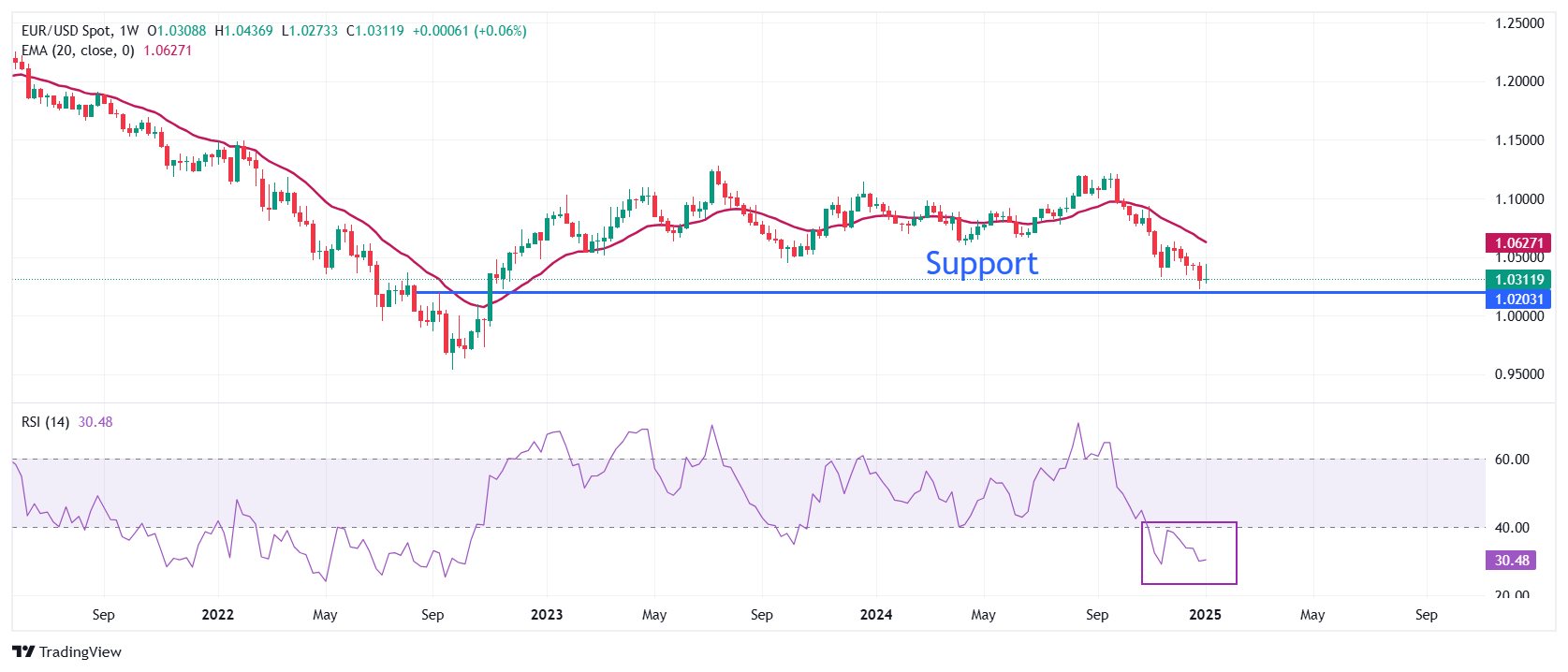
EUR/USD trades near the key support plotted from the September 2022 high of 1.0200 on a weekly timeframe. The outlook of the major currency pair is broadly bearish as the 20-week Exponential Moving Average (EMA) at 1.0627 is declining.
The 14-week Relative Strength Index (RSI) slides to near 30.00, indicating a strong downside momentum. However, a slight recovery cannot be ruled out as the momentum oscillator has turned oversold.
Looking down, the pair could find support near the round level of 1.0100. Conversely, the weekly high of 1.0458 will be the key barrier for the Euro bulls.
Fed FAQs
Monetary policy in the US is shaped by the Federal Reserve (Fed). The Fed has two mandates: to achieve price stability and foster full employment. Its primary tool to achieve these goals is by adjusting interest rates. When prices are rising too quickly and inflation is above the Fed’s 2% target, it raises interest rates, increasing borrowing costs throughout the economy. This results in a stronger US Dollar (USD) as it makes the US a more attractive place for international investors to park their money. When inflation falls below 2% or the Unemployment Rate is too high, the Fed may lower interest rates to encourage borrowing, which weighs on the Greenback.
The Federal Reserve (Fed) holds eight policy meetings a year, where the Federal Open Market Committee (FOMC) assesses economic conditions and makes monetary policy decisions. The FOMC is attended by twelve Fed officials – the seven members of the Board of Governors, the president of the Federal Reserve Bank of New York, and four of the remaining eleven regional Reserve Bank presidents, who serve one-year terms on a rotating basis.
In extreme situations, the Federal Reserve may resort to a policy named Quantitative Easing (QE). QE is the process by which the Fed substantially increases the flow of credit in a stuck financial system. It is a non-standard policy measure used during crises or when inflation is extremely low. It was the Fed’s weapon of choice during the Great Financial Crisis in 2008. It involves the Fed printing more Dollars and using them to buy high grade bonds from financial institutions. QE usually weakens the US Dollar.
Quantitative tightening (QT) is the reverse process of QE, whereby the Federal Reserve stops buying bonds from financial institutions and does not reinvest the principal from the bonds it holds maturing, to purchase new bonds. It is usually positive for the value of the US Dollar.
Author

Sagar Dua
FXStreet
Sagar Dua is associated with the financial markets from his college days. Along with pursuing post-graduation in Commerce in 2014, he started his markets training with chart analysis.