EUR/USD remains under pressure near 1.1150 post-German GDP
- EUR/USD stays vulnerable in the mid-1.1100s today.
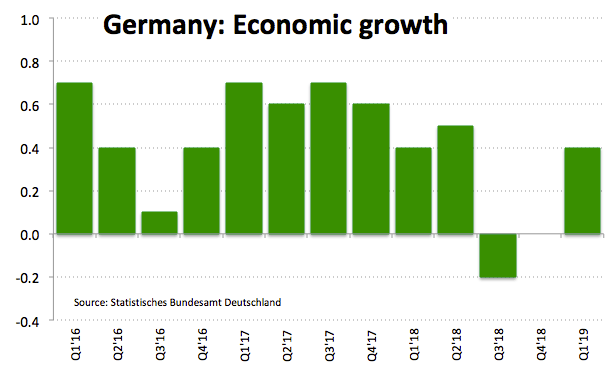
- German final Q1 GDP came in at 0.4% QoQ, 0.6% YoY.
- Advanced PMIs next of significance in Euroland.

The sentiment around the European currency remains fragile so far in the second half of the week, prompting EUR/USD to keep business around the 1.1150 region for the time being.
EUR/USD now looks to data, trade
The pair remains reluctant to extend the downside on a convincing fashion below the key 1.1150 level for the time being. However, the persistent demand for the greenback and rising political risks ahead of the European parliamentary elections in the next days threaten this current stance.
Further out, the absence of fresh headlines around the US-China trade dispute appears to be lending a tepid support to the pair somehow.
Data wise in the euro area, German final GDP figures showed the economy expanded 0.4% QoQ during the January-March period and 0.6% on an annualized basis. Later in the day, key preliminary prints from manufacturing and services PMIs in core Euroland will grab all the attention.
Across the pond, usual Claims, flash PMIs and speeches by Bostic, Kaplan, Daly and Barkin are coming up later in the NA session.
What to look for around EUR
Recent data releases in Euroland and Germany have poured cold water over the idea that some healing process could be under way in the region, re-shifting the focus to the ongoing slowdown and its probable duration and extension. In the meantime, the current ‘neutral/dovish’ stance from the ECB is expected to persist for the remainder of the year and probable through H1 2020. The broad-based risk-appetite trends and USD-dynamics should dictate the sentiment surrounding the European currency for the time being, all in combination with the now stalled US-China negotiations and potential US tariffs on EU products. On the political front, Italy has re-emerged as a source of uncertainty and volatility, while investors’ focus has now shifted to the EU parliamentary elections due later this week.
EUR/USD levels to watch
At the moment, the pair is gaining 0.01% at 1.1151 and a break above 1.1183 (21-day SMA) would target 1.1217 (23.6% Fibo of the 2019 drop) en route to 1.1236 (55-day SMA). On the downside, the next support lines up at 1.1135 (low May 3) seconded by 1.1109 (2019 low Apr.26) and finally 1.0839 (monthly low May 2017).
Author

Pablo Piovano
FXStreet
Born and bred in Argentina, Pablo has been carrying on with his passion for FX markets and trading since his first college years.

















