EUR/USD faces upbeat US Retail Sales revisions ahead of intensive retail season
- EUR/USD bounces after test of 1.0500 on Thursday, the lowest level in over a year.
- Euro recovers on Friday against the US Dollar due to profit-taking after a five-day losing streak.
- Markets turn nervous on the Fed putting the December rate cut in doubt, while the ECB is expected to continue easing, pointing to more downside for the EUR/USD.

EUR/USD recovers on Friday after a brief test of the 1.0500 level the prior day, erasing Thursday's incurred losses. The pair has eased nearly 1.5% so far this week as markets have priced in more Trump trade effects. That move is now facing some profit-taking after a five-day losing streak for the Euro against the Greenback. All pieces of the puzzle are now in, with potentially EUR/USD starting to trade sideways in a range until President-elect Donald Trump takes office in January.
The EUR/USD recovery on Friday looks to be triggered by some profit-taking after the steep decline this week. Economic data from France released earlier in the day showed that inflation, as measured by the Harmonized Consumer Price Index (HCPI), came a touch higher than the preliminary reading for October. However, this may not change the dovish stance of the European Central Bank (ECB), which is set to cut its policy rate in its upcoming policy meeting in December.
On Thursday, Federal Reserve (Fed) Chairman Jerome Powell joined the camp of members within the Fed that deem another rate cut in December, however, it is not granted. Powell pointed out that the US economy and job markets are still doing very well. Meanwhile, several analysts and economists have warned of exponential inflation in the US should President-elect Donald Trump roll out all his fiscal stimulus packages for both US companies and households, alongside slapped tariffs on China and Europe.
Daily digest market movers: Revisions in US Retail Sales in favor of the Greenback
- US Retail Sales was sharp upside revisions while the actual numbers were roughly in line of expectations. Headline Retail Sales for October came in at 0.4%, beating the 0.3% estimate. The devil in the detail was the upside revision of the previous number to 0.8%, coming from 0.4%.
- Japanese indices closed off rather flat to positive on Friday, while Chinese equities faced weekly losses.
- France’s final reading for the October inflation figures came in a touch higher than expected. The HCPI rose by 1.6% year-over-year (YoY), compared to the 1.5% previously reported and expected. The monthly HCPI came in at 0.3%, as expected.
- There is some good news on the economic data front from China, where Retail Sales surged 4.8% YoY in October, beating the lower expectation of 3.8%.
- All eyes will be on the US Retail Sales data for October on Friday, with the headline number expected to show 0.3% compared to 0.4% in September. As always, markets will move more on the revisions than on the actual number.
Technical Analysis: Euro is facing an uphill battle
EUR/USD slightly recovers on Friday, with some profit-taking during the European trading session after five consecutive trading days in the red. Pure fundamentally, much upside for EUR/USD is not expected after Fed Chairman Powell dampened hopes for an interest rate cut in December, while recent French inflation figures may not change the ECB’s dovish stance. The rate differential between the two contents will become wider if the Fed does not cut and the ECB does at their next meetings in December, which is oil on the fire in favour of more downside in EUR/USD by the end of the year.
On the upside, three firm lines in the sand can be seen. First up is the previous 2024 low, registered on April 16 at 1.0601. If that level breaks, the triple bottom from June at 1.0667 will be the next cap upwards. Further up, the 1.0800 round level, which roughly coincides with the green ascending trend line from the low of October 3, 2023, could deliver a harsh rejection before having more downside in EUR/USD.
Looking for support, the 2023 low at 1.0448 is the next technical candidate. That would mean that once tested, a fresh two-year low is in the cards. Further down, a wider area could open up with 1.0294 as the next level to consider.
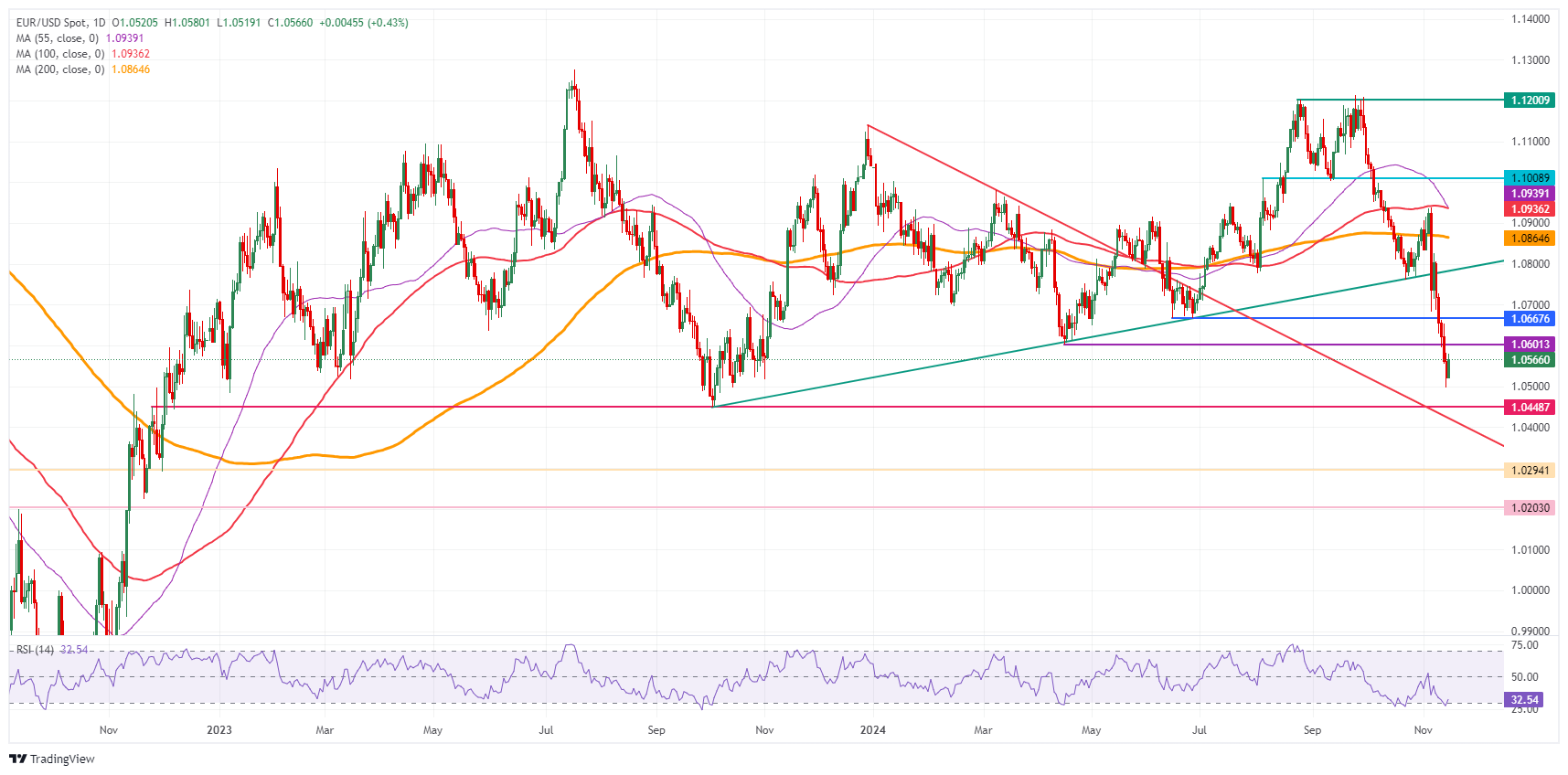
EUR/USD: Daily Chart
US Dollar FAQs
The US Dollar (USD) is the official currency of the United States of America, and the ‘de facto’ currency of a significant number of other countries where it is found in circulation alongside local notes. It is the most heavily traded currency in the world, accounting for over 88% of all global foreign exchange turnover, or an average of $6.6 trillion in transactions per day, according to data from 2022. Following the second world war, the USD took over from the British Pound as the world’s reserve currency. For most of its history, the US Dollar was backed by Gold, until the Bretton Woods Agreement in 1971 when the Gold Standard went away.
The most important single factor impacting on the value of the US Dollar is monetary policy, which is shaped by the Federal Reserve (Fed). The Fed has two mandates: to achieve price stability (control inflation) and foster full employment. Its primary tool to achieve these two goals is by adjusting interest rates. When prices are rising too quickly and inflation is above the Fed’s 2% target, the Fed will raise rates, which helps the USD value. When inflation falls below 2% or the Unemployment Rate is too high, the Fed may lower interest rates, which weighs on the Greenback.
In extreme situations, the Federal Reserve can also print more Dollars and enact quantitative easing (QE). QE is the process by which the Fed substantially increases the flow of credit in a stuck financial system. It is a non-standard policy measure used when credit has dried up because banks will not lend to each other (out of the fear of counterparty default). It is a last resort when simply lowering interest rates is unlikely to achieve the necessary result. It was the Fed’s weapon of choice to combat the credit crunch that occurred during the Great Financial Crisis in 2008. It involves the Fed printing more Dollars and using them to buy US government bonds predominantly from financial institutions. QE usually leads to a weaker US Dollar.
Quantitative tightening (QT) is the reverse process whereby the Federal Reserve stops buying bonds from financial institutions and does not reinvest the principal from the bonds it holds maturing in new purchases. It is usually positive for the US Dollar.
Author

Filip Lagaart
FXStreet
Filip Lagaart is a former sales/trader with over 15 years of financial markets expertise under its belt.