EUR/USD comes off its highs despite strong IFO data
- EUR/USD climbs above the key 1.0700 psychological level early on Wednesday but then pares gains.
- Weaker-than-expected US PMI data on Tuesday undermined the US Dollar and fueled the recovery.
- EUR/USD pares gains despite strong IFO economic sentiment data from Germany.

EUR/USD trades just shy of 1.0700 on Wednesday after weaker-than-expected private sector growth and US business activity dent the myth of US economic exceptionalism, weighing on the US Dollar (USD) and lifting the pair over the last 24-hours.
The EUR/USD pares earlier gains later in the day, however, despite the release of upbeat German economic sentiment IFO survey data for April. Data from the IFO Institute showed a greater-than-expected rise in the Business Climate (89.4) and Current Assessment (88.9) components, whilst Expectations increased to 89.9 in line with estimates.
During the US session, EUR/USD shrugs off US Durable Goods Orders data, which rose 2.6%, or $7.3 billion, to $283.4 billion in March, according to the US Census Bureau. This reading follows the 0.7% increase (revised from 1.4%) recorded in February.
EUR/USD recovers on weaker-than-expected US data
EUR/USD broke above the top of its seven-day range early on Wednesday after the Greenback lost favor with traders. The Euro (EUR), meanwhile, faired better on the back of growth in the Services sector revealed in Tuesday’s better-than-expected HCOB Eurozone Services PMI data for April.
In comparison, the PMI indexes from the US fell for both Services and Manufacturing in April, which took investors by surprise and suggested the economy is not coping as well as previously thought under the yoke of relatively high interest rates.
Stubborn price momentum in the services sector in both the US and Europe have delayed the time by which both the Federal Reserve (Fed) and European Central Bank (ECB) are expected to cut interest rates. Whilst ECB officials seem fairly united in wanting to cut the ECB’s base lending rate in June, Fed officials have become increasingly vague about when they might consider cutting interest rates.
Since the expectation of lower interest rates depreciates a currency, the lack of commitment of Fed officials compared to their ECB colleagues has been the main catalyst behind the US Dollar’s outperformance over recent weeks, and EUR/USD’s bearish momentum.
The higher-than-expected preliminary Services PMI data in the Eurozone revealed on Tuesday, however, introduces some doubt into confidence that the ECB will in fact go ahead with rate cuts in June.
On Wednesday, ECB governing council member and Bundesbank President Joachim Nagel reflected this doubt, saying “Services inflation remains high, driven by continued strong wage growth,” and because of this he was not convinced inflation was falling in a sustainable manner and, therefore, could not “pre-commit to a particular rate path.”
It means more weight will be given to the defining data point for the decision, which is – according to the ECB President Christine Lagarde – first quarter Eurozone wage growth data.
Technical Analysis: EUR/USD pierces top of short-term range
EUR/USD breaks out of the box-like range it had been trading in for the last seven days and pierces above the key 1.0700 level to bring into doubt the durability of the short-term downtrend.
It is now less certain EUR/USD is forming a Bear Flag price pattern as had previously been assumed. The pattern has quite bearish connotations with a potential downside target in the 1.0400s, so if it fails to activate the pair could reverse on the disappointment, with some short-covering adding fuel to the recovery.
EUR/USD 4-hour Chart
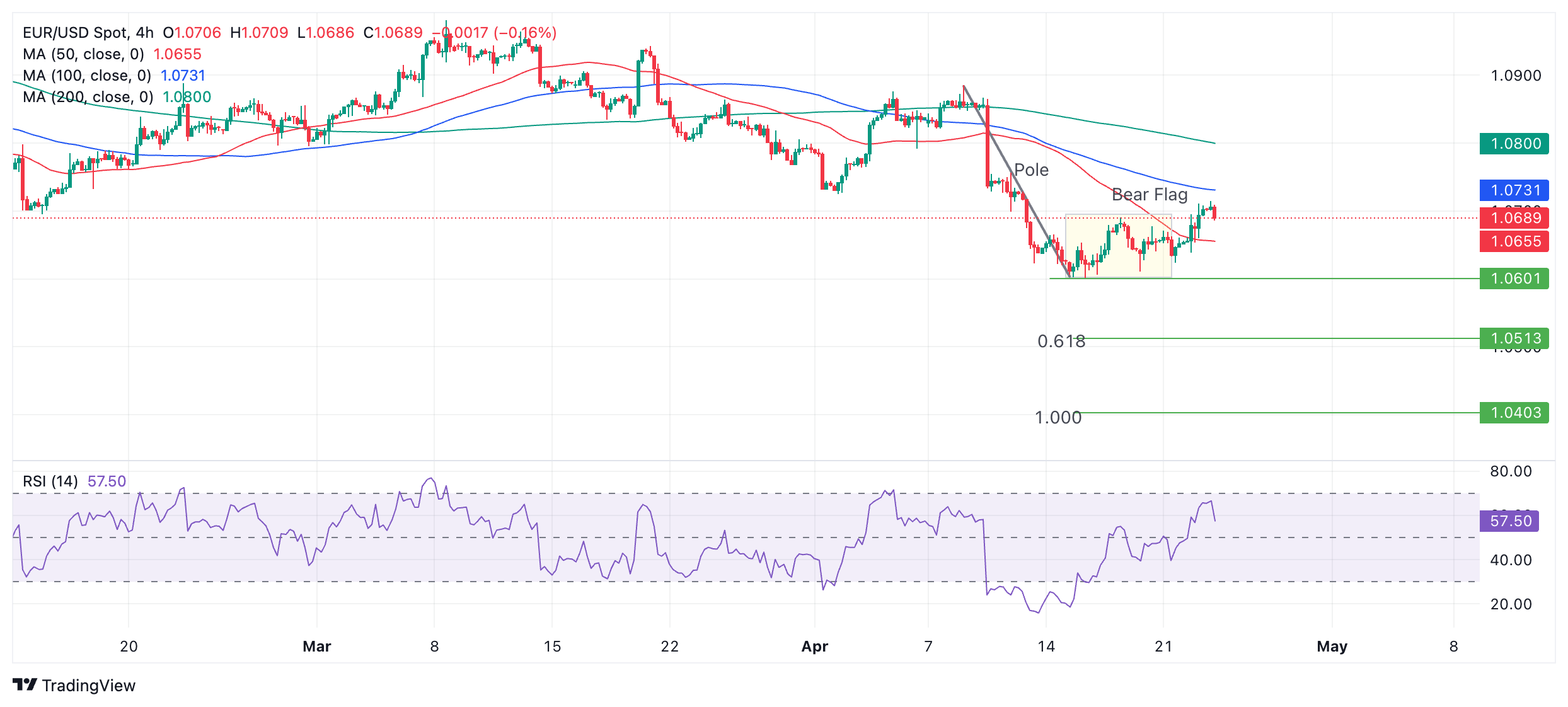
With the short-term downtrend in doubt more upside is possible, with the next target at resistance from the previous lower high providing an initial target at 1.0758. After that, the 50-day and 200-day Simple Moving Averages (SMA) provide resistance at 1.0807 on the daily chart (not shown).
A break below the 1.0601 April 16 low, however, would prove the Bear Flag hypothesis valid in the end and signal the start of a decline.
According to technical lore, the expected move out of a Bear Flag usually equals the length of the “pole” or steep decline preceding the box-like formation of the flag square, or a Fibonacci ratio of the pole.
The Fibonacci 0.618 ratio of the pole extrapolated lower provides the most reliable conservative target. This gives a price objective at 1.0503. After that, the next concrete target is at 1.0446 – the October 2023 low. A fall of equal length to the pole would take EUR/USD down to 1.0403.
Economic Indicator
Durable Goods Orders
The Durable Goods Orders, released by the US Census Bureau, measures the cost of orders received by manufacturers for durable goods, which means goods planned to last for three years or more, such as motor vehicles and appliances. As those durable products often involve large investments they are sensitive to the US economic situation. The final figure shows the state of US production activity. Generally speaking, a high reading is bullish for the USD.
Read more.Last release: Wed Apr 24, 2024 12:30
Frequency: Monthly
Actual: 2.6%
Consensus: -
Previous: 1.4%
Source: US Census Bureau
Author

Joaquin Monfort
FXStreet
Joaquin Monfort is a financial writer and analyst with over 10 years experience writing about financial markets and alt data. He holds a degree in Anthropology from London University and a Diploma in Technical analysis.
















