|

EUR/USD Price Analysis: Bears sink in their teeth to test bulls at a critical support structure

  • EUR/USD is testing a critical support structure that guards a breakout. 
  • EUR/USD has otherwise supported within the bullish cycle with prospects of a bullish extension. 

EUR/USD is moving in towards a price imbalance between 1.0580 and 1.0560 having already made a low of 1.0582. The price is coiled below the top of the bullish cycle up at 1.0763 and is breaking down the trend which leaves the bias to the downside. The following illustrates the prospects of an explosive move below trendline support and given the holidays, a narrow range could be the fuel for the same in the full trading days between Christmas and New Year.

EUR/USD daily charts
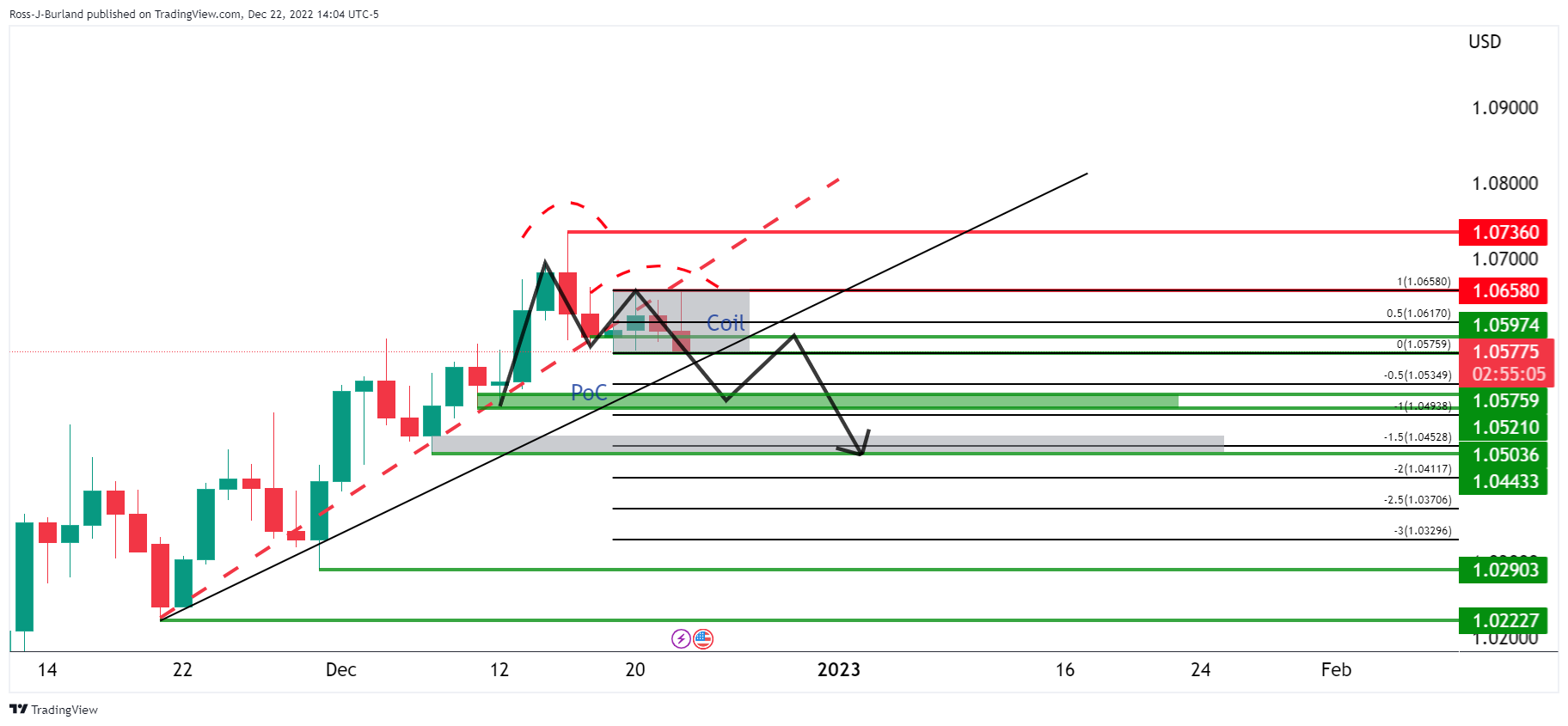
The breakout traders buying at the highs of the day are trapped following an inside day on Wednesday. The subsequent blow-off to the downside on Thursday is keeping longs trapped all the way to test the coil's lows. A break of 1.0575 opens the risk of a measured move near the Point of Control (Poc) of the bullish trend's swing lows of 1.0227 to cycle highs of 1.0736.

The  PoC comes in at 1.0520. A full 100% range expansion comes in at 1.0493.  If this scenario were to play out, an M-formation would be left on the chart and typically, the price would correct back towards the neckline for the restest of prior support prior to the next bearish impulse. In this case, 1.0450 will be eyed. 

On the flip side:
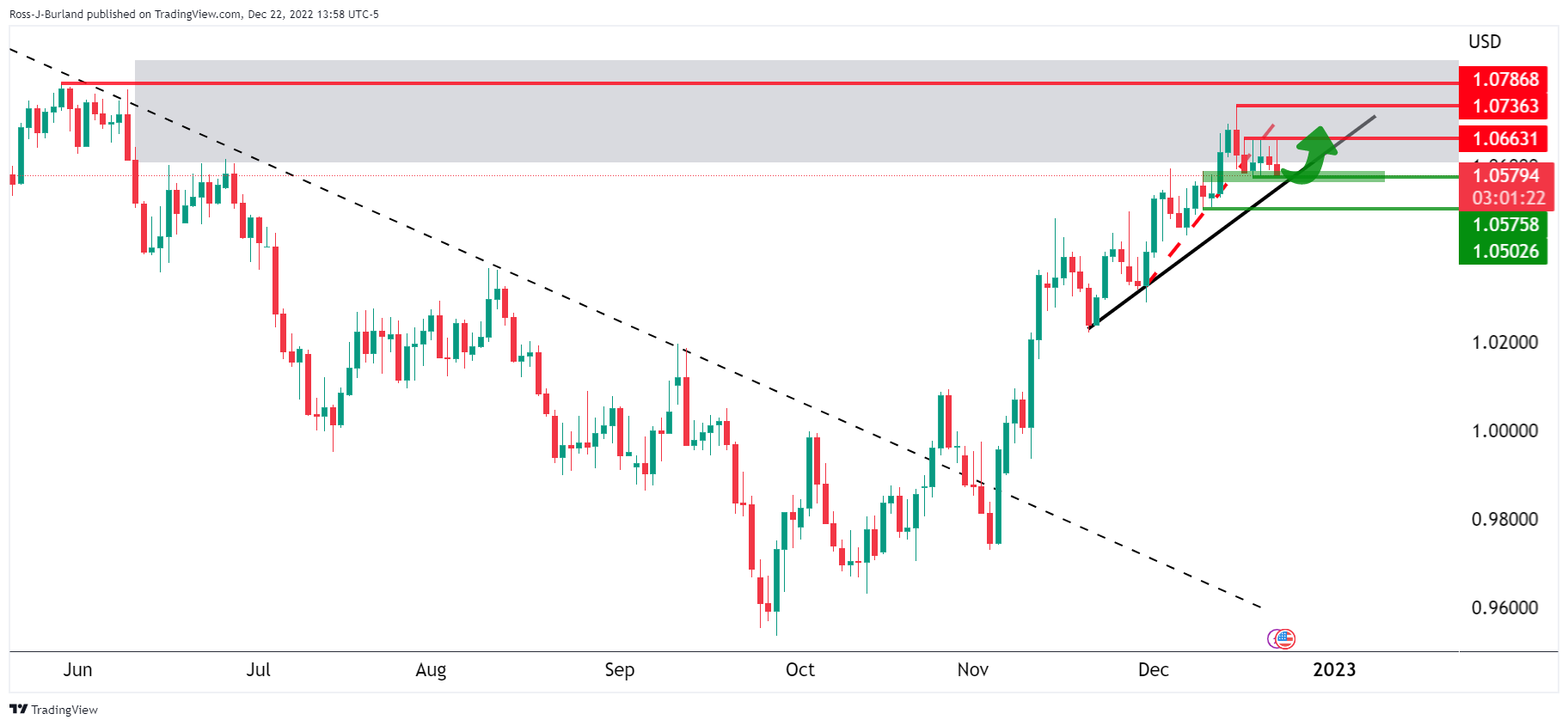
The price remains in a bullish trend and there is every possibility that we could see a higher for days ahead, i.e. consolidation within the bullish trendline and horizontal support of 1.0575 or thereabouts followed by a surge in demand to target fresh cycle highs.

Author

Ross J Burland

Ross J Burland, born in England, UK, is a sportsman at heart. He played Rugby and Judo for his county, Kent and the South East of England Rugby team.


More from Ross J Burland
Share:

Editor's Picks

AUD/USD picks up amid easing geopolitical tensions, bright data from China

The Australian Dollar posts moderate gains against the US Dollar on Tuesday, regaining some of the ground lost last week, although it remains at its lowest level in nearly two months. News that Israel and Iran halted hostilities has triggered a mild relief rally. At the same time, upbeat Chinese trade data has provided additional support for the Aussie, as China is Australia’s major trading partner.

Japanese Yen steadies near recent lows as ceasefire, Japan intervention threats offset

USD/JPY trades around 160.15 on Tuesday, remaining close to its highest level since April 30 despite a broadly neutral intraday performance. The pair retains an underlying bullish bias, supported by expectations that US monetary policy will remain restrictive, although upside potential is being capped by the risk of intervention from Japanese authorities.

Gold stays slightly bid near $4,340

Gold remains stuck in a narrow range on Tuesday, still trading below the $4,400 mark per troy ounce. The precious metal’s marginal advance comes on the back of easing geopolitical tensions and a deeper retracement in the US Dollar, although the likelihood of a cautious Fed down the road should keep the metal under scrutiny.

Crypto Today: Bitcoin, Ethereum, XRP edge lower despite Middle East tensions easing

Cryptocurrency prices trade amid persistent selling pressure on Tuesday. Bitcoin (BTC) hovers near $63,000, Ethereum (ETH) above $1,650, and Ripple (XRP) around $1.14.

Hotter US inflation numbers could further bolster Fed hike bets

Middle East tensions keep inflation risks elevated. Fed hike fully priced in by year end amid strong NFP report. US CPI data on Wednesday (12:30 GMT) to enter the spotlight. Further acceleration in inflation could drive the Dollar higher.

The US economy defies the rules: 100 days into the Oil shock and the recession signal is still missing

More than three months after the start of the Iran war and the resulting disruption to global energy markets, the US economy continues to display remarkable resilience. The conflict has triggered a sharp rise in Oil prices, reignited inflationary pressures and fueled widespread concerns about a potential economic slowdown.