EUR/USD juggles as Fed officials support higher for longer interest rates
- EUR/USD trades back and forth around 1.0850 with eyes on FOMC minutes and preliminary Eurozone and US PMIs.
- Doubts are rising over the possibility that the ECB will extend the rate-cut cycle beyond June.
- Fed officials say they need to see more soft inflation data to be sure that inflation will return to 2%.


EUR/USD is stuck in a tight range near 1.0850 in Tuesday’s American session. The major currency pair is expected to continue its sideways performance as the US Dollar (USD) stabilizes ahead of the publication later this week of the Federal Open Market Committee (FOMC) Minutes and the preliminary S&P Global Purchasing Managers Index (PMI) data for May.
The Euro trades relatively firm against the US Dollar (USD) as uncertainty over the European Central Bank (ECB) extending the rate-cut cycle beyond June has deepened. ECB policymakers are comfortable with the central bank starting to lower its three key interest rates from the June meeting, but are reluctant to commit to any further rate path and said they prefer to remain data-dependent.
Some ECB policymakers cautioned that a follow-up rate cut in the July meeting could revamp price pressures and offset the impact of the job done to tame sticky price pressures.
Daily digest market movers: EUR/USD remains firm ahead of Eurozone, US PMIs
- EUR/USD consolidates in a tight range near 1.0850 as investors look for fresh cues about the interest rate outlook on both sides of the Atlantic. In the United States region, Federal Reserve (Fed) officials continue to emphasize the need to maintain the restrictive policy framework as they are not convinced that price pressures will sustainably return to the desired rate of 2%.
- US inflation declined as expected in April. However, Fed policymakers want to see more good inflation data to gain confidence that price growth is on course to return to the 2% target. Therefore, Fed policymakers reiterate that the current monetary policy is in good shape and needs to remain at its current levels.
- On Monday, Fed Vice Chair for Supervision Michael Barr said "Q1 inflation was disappointing and did not provide the confidence needed to ease monetary policy". Barr vowed to allow more time for a tight policy stance to do its job, Reuters reported. Separately, Atlanta Fed Bank President Raphael Bostic said to Bloomberg TV that officials would take a while to be certain that inflation will come down to 2%.
- In Tuesday's New York session, Raphael Bostic appeared again and commented that he is not in a hurry for rate cuts and wants to be sure that inflation will not bounce again before considering rate cuts. When asked about timing for rate cuts, Bostic said he doesn't see them before the fourth quarter of this year.
- Meanwhile, investors shift focus to the FOMC minutes for the May policy meeting, which will be published on Wednesday. Officials' view on the interest rate outlook in the May meeting is expected to be hawkish as hotter-than-expected inflation in the January-March period indicated that the progress in the disinflation process stalled.
- On the economic data front, investors await the preliminary Eurozone and United States PMI data for May, which will be published on Thursday. The PMI data will gauge the economic outlook of the respective nations.
Technical Analysis: EUR/USD hovers near 1.0850
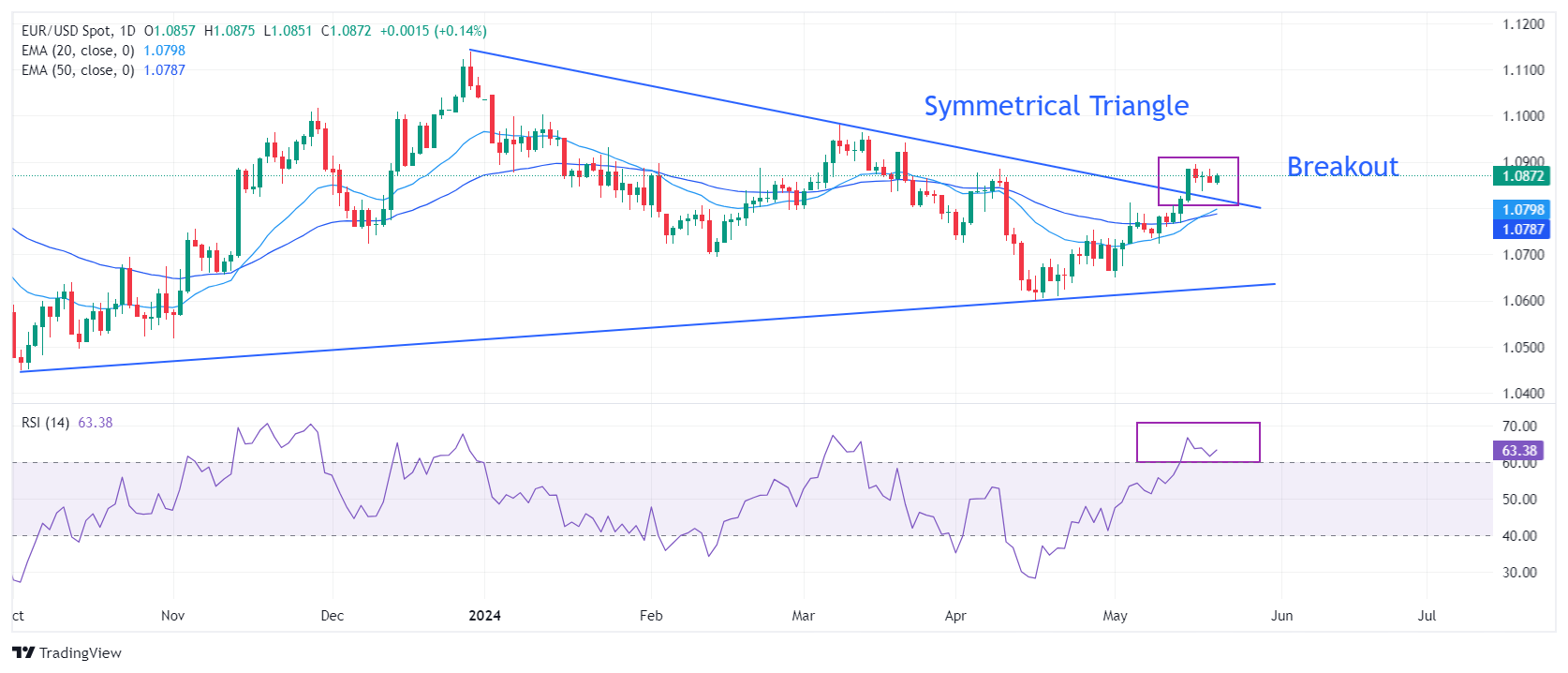
EUR/USD trades in a narrow range around 1.0850 as investors look for fresh triggers that could guide the next potential move. The shared currency pair is broadly firm as it is holding the Symmetrical Triangle breakout that formed on the daily time frame. Also, a bullish crossover involving the 20-day and 50-day Exponential Moving Averages (EMAs) around 1.0780 has improved the near-term outlook of the shared currency pair.
The 14-period Relative Strength Index (RSI) has shifted comfortably into the range of 60.00-80.00, suggesting that the momentum has turned bullish.
Fed FAQS
Monetary policy in the US is shaped by the Federal Reserve (Fed). The Fed has two mandates: to achieve price stability and foster full employment. Its primary tool to achieve these goals is by adjusting interest rates. When prices are rising too quickly and inflation is above the Fed’s 2% target, it raises interest rates, increasing borrowing costs throughout the economy. This results in a stronger US Dollar (USD) as it makes the US a more attractive place for international investors to park their money. When inflation falls below 2% or the Unemployment Rate is too high, the Fed may lower interest rates to encourage borrowing, which weighs on the Greenback.
The Federal Reserve (Fed) holds eight policy meetings a year, where the Federal Open Market Committee (FOMC) assesses economic conditions and makes monetary policy decisions. The FOMC is attended by twelve Fed officials – the seven members of the Board of Governors, the president of the Federal Reserve Bank of New York, and four of the remaining eleven regional Reserve Bank presidents, who serve one-year terms on a rotating basis.
In extreme situations, the Federal Reserve may resort to a policy named Quantitative Easing (QE). QE is the process by which the Fed substantially increases the flow of credit in a stuck financial system. It is a non-standard policy measure used during crises or when inflation is extremely low. It was the Fed’s weapon of choice during the Great Financial Crisis in 2008. It involves the Fed printing more Dollars and using them to buy high grade bonds from financial institutions. QE usually weakens the US Dollar.
Quantitative tightening (QT) is the reverse process of QE, whereby the Federal Reserve stops buying bonds from financial institutions and does not reinvest the principal from the bonds it holds maturing, to purchase new bonds. It is usually positive for the value of the US Dollar.
Author
Sagar Dua
FXStreet
Sagar Dua is associated with the financial markets from his college days. Along with pursuing post-graduation in Commerce in 2014, he started his markets training with chart analysis.