EUR/USD falls back below 1.05 as Fiber bulls blink on fresh tariff threats
- EUR/USD shed 0.5% on Monday as buyers flub the 1.0500 handle.
- Markets are recoiling from trade war headlines pouring out of the White House.
- Fed rate call and EU growth figures due later in the week.

EUR/USD backslid one-half of one percent on Monday, falling back below the 1.0500 handle and paring recent gains as broad-market risk sentiment takes a step lower. Trade war headlines are back on the offering following a weekend spat between US President Donald Trump and Colombia over migrant deportations, and newly-minted Treasury Secretary Scott Bessent has immediately pivoted into favoring global tariffs across the board, mere minutes after getting confirmed by the US Senate.
The Fed is expected to maintain interest rates for January. However, if Chair Jerome Powell sounds unsure during his mid-week press conference, market hopes for increased Fed rate cuts in 2025 could diminish. Markets have raised expectations for rate cuts this year, with a total of 50 bps anticipated.
Political headlines are affecting markets again as US President Donald Trump engaged in a social media feud with Colombia over the travel conditions of migrants being extradited, threatening 50% tariffs on US-bound Colombian exports. Although the threat proved to be bluster, markets are wary of the rapidity of Trump-imposed tariffs.
Late Monday, President Trump reinvigorated trade war fears by announcing plans to impose trade tariffs on key trade industries that the US economy overwhelmingly relies on, including steel, computer chips, aluminum, copper, and other semiconductors. Trump’s insistence that the only way to avoid trade tariffs will be to build production facilities within the US faces a steep uphill climb as the American economy is exorbitantly expensive to operate in, far over and above any purported costs that could be levied onto the US consumers in order to retaliate against countries that export to the US.
EUR/USD price forecast
EUR/USD’s Monday backslide has dragged Fiber back below 1.0500, halting the pair’s brief bullish reprieve after hitting a 26-month low in mid-January. The 50-day Exponential Moving Average (EMA) near 1.0450 is dragging bids back into the low side as EUR/USD gears up for a bearish turnaround.
EUR/USD daily chart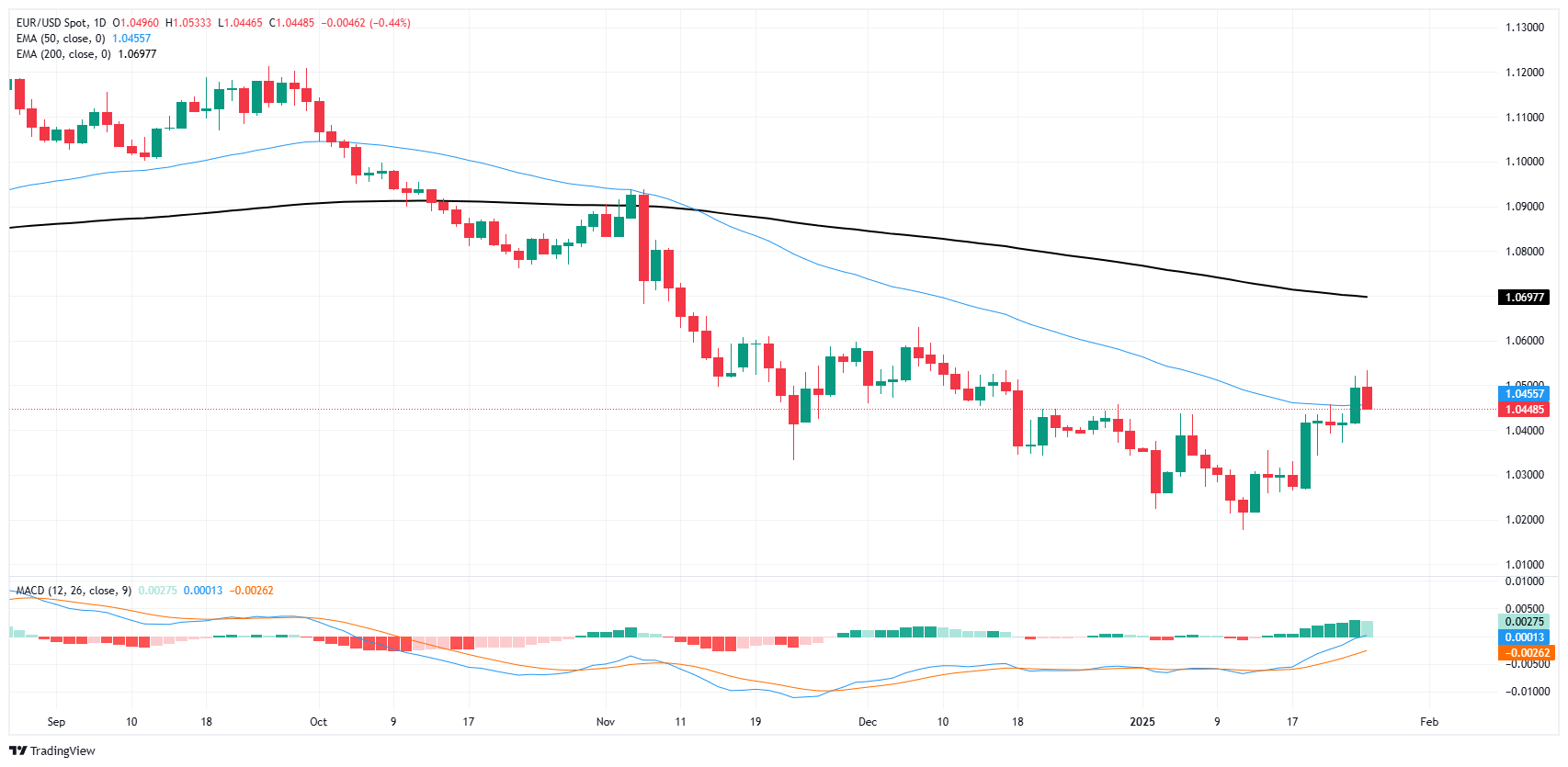
Euro FAQs
The Euro is the currency for the 19 European Union countries that belong to the Eurozone. It is the second most heavily traded currency in the world behind the US Dollar. In 2022, it accounted for 31% of all foreign exchange transactions, with an average daily turnover of over $2.2 trillion a day. EUR/USD is the most heavily traded currency pair in the world, accounting for an estimated 30% off all transactions, followed by EUR/JPY (4%), EUR/GBP (3%) and EUR/AUD (2%).
The European Central Bank (ECB) in Frankfurt, Germany, is the reserve bank for the Eurozone. The ECB sets interest rates and manages monetary policy. The ECB’s primary mandate is to maintain price stability, which means either controlling inflation or stimulating growth. Its primary tool is the raising or lowering of interest rates. Relatively high interest rates – or the expectation of higher rates – will usually benefit the Euro and vice versa. The ECB Governing Council makes monetary policy decisions at meetings held eight times a year. Decisions are made by heads of the Eurozone national banks and six permanent members, including the President of the ECB, Christine Lagarde.
Eurozone inflation data, measured by the Harmonized Index of Consumer Prices (HICP), is an important econometric for the Euro. If inflation rises more than expected, especially if above the ECB’s 2% target, it obliges the ECB to raise interest rates to bring it back under control. Relatively high interest rates compared to its counterparts will usually benefit the Euro, as it makes the region more attractive as a place for global investors to park their money.
Data releases gauge the health of the economy and can impact on the Euro. Indicators such as GDP, Manufacturing and Services PMIs, employment, and consumer sentiment surveys can all influence the direction of the single currency. A strong economy is good for the Euro. Not only does it attract more foreign investment but it may encourage the ECB to put up interest rates, which will directly strengthen the Euro. Otherwise, if economic data is weak, the Euro is likely to fall. Economic data for the four largest economies in the euro area (Germany, France, Italy and Spain) are especially significant, as they account for 75% of the Eurozone’s economy.
Another significant data release for the Euro is the Trade Balance. This indicator measures the difference between what a country earns from its exports and what it spends on imports over a given period. If a country produces highly sought after exports then its currency will gain in value purely from the extra demand created from foreign buyers seeking to purchase these goods. Therefore, a positive net Trade Balance strengthens a currency and vice versa for a negative balance.
Author

Joshua Gibson
FXStreet
Joshua joins the FXStreet team as an Economics and Finance double major from Vancouver Island University with twelve years' experience as an independent trader focusing on technical analysis.