EUR/USD corrects from 1.1200 as Fed, ECB September rate cut bets swell
- EUR/USD struggles to extend its upside above 1.1200 as the ECB is expected to cut interest rates again in September.
- Fed’s Chairman Jerome Powell gives green signal to an interest-rate cut in September.
- Investors await the US core PCE inflation data for July and flash Eurozone HICP for August.

EUR/USD dips from a fresh YTD high of 1.1200 in North American trading hours on Monday. The major currency pair drops as the Euro (EUR) underperforms its major peers amid growing speculation that the European Central Bank (ECB) will reduce interest rates again in the September meeting. The ECB is also expected to deliver one more interest rate cut in the last quarter of this year.
Market expectations for ECB interest rate cuts in September have increased due to rising uncertainty over the Eurozone economic outlook and easing wage growth. Economic activity in the Eurozone surprisingly rose in August, as shown by the flash HCOB PMI report, but this rebound was largely driven by strong demand in France due to the Olympics in Paris. Economists considered it a one-time event and not a structural change.
On the contrary, ECB Chief Economist Philip Lane said at the JH Symposium on Saturday that the monetary policy needs to be restrictive. Lane acknowledged that the ECB has made some progress in inflation but also said that the success over inflation is not assured, Reuters reported.
For more cues on the interest rate guidance, investors will focus on the preliminary German and Eurozone Harmonized Index of Consumer Prices (HICP) data for August, which will be published on Thursday and Friday, respectively. Eurozone annual headline and core HICP, which excludes volatile items, are estimated to have decelerated to 2.3% and 2.8% respectively.
Meanwhile, the IFO Institute reported on Monday that the German Business Climate, Current Assessment, and Expectations of August beat expectations but remained lower than July’s readings. The reading failed to provide any significant impetus to the EUR/USD pair.
Daily digest market movers: EUR/USD falls on Euro's underperformance
- EUR/USD corrects from 1.1200, the highest level seen in more than a year, in Monday’s New York session. Still, the broader outlook for the major currency pair is positive as the US Dollar (USD) remains on the backfoot as a Fed rate cut in September is fully priced in.
- The US Dollar Index (DXY), which tracks the Greenback’s value against six major currencies, finds some little buying interest after posting a fresh year-to-date (YTD) low of 100.53.
- Market expectations for Fed interest rate cuts in September appear to be certain, as Fed Chair Jerome Powell said in his speech at the Jackson Hole (JH) Symposium on Friday, “The time has come for policy to adjust.” Powell’s speech suggested that the central bank is more concerned about growing risks in the labor market, while it is gaining confidence that inflation is sustainably on track to the desired rate of 2%. "We will do everything we can to support a strong labor market, Powell added"
- Even though the Fed is widely anticipated to deliver an interest rate cut in September, traders remain split over its size. According to the CME FedWatch tool, 30-day Federal Funds futures pricing data shows that the likelihood of a 50-basis point (bps) interest-rate reduction is at 36.5%, while the remaining 63.5% points to a smaller 25 bps cut.
- On the economic front, the United States (US) Census Bureau has reported strong Durable Goods Orders data for July. New orders for Durable Goods rose at a robust pace of 9.9% from the estimates of 4%, after contracting in June.
- This week, the major trigger for the US Dollar will likely be the US core Personal Consumption Expenditure Price Index (PCE) data for July, which will be published on Friday. The Fed’s preferred inflation measure is estimated to have grown at a steady pace of 0.2% month-over-month.
Technical Analysis: EUR/USD faces pressure near 1.1200
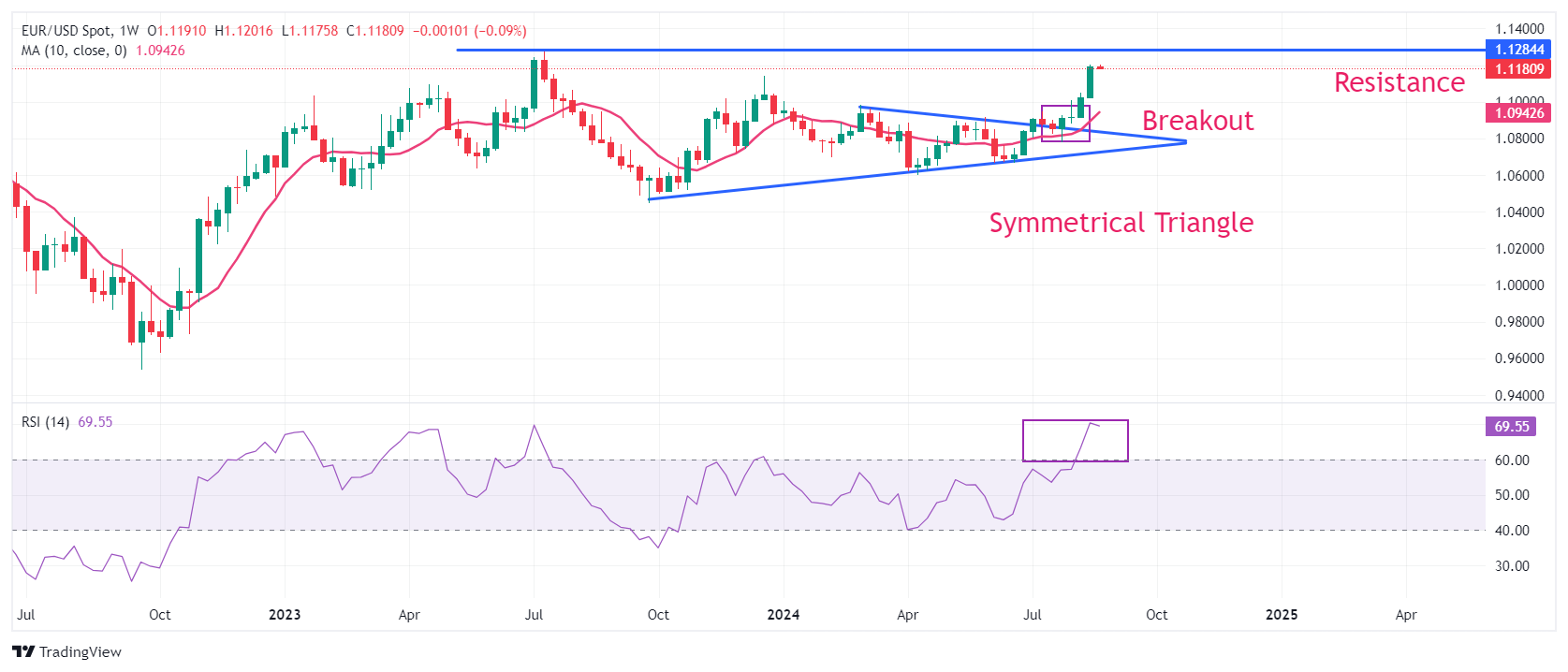
EUR/USD posted a fresh swing high at 1.1200 on the weekly timeframe, suggesting a bullish reversal. The major currency pair strengthened after a breakout of the Symmetrical Triangle chart pattern. The upward-sloping 10-week Exponential Moving Average (EMA) near 1.0940 warrants more upside ahead.
The 14-period Relative Strength Index (RSI) oscillates in the bullish range of 60.00-80.00, suggesting a strong upside momentum. Still, it has reached overbought levels at around 70.00, increasing the chances of a corrective pullback. On the upside, the July 2023 high at 1.1275 will be the next target for the Euro bulls.
Economic Indicator
Core Harmonized Index of Consumer Prices (YoY)
The Core Harmonized Index of Consumer Prices (HICP) measures changes in the prices of a representative basket of goods and services in the European Monetary Union. The HICP, – released by Eurostat on a monthly basis, is harmonized because the same methodology is used across all member states and their contribution is weighted. The YoY reading compares prices in the reference month to a year earlier. Core HICP excludes volatile components like food, energy, alcohol, and tobacco. The Core HICP is a key indicator to measure inflation and changes in purchasing trends. Generally, a high reading is seen as bullish for the Euro (EUR), while a low reading is seen as bearish.
Read more.Next release: Fri Aug 30, 2024 09:00 (Prel)
Frequency: Monthly
Consensus: 2.8%
Previous: 2.9%
Source: Eurostat
Author

Sagar Dua
FXStreet
Sagar Dua is associated with the financial markets from his college days. Along with pursuing post-graduation in Commerce in 2014, he started his markets training with chart analysis.

















