EUR/USD crosses over 1.09 on Wednesday as Euro bulls gear up for ECB rate call
- EUR/USD extended into bullish territory on Wednesday.
- ECB rate call looms ahead, rate hold expected for now.
- Markets have fully priced in a September rate cut from the Fed.

EUR/USD rallied into fresh 18-week highs on Wednesday as market sentiment tilts firmly into the risk-on side ahead of the European Central Bank’s (ECB) latest rate call slated for Thursday. Broad-market risk appetite remains pinned into the ceiling as markets fully price in a rate cut from the Federal Reserve (Fed) on September 18.
Forex Today: The ECB and Lagarde steal the show
Fiber traders will be keeping eyes pinned to the ECB’s latest rate call slated for Thursday. The ECB is broadly expected to keep rates on hold for the time being as policymakers waver after an early quarter-point rate cut in June. With the ECB forecast to keep rates steady, traders will be looking for any shifts in policy speech talking points from ECB President Christine Lagarde later in the European market session.
Read more:
Fed's Barkin: Will debate at July meeting whether still appropriate to describe inflation as elevated
Fed's Waller: Most likely direction for monetary policy is rate cuts
Rate markets have fully priced in at least a quarter-point rate trim when the Federal Open Market Committee (FOMC) gathers for a rate call on September 18, and July’s month-end meeting is still expected to keep rates flat. According to the CME’s FedWatch Tool, 98% odds of a September rate cut are fully priced in, with rate traders seeing three cuts in 2024 compared to the Fed’s own modest projections of one or two.
Despite a broad-market dog-pile into Fed rate cut bets, Fedspeak from key policymakers maintains a dark tint to otherwise sunny skies. Both Fed Governor Christopher Waller and Richmond Fed President Thomas Barkin noted that labor markets remain particularly robust despite easing inflation pressures.
Euro PRICE This week
The table below shows the percentage change of Euro (EUR) against listed major currencies this week. Euro was the strongest against the Australian Dollar.
| USD | EUR | GBP | JPY | CAD | AUD | NZD | CHF | |
|---|---|---|---|---|---|---|---|---|
| USD | -0.29% | -0.15% | -1.56% | 0.26% | 0.80% | 0.46% | -1.35% | |
| EUR | 0.29% | 0.18% | -1.07% | 0.75% | 1.13% | 0.95% | -0.87% | |
| GBP | 0.15% | -0.18% | -1.17% | 0.57% | 0.95% | 0.72% | -1.04% | |
| JPY | 1.56% | 1.07% | 1.17% | 1.84% | 2.17% | 2.01% | 0.03% | |
| CAD | -0.26% | -0.75% | -0.57% | -1.84% | 0.47% | 0.20% | -1.60% | |
| AUD | -0.80% | -1.13% | -0.95% | -2.17% | -0.47% | -0.18% | -1.97% | |
| NZD | -0.46% | -0.95% | -0.72% | -2.01% | -0.20% | 0.18% | -1.79% | |
| CHF | 1.35% | 0.87% | 1.04% | -0.03% | 1.60% | 1.97% | 1.79% |
The heat map shows percentage changes of major currencies against each other. The base currency is picked from the left column, while the quote currency is picked from the top row. For example, if you pick the Euro from the left column and move along the horizontal line to the US Dollar, the percentage change displayed in the box will represent EUR (base)/USD (quote).
EUR/USD technical outlook
Fiber tilted into the top end on Wednesday, looking upwards through the midweek trading session and EUR/USD is on pace to chalk in a fourth straight week in the green, assuming buyers are able to maintain topside pressure.
EUR/USD follows a near-term rising trendline from late June’s bottom bids near 1.0670, clipping into an 18-week peak just shy of 1.0950. An extension of the Fiber’s topside recovery has sent bids through the top end of a rough descending channel, and bidders are running out of footholds as short pressure gathers to drag the pair back down to the 200-day Exponential Moving Average (EMA) at 1.0800.
EUR/USD hourly chart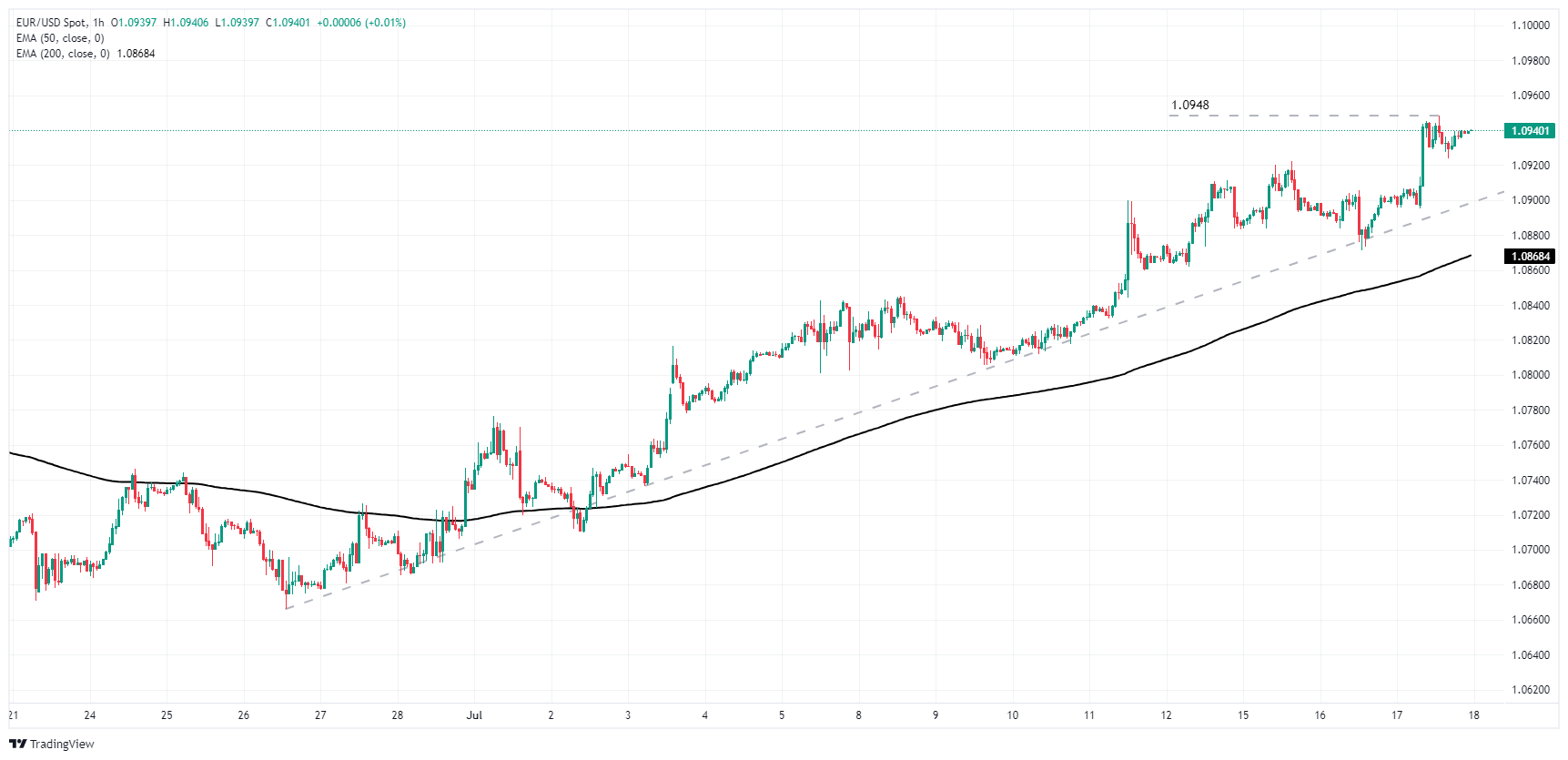
EUR/USD daily chart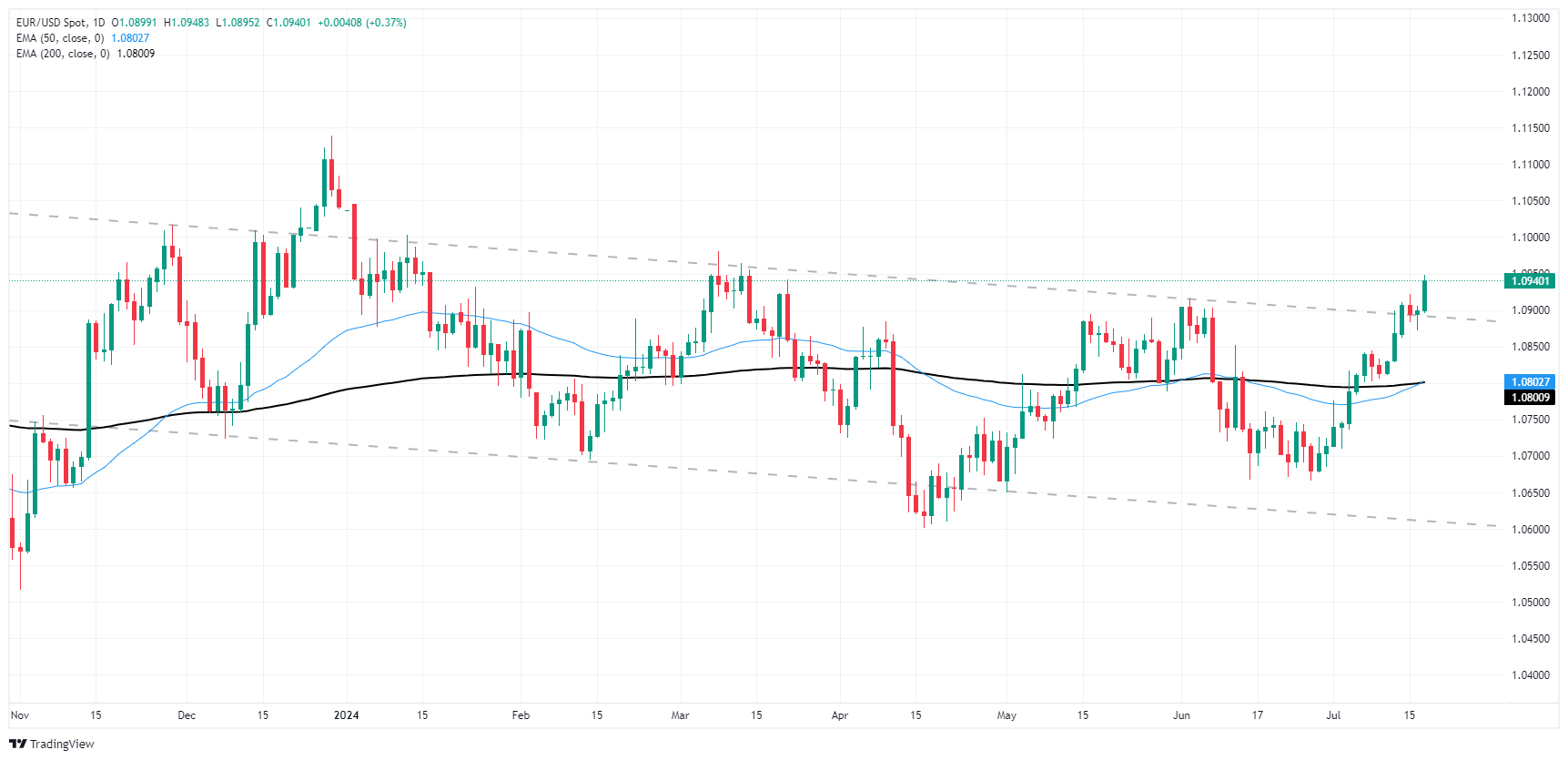
Euro FAQs
The Euro is the currency for the 20 European Union countries that belong to the Eurozone. It is the second most heavily traded currency in the world behind the US Dollar. In 2022, it accounted for 31% of all foreign exchange transactions, with an average daily turnover of over $2.2 trillion a day. EUR/USD is the most heavily traded currency pair in the world, accounting for an estimated 30% off all transactions, followed by EUR/JPY (4%), EUR/GBP (3%) and EUR/AUD (2%).
The European Central Bank (ECB) in Frankfurt, Germany, is the reserve bank for the Eurozone. The ECB sets interest rates and manages monetary policy. The ECB’s primary mandate is to maintain price stability, which means either controlling inflation or stimulating growth. Its primary tool is the raising or lowering of interest rates. Relatively high interest rates – or the expectation of higher rates – will usually benefit the Euro and vice versa. The ECB Governing Council makes monetary policy decisions at meetings held eight times a year. Decisions are made by heads of the Eurozone national banks and six permanent members, including the President of the ECB, Christine Lagarde.
Eurozone inflation data, measured by the Harmonized Index of Consumer Prices (HICP), is an important econometric for the Euro. If inflation rises more than expected, especially if above the ECB’s 2% target, it obliges the ECB to raise interest rates to bring it back under control. Relatively high interest rates compared to its counterparts will usually benefit the Euro, as it makes the region more attractive as a place for global investors to park their money.
Data releases gauge the health of the economy and can impact on the Euro. Indicators such as GDP, Manufacturing and Services PMIs, employment, and consumer sentiment surveys can all influence the direction of the single currency. A strong economy is good for the Euro. Not only does it attract more foreign investment but it may encourage the ECB to put up interest rates, which will directly strengthen the Euro. Otherwise, if economic data is weak, the Euro is likely to fall. Economic data for the four largest economies in the euro area (Germany, France, Italy and Spain) are especially significant, as they account for 75% of the Eurozone’s economy.
Another significant data release for the Euro is the Trade Balance. This indicator measures the difference between what a country earns from its exports and what it spends on imports over a given period. If a country produces highly sought after exports then its currency will gain in value purely from the extra demand created from foreign buyers seeking to purchase these goods. Therefore, a positive net Trade Balance strengthens a currency and vice versa for a negative balance.
Author

Joshua Gibson
FXStreet
Joshua joins the FXStreet team as an Economics and Finance double major from Vancouver Island University with twelve years' experience as an independent trader focusing on technical analysis.