EUR/USD grinds between Fed's hawkish remarks and ECB's pause to rate cuts
- EUR/USD attempts to gain ground near 1.0700 as ECB Lane rules out hopes of subsequent rate cuts.
- Investors worry the French economy will face a financial crisis if the far right forms a new government.
- The US Dollar will dance to the tunes of the US Retail Sales data.

EUR/USD aims to gain ground near the crucial support of 1.0700 in Monday’s New York session. The major currency pair finds cushion as European Central Bank (ECB) Chief Economist Philip Lane emphasizes maintaining interest rates at their current levels in coming months. Lane added that he wants to see disinflation in the service sector for more than a month as needed for easing policy further.
ECB policymakers have been reluctant to provide an interest rate-cut trajectory as they remain concerned over the stubborn wage growth outlook, which could revamp price pressures again. On Sunday, ECB Governing Council member and Governor of the Bank of Latvia Martins Kazaks said that the bank must not allow inflation to remain above 2% into 2026. Kazaks added, “Currently, I think we are still on the path to 2% in the second half of 2025, and I really hope that we will do it by that time.”
Earlier, the shared currency pair remained under pressure as potential risks of the financial crisis in France amid firm speculation that Marine Le Pen's far-right National Rally (RN) will form a new government, which will have an adverse impact on the nation’s fiscal situation, that has dampened Euro’s appeal.
French Finance Minister Bruno Le Maire said on Friday that the euro zone's second-biggest economy was at risk of a financial crisis if either the far right or left won because of their heavy spending plans, Reuters reported.On the monetary policy front,
Daily digest market movers: EUR/USD finds cushion while the near-term outlook remains uncertain
- EUR/USD finds temporary support around 1.0700 after rebounding from 1.0660 as the US Dollar (USD) struggles to extend upside above a six-week high of 105.80. The US Dollar Index (DXY), which tracks the Greenback’s value against six major currencies, corrects modestly to near 105.50.
- The USD Index grinds between market speculation for two rate cuts by the Federal Reserve (Fed) this year due to resumed progress in the disinflation process and the Fed’s projection for only one rate cut amid fears of reacceleration in price pressures.
- According to the CME FedWatch tool, 30-day Federal Fund Futures pricing data has firm expectations to begin reducing interest rates from the September meeting and following suit again in the November or December meeting.
- After the Fed’s blackout period, policymakers advocate for only one rate cut this year, as they updated in the latest interest rate projections. On Friday, Chicago Fed Bank President Austan Goolsbee said that he was relieved after consumer and producer inflation data for May showed that price pressures were softer than expected. However, he wants to see similar data for months before lowering interest rates.
- Going forward, investors will pay close attention to the United States (US) monthly Retail Sales data for May, which will be published on Tuesday. The Retail Sales data, a close measure of consumer spending, is estimated to have increased by 0.3% after remaining flat in April.
Technical Analysis: EUR/USD establishes below 200-day EMA
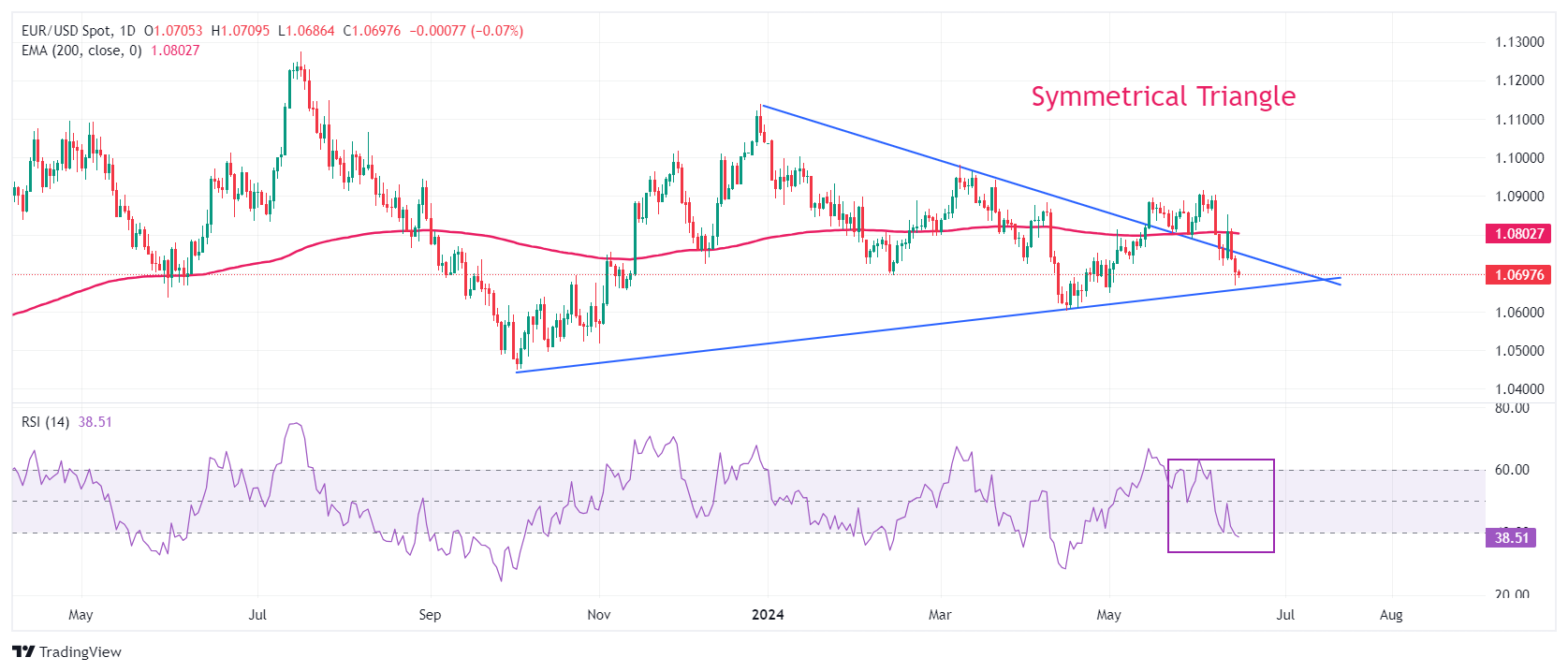
EUR/USD hovers around 1.0700 after returning into the Symmetrical Triangle formation on a daily timeframe. The major currency pair is expected to find support at 1.0636, near the upward-sloping trendline of the chart pattern plotted from the low from October 3, 2023, at 1.0448, and the horizontal cushion plotted from the April 16 low around 1.0600.
On the upside, the downward-sloping border from the high of December 28, 2023, at 1.1140 will be a major barrier for the Euro bulls near 1.0750.
The long-term outlook of the shared currency pair has also turned negative as prices dropped below the 200-day Exponential Moving Average (EMA), which trades around 1.0800.
The 14-period Relative Strength Index (RSI) falls below 40.00. Momentum could turn bearish if the RSI sustains below this level.
Economic Indicator
Retail Sales (MoM)
The Retail Sales data, released by the US Census Bureau on a monthly basis, measures the value in total receipts of retail and food stores in the United States. Monthly percent changes reflect the rate of changes in such sales. A stratified random sampling method is used to select approximately 4,800 retail and food services firms whose sales are then weighted and benchmarked to represent the complete universe of over three million retail and food services firms across the country. The data is adjusted for seasonal variations as well as holiday and trading-day differences, but not for price changes. Retail Sales data is widely followed as an indicator of consumer spending, which is a major driver of the US economy. Generally, a high reading is seen as bullish for the US Dollar (USD), while a low reading is seen as bearish.
Read more.Next release: Tue Jun 18, 2024 12:30
Frequency: Monthly
Consensus: 0.2%
Previous: 0%
Source: US Census Bureau
Retail Sales data published by the US Census Bureau is a leading indicator that gives important information about consumer spending, which has a significant impact on the GDP. Although strong sales figures are likely to boost the USD, external factors, such as weather conditions, could distort the data and paint a misleading picture. In addition to the headline data, changes in the Retail Sales Control Group could trigger a market reaction as it is used to prepare the estimates of Personal Consumption Expenditures for most goods.
Author

Sagar Dua
FXStreet
Sagar Dua is associated with the financial markets from his college days. Along with pursuing post-graduation in Commerce in 2014, he started his markets training with chart analysis.

















