EUR/USD consolidates around 1.03 as bond market gets stressed over inflation
- EUR/USD consolidates around 1.0300 on Thursday ahead of a calm trading day regarding economic data.
- The bond market looks to be on fire, with UK Gilt yields surging as inflation concerns weight.
- Markets are getting increasingly nervous over the vast amount of fiscal spending, reforms, and tariff imposing that President-elect Donald Trump is announcing.

The EUR/USD pair is on the back foot again and consolidates around 1.0300 on Thursday. The recent dip lower comes as markets start to get worried about the vast amount of measures, reforms, spending, and tariff levies that President-elect Donald Trump announced before his inauguration on January 20. As a result, US yields are rising further this week.
Meanwhile, UK Gilt yields are experiencing a mini-crisis. Over the past few days, long-term UK borrowing costs have soared, and the British Pound (GBP) has fallen. This could be a sign that investors have lost faith in the government’s ability to manage the national debt and control inflation.
Daily digest market movers: Inflation uncertainty
- US stock markets will remain closed on Thursday, observing a National Day of Mourning in honor of former President Jimmy Carter. The bond market will operate on a shortened schedule, closing early.
- Economic data earlier this Thursday showed that German Imports fell by 3.3% in November, while Exports rose by 2.1%.
- Excessive concern about possible inflation shocks can be harmful to the economy, European Central Bank (ECB) Executive Board member Piero Cipollone told Corriere della Sera in an interview, Bloomberg reports.
- The ECB should keep lowering borrowing costs at every meeting as long as the retreat in inflation matches its projections, according to Governing Council member François Villeroy de Galhau on Wednesday, Reuters reported.
- German Bunds ticked up further to hit another fresh six-month high of 2.571%, which is no longer far off from the 2.642% high seen in July 2024.
- European equities are trading in the red, taking over the downbeat tone seen in Asia.
Technical Analysis: Concerns are growing
Concerns are emerging, and clearly, inflation is becoming a top priority for traders regarding positioning. That means the US Dollar (USD) should become even more supported, as US yields will keep surging, widening the rate differential gap between the Eurozone and the US.
A recovery for EUR/USD would involve a first-stage move to 1.0448, the low of October 3, 2023. Once through that level, the 55-day Simple Moving Average (SMA) at 1.0539 would come into play. Another catalyst will be needed for this kind of move, as it could squeeze the Dollar bulls.
On the downside, the two-year low of 1.0224 reached on January 2 is now the first level to watch after the 1.0294 level lost its importance this week. Further down, the round level at 1.02 would mean a fresh two-year low. Breaking below that level would open up the room to head to parity, with 1.0100 as the last man standing before that magical 1.00 level.
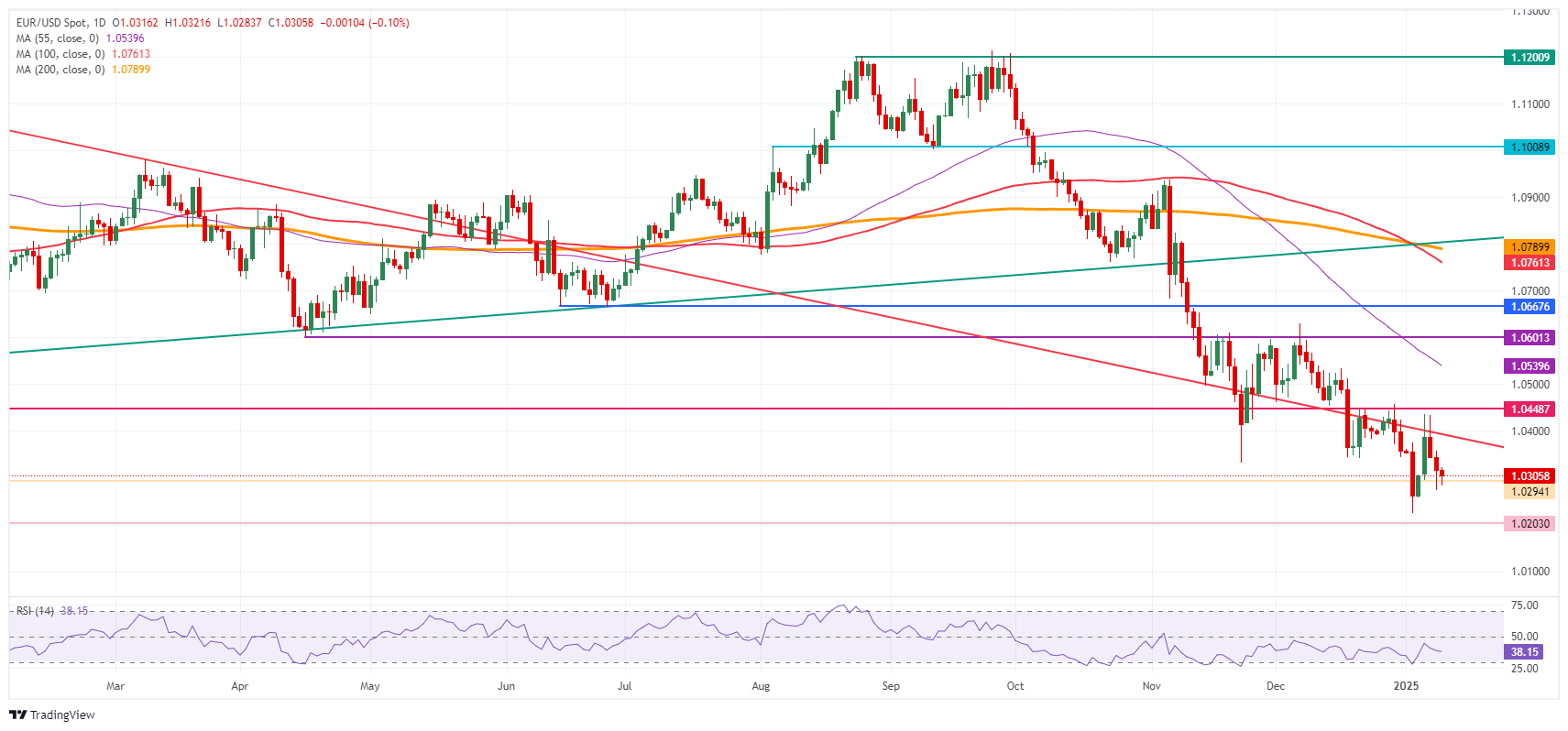
EUR/USD: Daily Chart
Euro FAQs
The Euro is the currency for the 19 European Union countries that belong to the Eurozone. It is the second most heavily traded currency in the world behind the US Dollar. In 2022, it accounted for 31% of all foreign exchange transactions, with an average daily turnover of over $2.2 trillion a day. EUR/USD is the most heavily traded currency pair in the world, accounting for an estimated 30% off all transactions, followed by EUR/JPY (4%), EUR/GBP (3%) and EUR/AUD (2%).
The European Central Bank (ECB) in Frankfurt, Germany, is the reserve bank for the Eurozone. The ECB sets interest rates and manages monetary policy. The ECB’s primary mandate is to maintain price stability, which means either controlling inflation or stimulating growth. Its primary tool is the raising or lowering of interest rates. Relatively high interest rates – or the expectation of higher rates – will usually benefit the Euro and vice versa. The ECB Governing Council makes monetary policy decisions at meetings held eight times a year. Decisions are made by heads of the Eurozone national banks and six permanent members, including the President of the ECB, Christine Lagarde.
Eurozone inflation data, measured by the Harmonized Index of Consumer Prices (HICP), is an important econometric for the Euro. If inflation rises more than expected, especially if above the ECB’s 2% target, it obliges the ECB to raise interest rates to bring it back under control. Relatively high interest rates compared to its counterparts will usually benefit the Euro, as it makes the region more attractive as a place for global investors to park their money.
Data releases gauge the health of the economy and can impact on the Euro. Indicators such as GDP, Manufacturing and Services PMIs, employment, and consumer sentiment surveys can all influence the direction of the single currency. A strong economy is good for the Euro. Not only does it attract more foreign investment but it may encourage the ECB to put up interest rates, which will directly strengthen the Euro. Otherwise, if economic data is weak, the Euro is likely to fall. Economic data for the four largest economies in the euro area (Germany, France, Italy and Spain) are especially significant, as they account for 75% of the Eurozone’s economy.
Another significant data release for the Euro is the Trade Balance. This indicator measures the difference between what a country earns from its exports and what it spends on imports over a given period. If a country produces highly sought after exports then its currency will gain in value purely from the extra demand created from foreign buyers seeking to purchase these goods. Therefore, a positive net Trade Balance strengthens a currency and vice versa for a negative balance.
Author

Filip Lagaart
FXStreet
Filip Lagaart is a former sales/trader with over 15 years of financial markets expertise under its belt.