EUR/USD backslides in runup to key midweek data prints
- EUR/USD grinds down back to 1.0850 as investors huddle ahead of key data prints.
- EU and US PMI figures are due on Wednesday.
- US GDP update and PCE inflation figures due on Thursday and Friday, respectively.

EUR/USD dipped one-third of one percent on Tuesday as investors knuckle down for the wait to a double-header of Purchasing Managers Index (PMI) figures due from both the EU and the US on Wednesday.
Forex Today: Global PMIs take centre stage
Pan-EU PMI figures will kick things off during the early European market session on Wednesday, and markets anticipate a slight uptick in EU Services PMI figures to 53.0 in July after June’s 52.8.
In the US, the Services PMI for July is anticipated to ease slightly to 54.4 from June's 55.3. Global markets are widely anticipating a rate cut from the Federal Reserve (Fed) in September, and investors are closely monitoring US economic indicators for further signs of softening to affirm the rate outlook. Rate traders are currently pricing in nearly 100% odds of at least a quarter-point rate cut from the Federal Open Market Committee (FOMC) during the September 18 rate call.
As the week progresses, the quarterly US Gross Domestic Product figures are scheduled for Thursday, and the US Personal Consumption Expenditure Price Index (PCE) inflation is on the agenda for Friday. It is forecasted that the annualized Q2 US GDP will rise to 1.9% from 1.4%, and Core PCE inflation on Friday is expected to further decrease to 2.5% year-over-year for the year ended in June, compared to the previous month's 2.6%.
Euro PRICE This week
The table below shows the percentage change of Euro (EUR) against listed major currencies this week. Euro was the strongest against the Australian Dollar.
| USD | EUR | GBP | JPY | CAD | AUD | NZD | CHF | |
|---|---|---|---|---|---|---|---|---|
| USD | 0.29% | 0.08% | -1.00% | 0.49% | 1.07% | 1.02% | 0.42% | |
| EUR | -0.29% | -0.21% | -1.30% | 0.16% | 0.83% | 0.68% | 0.06% | |
| GBP | -0.08% | 0.21% | -1.21% | 0.36% | 1.04% | 0.88% | 0.26% | |
| JPY | 1.00% | 1.30% | 1.21% | 1.52% | 2.15% | 1.99% | 1.35% | |
| CAD | -0.49% | -0.16% | -0.36% | -1.52% | 0.68% | 0.53% | -0.09% | |
| AUD | -1.07% | -0.83% | -1.04% | -2.15% | -0.68% | -0.15% | -0.77% | |
| NZD | -1.02% | -0.68% | -0.88% | -1.99% | -0.53% | 0.15% | -0.58% | |
| CHF | -0.42% | -0.06% | -0.26% | -1.35% | 0.09% | 0.77% | 0.58% |
The heat map shows percentage changes of major currencies against each other. The base currency is picked from the left column, while the quote currency is picked from the top row. For example, if you pick the Euro from the left column and move along the horizontal line to the US Dollar, the percentage change displayed in the box will represent EUR (base)/USD (quote).
EUR/USD technical outlook
The Euro’s early decline on Tuesday has sent EUR/USD into fresh lows near 1.0850, and the pair is scrambling to find a foothold ahead of Wednesday’s meaningful trading window. The Fiber has declined nearly a full percent since getting turned around from a near-term high of 1.0948.
Fiber remains on the north side of the 200-day Exponential Moving Average (EMA) at 1.0804, but this week’s downturn leaves the pair exposed to further downside as bids dip back into the wrong side of a rough descending channel.
EUR/USD hourly chart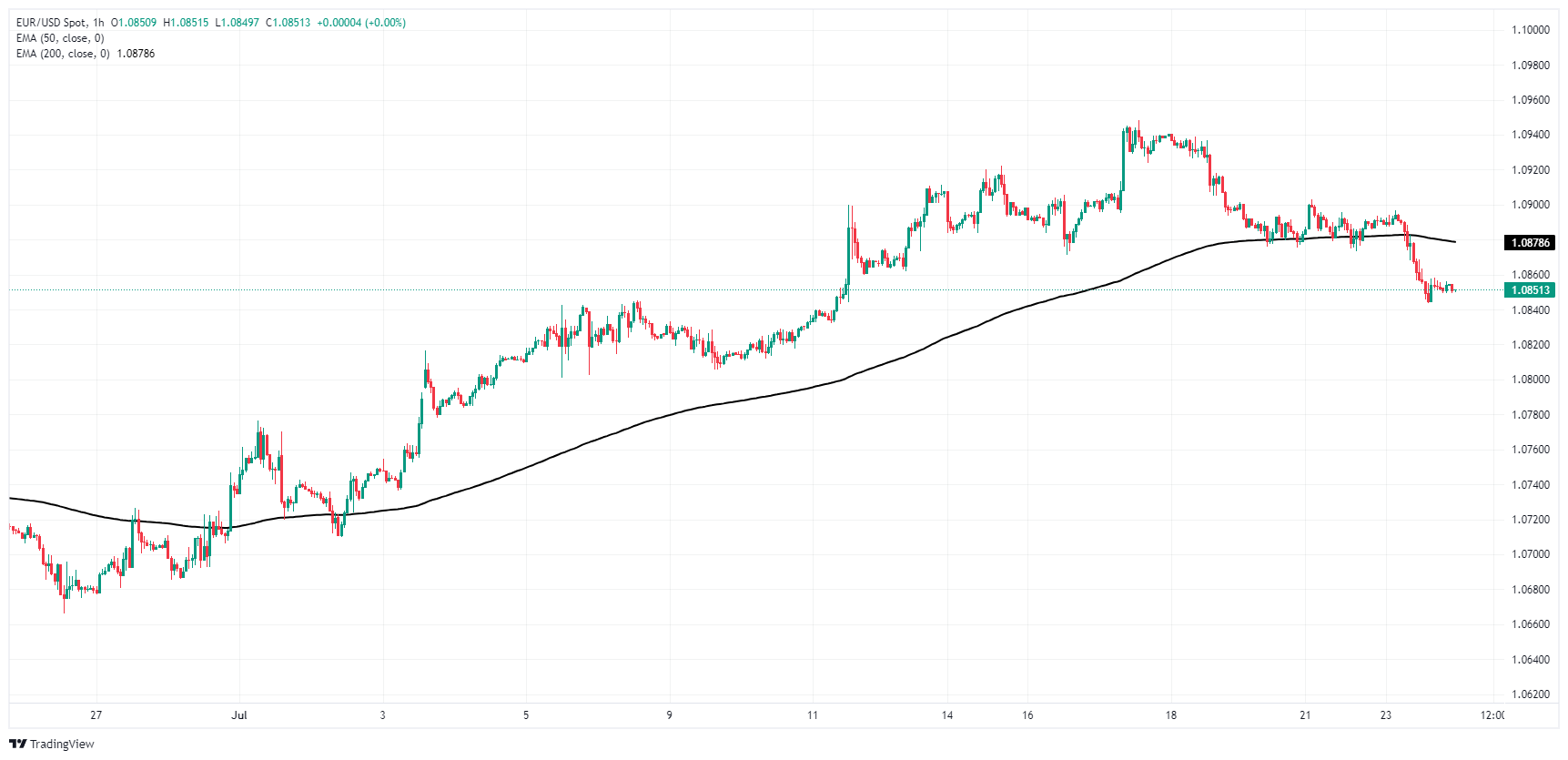
EUR/USD daily chart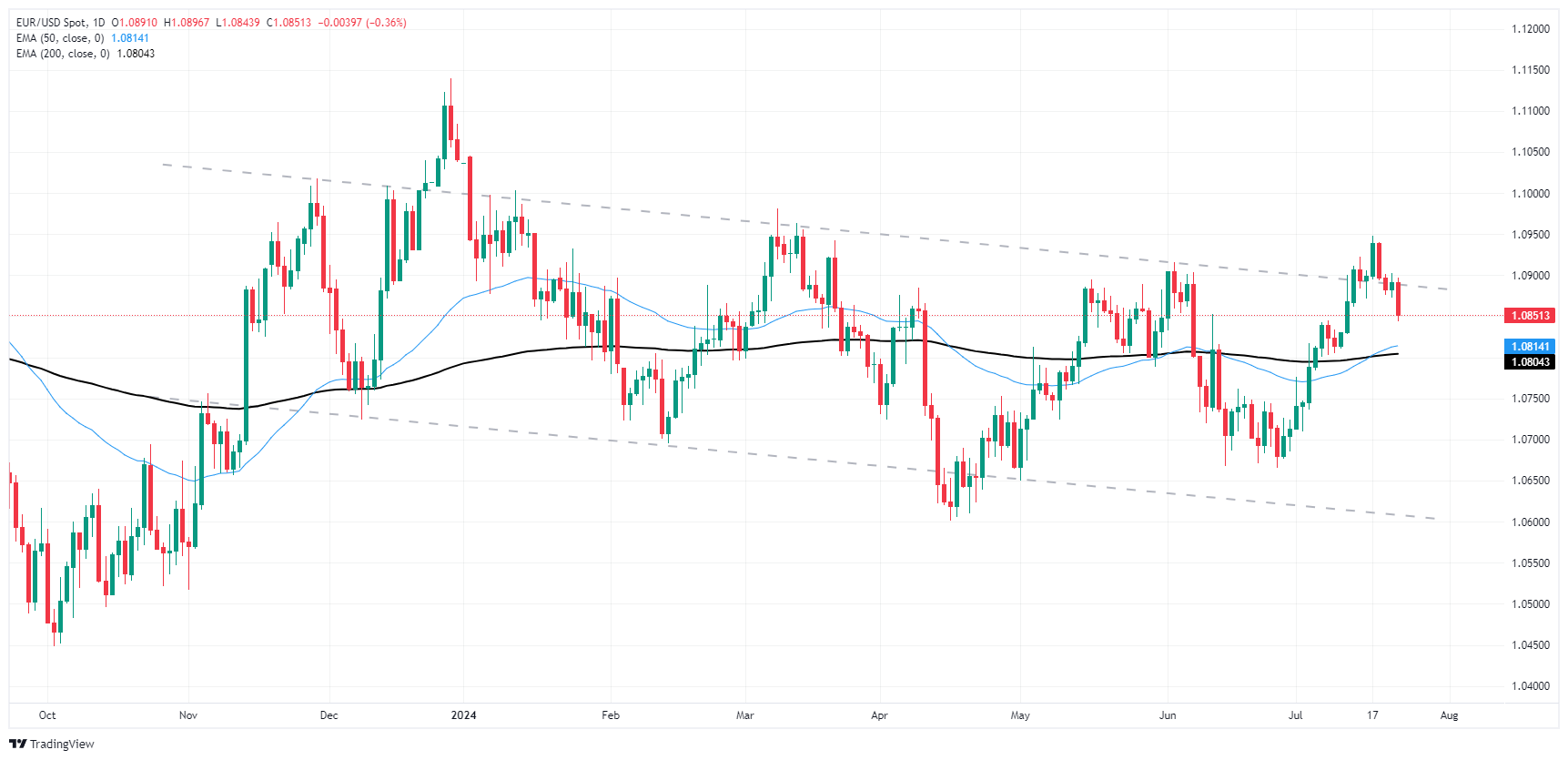
Euro FAQs
The Euro is the currency for the 20 European Union countries that belong to the Eurozone. It is the second most heavily traded currency in the world behind the US Dollar. In 2022, it accounted for 31% of all foreign exchange transactions, with an average daily turnover of over $2.2 trillion a day. EUR/USD is the most heavily traded currency pair in the world, accounting for an estimated 30% off all transactions, followed by EUR/JPY (4%), EUR/GBP (3%) and EUR/AUD (2%).
The European Central Bank (ECB) in Frankfurt, Germany, is the reserve bank for the Eurozone. The ECB sets interest rates and manages monetary policy. The ECB’s primary mandate is to maintain price stability, which means either controlling inflation or stimulating growth. Its primary tool is the raising or lowering of interest rates. Relatively high interest rates – or the expectation of higher rates – will usually benefit the Euro and vice versa. The ECB Governing Council makes monetary policy decisions at meetings held eight times a year. Decisions are made by heads of the Eurozone national banks and six permanent members, including the President of the ECB, Christine Lagarde.
Eurozone inflation data, measured by the Harmonized Index of Consumer Prices (HICP), is an important econometric for the Euro. If inflation rises more than expected, especially if above the ECB’s 2% target, it obliges the ECB to raise interest rates to bring it back under control. Relatively high interest rates compared to its counterparts will usually benefit the Euro, as it makes the region more attractive as a place for global investors to park their money.
Data releases gauge the health of the economy and can impact on the Euro. Indicators such as GDP, Manufacturing and Services PMIs, employment, and consumer sentiment surveys can all influence the direction of the single currency. A strong economy is good for the Euro. Not only does it attract more foreign investment but it may encourage the ECB to put up interest rates, which will directly strengthen the Euro. Otherwise, if economic data is weak, the Euro is likely to fall. Economic data for the four largest economies in the euro area (Germany, France, Italy and Spain) are especially significant, as they account for 75% of the Eurozone’s economy.
Another significant data release for the Euro is the Trade Balance. This indicator measures the difference between what a country earns from its exports and what it spends on imports over a given period. If a country produces highly sought after exports then its currency will gain in value purely from the extra demand created from foreign buyers seeking to purchase these goods. Therefore, a positive net Trade Balance strengthens a currency and vice versa for a negative balance.
Author

Joshua Gibson
FXStreet
Joshua joins the FXStreet team as an Economics and Finance double major from Vancouver Island University with twelve years' experience as an independent trader focusing on technical analysis.