|

EUR/USD around 1.1630 on EMU’s CPI

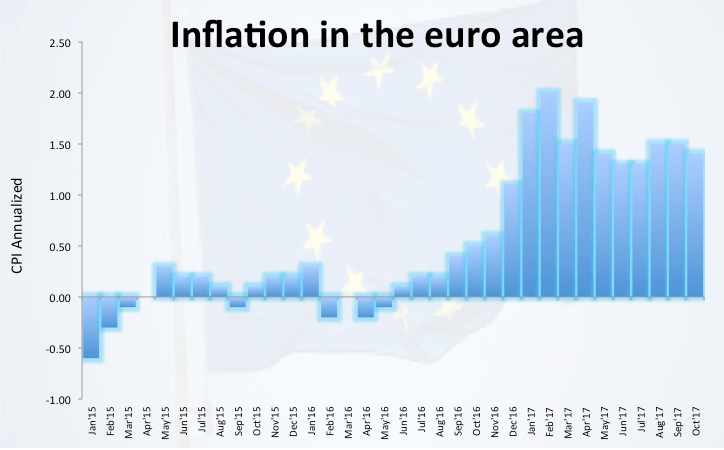
  • Inflation in the euro area surprised to the downside.
  • EMU’s GDP expected to expand 2.5% YoY.
  • Spot stays in red near 1.1630.

The bearish note around the European currency remains unchanged on Tuesday and is now taking EUR/USD to the 1.1630 region in the wake of key releases in the euro area.

EUR/USD stays offered post-data

The pair remains unable to gather some traction today despite EMU’s advanced GDP figures showed the economy in the region is expected to expand at an annualized 2.5% during the July-September period and 0.6% inter-quarter, both prints surpassing prior surveys.

Still on the bright side, unemployment in the euro bloc ticked lower to 8.9% in September, bettering initial estimates.

However, critical inflation figures in the region tracked by the CPI showed headline consumer prices are seen rising at 1.4% on a year to October, while prices stripping food and energy costs are expected to rise 1.1% YoY, both prints coming in below expectations.

The pair, in the meantime, remains on the defensive for the day and keeps retracing Monday’s advance to the vicinity of 1.1660.

EUR/USD levels to watch

At the moment, the pair is losing 0.16% at 1.1631 and a breakdown of 1.1575 (low Oct.27) would open the door to 1.1448 (high Jun.30) and finally 1.1254 (200-day sma). On the other hand, the next up barrier lines up at 1.1658 (high Oct.30) seconded by 1.1683 (100-day sma) and then 1.1729 (10-day sma).
Author

Pablo Piovano

Born and bred in Argentina, Pablo has been carrying on with his passion for FX markets and trading since his first college years.


More from Pablo Piovano
Share:

Editor's Picks

AUD/USD sticks to positive bias above 0.7100; lacks bullish conviction

AUD/USD trades with a positive bias for the second straight day, holding above 0.7100 in the Asian session on Friday as softer US bond yields keep US Dollar bulls on the back foot. Furthermore, hawkish RBA Governor Bullock's comments boost rate hike bets and support the Aussie. However, the Fed's hawkish outlook, along with geopolitical uncertainties, limits USD losses and caps the pair.

USD/JPY approaches 158.00 as Japanese Yen resumes decline

USD/JPY is resuming its upside in the European session on Friday, refreshing two-week highs and nearing 158.00. The Japanese Yen extends losses, despite the Bank of Japan's (BoJ) expected rate hike to 1.25% and hawkish Governor Ueda's comments, as two surprise dissents against the rate hike weigh on it.

Gold tests $$4,400 as softer US bond yields cap USD gains

Gold scales higher for the second straight day and continues to hit new weekly highs through the first half of the European session on Friday, with bulls now awaiting a sustained move beyond the $4,400 mark before positioning for further gains. Retreating US Treasury bond yields keep the US Dollar (USD) uptrend capped ahead of Fedspeak and mid-tier US data.

Bitcoin extends recovery, Ethereum eyes $2,500, XRP holds $1.30
Bitcoin (BTC), Ethereum (ETH) and Ripple (XRP) extend their recovery, trading above $76,700, $2,400 and $1.300, respectively, on Friday. These top three cryptocurrencies now face key technical levels that could determine whether their recoveries extend further or pull back.
Why Bitcoin's over 30% rebound doesn't mean the bear market cycle is done

BTC has staged a strong recovery after falling to a yearly low of $57,800 in July, gaining nearly 33% and recording two consecutive months of gains in July and August. However, despite that rebound, Bitcoin remains around 40% below its all-time high, leaving one key question for traders: is this the start of a new bullish phase, or simply another recovery within a broader bear-market cycle?

How Japan became the World's Banker and why that era may be ending

Japan's ultra-low interest rates helped finance trillions of dollars in global investments for more than a decade, making the Japanese Yen one of the world’s cheapest sources of funding. With the Bank of Japan expected to tighten policy again this week, that advantage may be entering a new phase. While most major economies raised interest rates, Japan remained the world's outlier.