EUR/JPY Price Forecast: Retakes 160.00 mark on weaker JPY; not out of the woods yet
- EUR/JPY recovers from a multi-month low amid the emergence of some selling around the JPY.
- Bets for a December BoJ rate hike, trade war fears and geopolitical risks could limit JPY losses.
- The setup supports prospects for the emergence of fresh selling around the cross at higher levels.


The EUR/JPY cross gains some positive traction during the Asian session on Thursday and moves away from its lowest level since early October, around the 159.10 region touched the previous day. The intraday uptick lifts spot prices to the 160.00 psychological mark in the last hour and is sponsored by the emergence of fresh selling around the Japanese Yen (JPY).
Any meaningful JPY depreciation, however, seems elusive in the wake of speculations that the Bank of Japan (BoJ) will hike interest rates again in December. Apart from this, US President-elect Donald Trump's tariff threats and geopolitical risks might continue to benefit the safe-haven JPY. This, along with bets for faster interest rate cuts from the European Central Bank (ECB), should act as a headwind for the shared currency and cap the EUR/JPY cross.
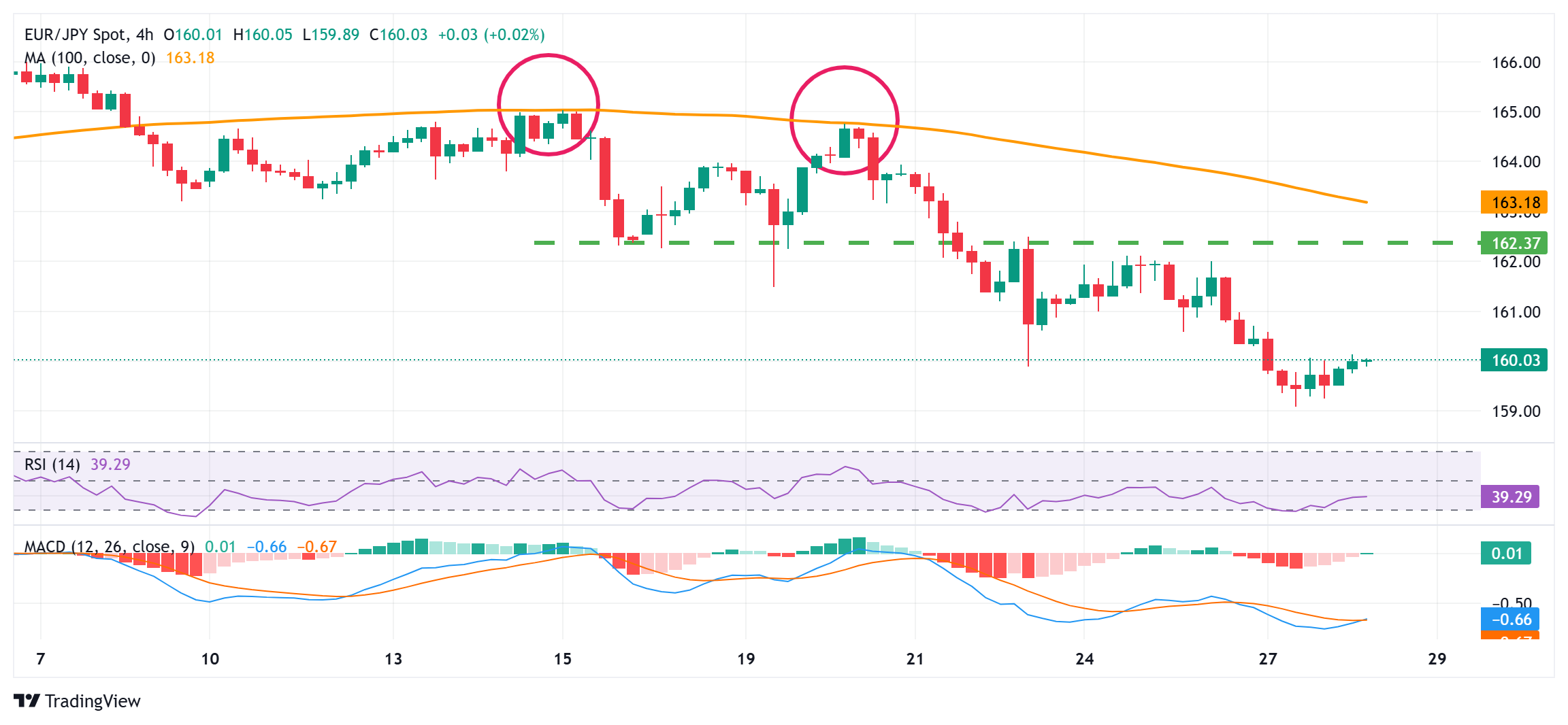
From a technical perspective, the recent repeated failures near the 100-period Simple Moving Average (SMA) on the 4-hour chart and a subsequent breakdown below the 162.35-162.30 support favor bearish traders. Moreover, oscillators on the daily chart are holding deep in negative territory and are still away from being in the oversold zone. This suggests that any subsequent move up in the EUR/JPY cross could be seen as a selling opportunity and remain limited.
In the meantime, the overnight swing high, around the 160.70 area, is likely to act as an immediate hurdle ahead of the 161.00 mark. Some follow-through buying beyond the 161.30 region might trigger a short-covering rally and allow the EUR/JPY ross to reclaim the 162.00 round figure. The momentum, however, runs the risk of fizzling out rather quickly near the 162.30-162.35 region, which now seems to act as a key pivotal point for short-term traders.
On the flip side, the Asian session low, around the 159.45 area, could protect the immediate downside ahead of the 159.10-159.05 region, or the multi-month low set on Wednesday. A sustained break below the 159.00 mark will be seen as a fresh trigger for bearish traders and drag the EUR/JPY cross to the 158.55 zone en route to the late September swing low, around the 158.00 mark and the next relevant support near the 157.65 region.
EUR/JPY 4-hour chart
Japanese Yen FAQs
The Japanese Yen (JPY) is one of the world’s most traded currencies. Its value is broadly determined by the performance of the Japanese economy, but more specifically by the Bank of Japan’s policy, the differential between Japanese and US bond yields, or risk sentiment among traders, among other factors.
One of the Bank of Japan’s mandates is currency control, so its moves are key for the Yen. The BoJ has directly intervened in currency markets sometimes, generally to lower the value of the Yen, although it refrains from doing it often due to political concerns of its main trading partners. The BoJ ultra-loose monetary policy between 2013 and 2024 caused the Yen to depreciate against its main currency peers due to an increasing policy divergence between the Bank of Japan and other main central banks. More recently, the gradually unwinding of this ultra-loose policy has given some support to the Yen.
Over the last decade, the BoJ’s stance of sticking to ultra-loose monetary policy has led to a widening policy divergence with other central banks, particularly with the US Federal Reserve. This supported a widening of the differential between the 10-year US and Japanese bonds, which favored the US Dollar against the Japanese Yen. The BoJ decision in 2024 to gradually abandon the ultra-loose policy, coupled with interest-rate cuts in other major central banks, is narrowing this differential.
The Japanese Yen is often seen as a safe-haven investment. This means that in times of market stress, investors are more likely to put their money in the Japanese currency due to its supposed reliability and stability. Turbulent times are likely to strengthen the Yen’s value against other currencies seen as more risky to invest in.
Author
Haresh Menghani
FXStreet
Haresh Menghani is a detail-oriented professional with 10+ years of extensive experience in analysing the global financial markets.