|

EUR/JPY Price Forecast: Pulling back within persistent short-term downtrend

  • EUR/JPY is pulling back within a month-long downtrend. 
  • Despite some bullish signs the short-term trend remains bearish.

EUR/JPY is pulling back after making a lower low on its persistent journey south.

Since the August 16 high the pair has steadily declined, tracing out a sequence of falling peaks and troughs which indicates EUR/JPY has established a short-term downtrend. According to technical analysis theory this favors more downside because “the trend is your friend”. 

EUR/JPY 4-hour Chart 
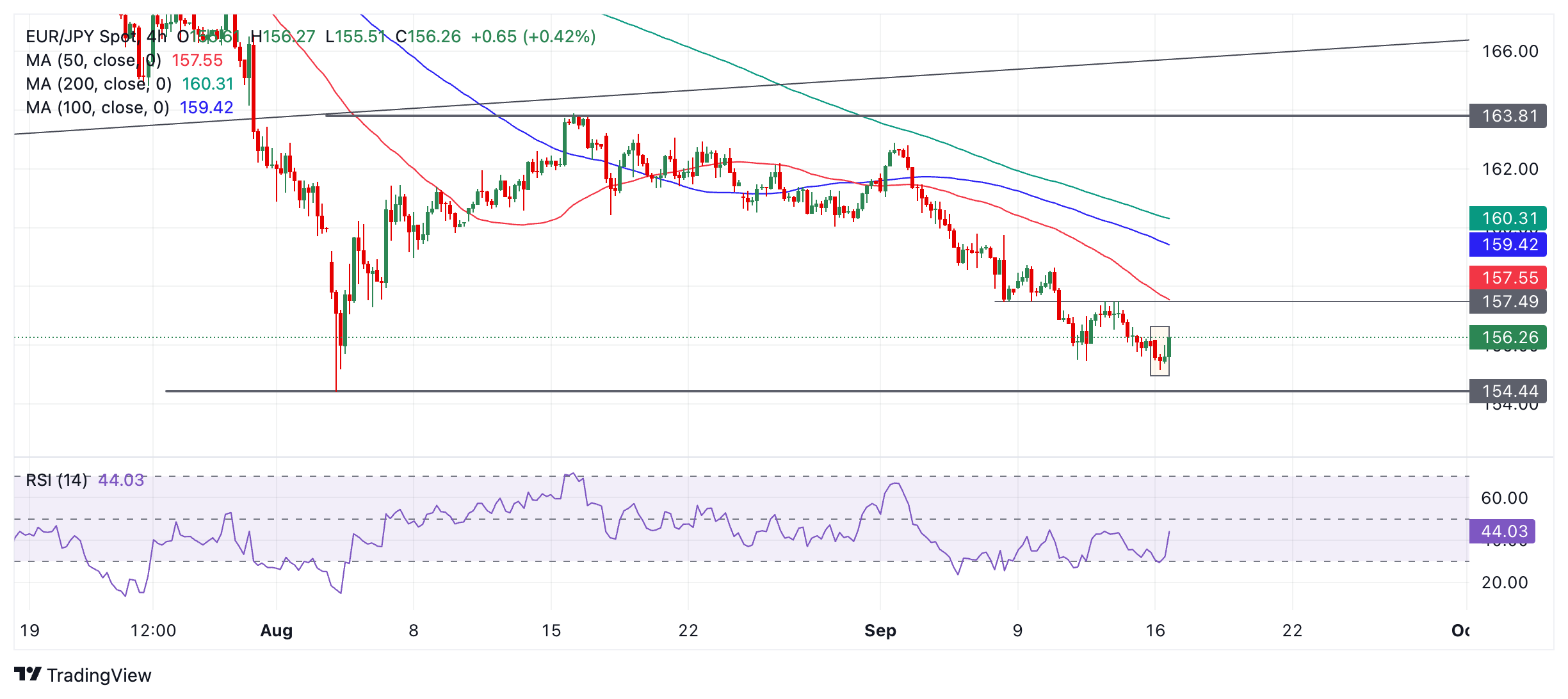
The last few periods, however, have formed a Japanese Hammer candlestick reversal pattern (shaded rectangle on chart). This Hammer was followed by a confirmatory green bullish candlestick. The current period is also strongly bullish – so far although it has not finished. 

At the same time the Relative Strength Index (RSI) has moved from oversold back into neutral. This advises traders to close short positions and open long positions. 

The correction lacks upside so far, however, which means there is not enough evidence from price action to indicate EUR/JPY has reversed its short-term downtrend. 

It is showing bullish warning signs though, and if price can close above 157.49 it will suggest the short-term trend has reversed and the odds favor more upside. 

Alternatively the pull back could soon run out of steam, allowing price to resume its downtrending bias. A break below 155.15 (September 16 low) would provide confirmation of a continuation of the bear trend to the next target at 154.44 – the August 5 low. 

A break below that would be an even more bearish sign and suggest a probable reversal of the long-term uptrend.

Author

Joaquin Monfort

Joaquin Monfort is a financial writer and analyst with over 10 years experience writing about financial markets and alt data. He holds a degree in Anthropology from London University and a Diploma in Technical analysis.


More from Joaquin Monfort
Share:

Editor's Picks

AUD/USD hits nine-week lows below 0.7000 on RBA Bullock's remarks

AUD/USD reverses a brief uptick and turns lower to hit nine-week lows below 0.7000 in the European morning on Tuesday, as traders digest cautious remarks from Reserve Bank of Australia (RBA) Governor Michele Bullock during the press conference. Earlier on, the RBA raised the cash rate to 4.60%, as widely expected, leaving the door open to further rate hikes if needed.

USD/JPY consolidates near 157.50 as a bullish USD counters intervention risks

USD/JPY struggles to capitalize on the overnight bounce from a one-week low, consolidating around 157.50 in the Asian session on Tuesday. Trump's concerns about the Japanese Yen's weakness fueled speculation about another US-Japan joint intervention. This, along with the hawkish BoJ, underpins the JPY and caps the currency pair. Meanwhile, rising Fed rate-hike bets and oil-driven inflation fears continue to push US bond yields to multi-year highs, keeping the US Dollar pinned near a two-month high and supporting the pair.

Gold steadies after sharp drop as traders assess Fed outlook, Middle East risks

Gold steadies on Tuesday after suffering a sharp sell-off at the start of the week. The move appears to be a corrective bounce, as the broader narrative remains tied to expectations of further Federal Reserve interest rate hikes.

Chainlink trims gains after CCIP 2.0 launch, Swift ledger integration

Chainlink (LINK) edges below $15.00 on Tuesday, trimming its 10% gains from the previous day, driven by the launch of its new Cross-Chain Interoperability Protocol 2.0 and Swift ledger integration for tokenized deposits and 24/7 cross-border payments.

Focus turns to US job openings
In the euro area, focus turns to the September flash inflation print for Spain which will give the first indication of where the euro area data on Friday lands. We expect a modest rise in headline due to higher energy costs and a small increase in core inflation. We also receive the European Commission's business survey for September.
Fed vs BoJ: Both hiked. The market only believes one of them – and the chart shows which

The Fed and the BoJ have just done something remarkably similar. Both central banks raised interest rates by 25 bps last week, both are confronting inflation risks, and both signal that future decisions will depend on incoming economic data.