Dow Jones Industrial Average treads water after Fed delivers quarter-point rate cut
- The Dow Jones is trading tightly on Thursday, cruising near record highs.
- Investors are holding in the midrange after the Fed delivered a widely-anticipated 25 bps rate trim.
- Markets broadly anticipate another quarter-point rate cut from the Fed in December.

The Dow Jones Industrial Average (DJIA) is trading in a tight range on Thursday, testing close to record highs set earlier this week near 43,800. Markets surged this week after 2024’s US presidential election revealed a clear path to victory for former President Donald Trump, and markets are holding close to the top end on the back of a widely-anticipated rate cut from the Federal Reserve (Fed).
The Fed brought a follow-up quarter-point rate reduction to the table on Thursday, adding onto September's opening volley of a jumbo 50 bps rate slash. While an additional 25 bps met investor expectations and will keep markets running smoothly, investors will be pivoting quickly to weighing odds of a December three-peat. According to the CME’s FedWatch Tool, rate traders are pricing in one more 25 bps rate trim from the Fed in December. Investors hoping for a final quarter-point rate trim in December are battling it out with some expectations that the Fed may hold after November, with 67% odds of one last 25 bps rate cut on December 18.
University of Michigan (UoM) Consumer Sentiment Index figures due on Friday will wrap up the week’s hectic release schedule. Median market forecasts expect the UoM’s sentiment survey to tick upwards to 71.0 in November after the previous month’s cautious step into 70.5.
Dow Jones news
The Dow Jones is shuffling its feet on Thursday, with the major equity board pulling into the middle. Intel (INTC) has recovered around 4%, climbing to $26 per share in a rebound after it was announced that the legacy chipmaker would be removed from the Dow Jones this week, ending a 25-year on the major stock index. On the low end, JPMorgan Chase (JPM) slipped nearly 4% lower, falling below $238 per share following a stellar post-election rally.
Dow Jones price forecast
The Dow Jones’ latest bullish push has sent the major equity index within reach of the 44,000 major handle. The DJIA is now up nearly 17% on the year, climbing 5.33% bottom-to-top in October alone.
With the Dow Jones testing deep into bull country, short pressure will be building to drag price action back down to the 50-day Exponential Moving Average (EMA) near the 42,000 key price level. Despite a clear way forward for bears, a lack of technical turnaround points with bids tapping record high territory makes it difficult to price in a short entry point; it turns out rising knives are just as difficult to catch as falling ones.
Dow Jones daily chart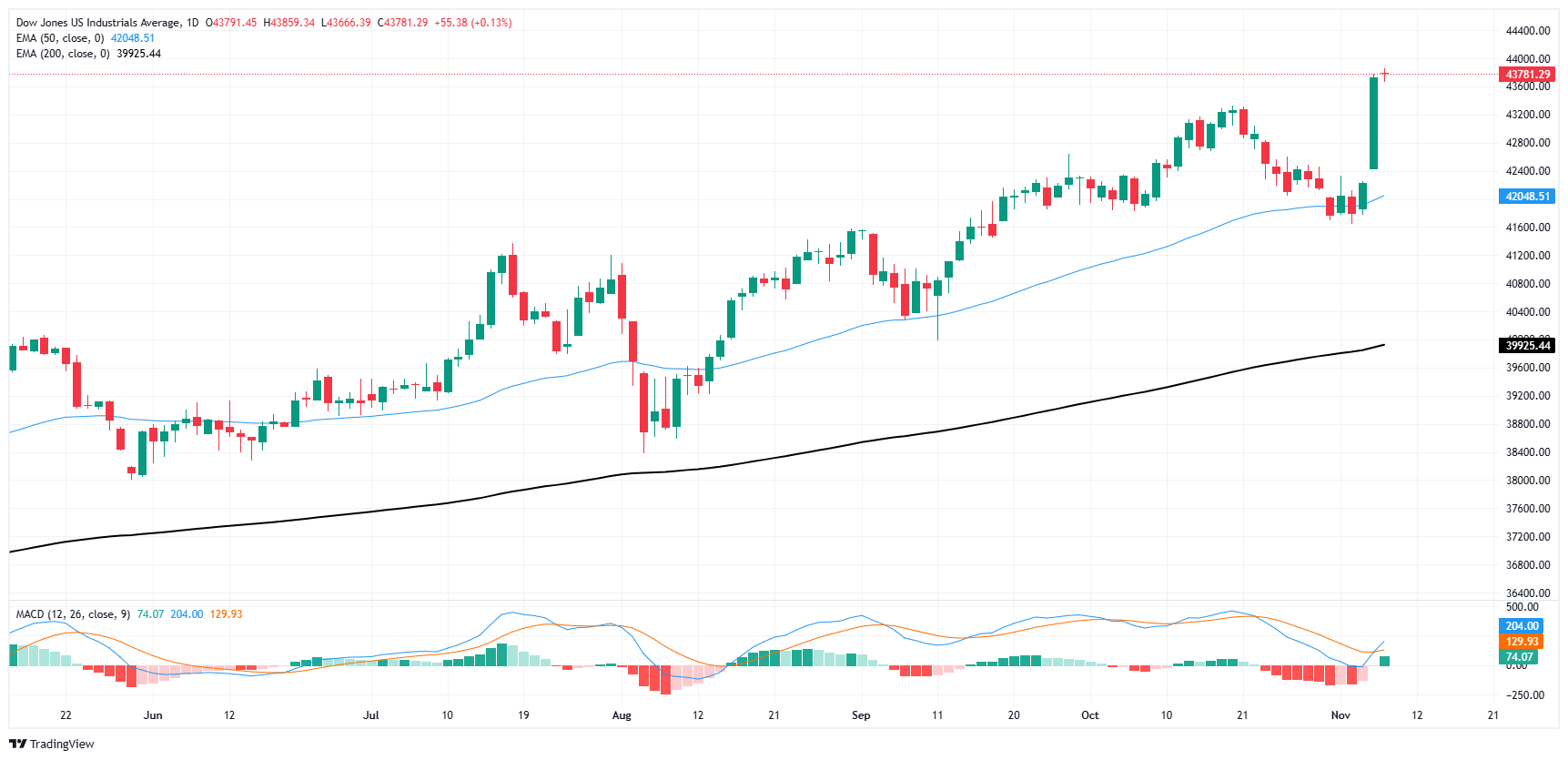
Interest rates FAQs
Interest rates are charged by financial institutions on loans to borrowers and are paid as interest to savers and depositors. They are influenced by base lending rates, which are set by central banks in response to changes in the economy. Central banks normally have a mandate to ensure price stability, which in most cases means targeting a core inflation rate of around 2%. If inflation falls below target the central bank may cut base lending rates, with a view to stimulating lending and boosting the economy. If inflation rises substantially above 2% it normally results in the central bank raising base lending rates in an attempt to lower inflation.
Higher interest rates generally help strengthen a country’s currency as they make it a more attractive place for global investors to park their money.
Higher interest rates overall weigh on the price of Gold because they increase the opportunity cost of holding Gold instead of investing in an interest-bearing asset or placing cash in the bank. If interest rates are high that usually pushes up the price of the US Dollar (USD), and since Gold is priced in Dollars, this has the effect of lowering the price of Gold.
The Fed funds rate is the overnight rate at which US banks lend to each other. It is the oft-quoted headline rate set by the Federal Reserve at its FOMC meetings. It is set as a range, for example 4.75%-5.00%, though the upper limit (in that case 5.00%) is the quoted figure. Market expectations for future Fed funds rate are tracked by the CME FedWatch tool, which shapes how many financial markets behave in anticipation of future Federal Reserve monetary policy decisions.
Author

Joshua Gibson
FXStreet
Joshua joins the FXStreet team as an Economics and Finance double major from Vancouver Island University with twelve years' experience as an independent trader focusing on technical analysis.