Dow Jones Industrial Average hits the gas on a Monday late break, climbs over 200 points
- The Dow Jones cracked a fresh all-time high during Monday trading.
- Despite the upside stretch, equities remain tepid overall.
- Investors are buckling down for the wait to Wednesday’s Fed rate call.

The Dow Jones Industrial Average (DJIA) clipped into another record intraday bid to kick off the new trading week. The largest equities on the New York Stock Exchange (NYSE) inched higher on Monday, ahead of Wednesday’s Federal Reserve (Fed) rate call, which is widely expected to be the Fed’s first rate cut since March of 2020.
The Fed kicking off a new rate-cutting cycle on Wednesday is all but a given according to investors, and it now comes down to a debate of how much rather than when. According to the CME’s FedWatch Tool, rate traders are pricing in around 60% odds that the Fed’s first rate cut in over four years will be a 50 bps decline in the Fed funds rate, with the remaining 40% expecting a more demure 25 bps. Rate markets are also pricing in a total of 125-150 bps in cuts by the end of the year, with interest rate traders seeing a roughly 80% chance that the Fed funds rate will hit 400-425 total bps by December 18 versus the current interest rate of 525-550.
US Retail Sales are slated for an update on Tuesday, but the key datapoint that would normally drive some level of volatility is not expected to move the needle this week unless the print comes in wildly out of alignment with forecasts. MoM US Retail Sales growth in August is expected to ease back to 0.2% from July’s 1.0%, while core MoM Retail Sales (excluding automotive purchases) are expected to tick down to 0.3% from 0.4%.
Dow Jones news
Despite an overall tepid tone in US equities on Monday, the Dow Jones has tilted into the bullish side, rising around 220 points and adding 0.54% at the current average near 41,600. The DJIA clipped a new record intraday bid of 41,738 before settling back as investors bide their time.
Intel Corp (INTC) added 7%, climbing over $21 per share after it was revealed that the chipmaker was set to receive a $3.5 billion grant from the US government to produce chipsets for the US military and the Pentagon. Despite the Monday pop, INTC is barely off of its decade-plus lows and has yet to recover ground after missing an earnings call in August. A technical recovery has yet to materialize after the silicon giant gleefully announced they would axe over 15,000 employees in a bid to appease shareholders and try to backstop the company’s share value decline of nearly 60% YTD.
On the low end, Apple Inc (AAPL) tumbled -2.7% to $216 per share after reports surfaced that demand for the company’s 16th iteration of its iPhone platform may not be as high as many anticipated. According to analysts, key AI-driven features that Apple was banking on to revive flagging sales figures are still not publicly available, flattening phone sales. At the same time, extended shipping times are further shaking out potential buyers. Sales for the company’s latest annual mobile phone update are down 12% YoY, according to analysis from TF Securities.
Dow Jones price forecast
Despite an overall tepid stance to stock trading on Monday, the Dow Jones is still finding plenty of room on the bidding side, clipping into a fresh all-time high and rounds the corner into a fourth straight trading day of gains. The major equity index has recovered nearly 4.4% bottom-to-top from last week’s swing low below 40,000.
With the DJIA recovering back above the 50-day Exponential Moving Average (EMA) rising through 40,450, action is squarely planted on the bullish side, though long-term bidders will be cautious with price action cycling familiar technical levels. This isn’t the first time the Dow Jones has priced in a topping pattern ahead of major news events, and despite having a short-term memory issue, buyers can still recall July’s bumpy -7.2% decline from previous record highs.
Dow Jones daily chart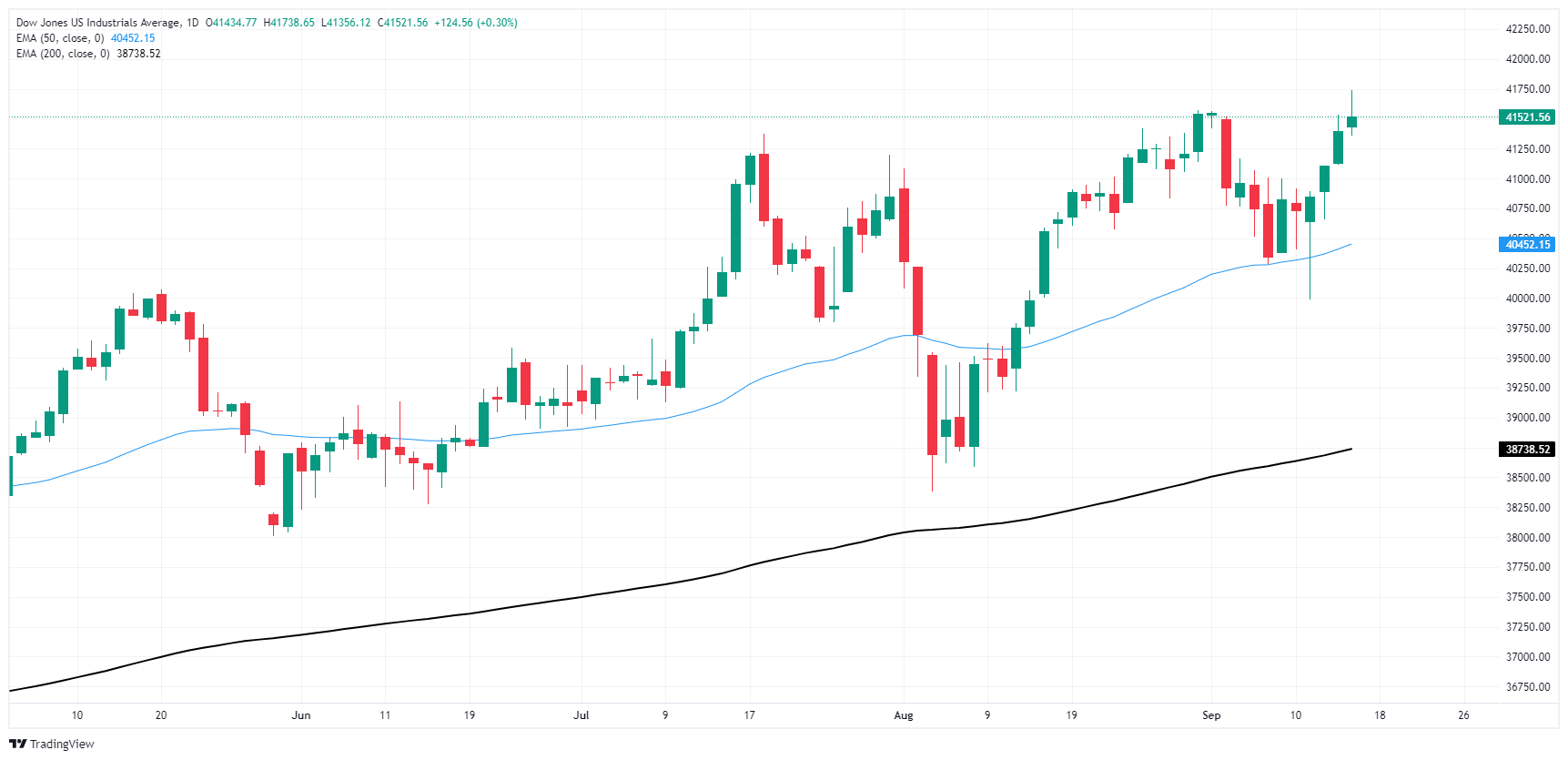
Fed FAQs
Monetary policy in the US is shaped by the Federal Reserve (Fed). The Fed has two mandates: to achieve price stability and foster full employment. Its primary tool to achieve these goals is by adjusting interest rates. When prices are rising too quickly and inflation is above the Fed’s 2% target, it raises interest rates, increasing borrowing costs throughout the economy. This results in a stronger US Dollar (USD) as it makes the US a more attractive place for international investors to park their money. When inflation falls below 2% or the Unemployment Rate is too high, the Fed may lower interest rates to encourage borrowing, which weighs on the Greenback.
The Federal Reserve (Fed) holds eight policy meetings a year, where the Federal Open Market Committee (FOMC) assesses economic conditions and makes monetary policy decisions. The FOMC is attended by twelve Fed officials – the seven members of the Board of Governors, the president of the Federal Reserve Bank of New York, and four of the remaining eleven regional Reserve Bank presidents, who serve one-year terms on a rotating basis.
In extreme situations, the Federal Reserve may resort to a policy named Quantitative Easing (QE). QE is the process by which the Fed substantially increases the flow of credit in a stuck financial system. It is a non-standard policy measure used during crises or when inflation is extremely low. It was the Fed’s weapon of choice during the Great Financial Crisis in 2008. It involves the Fed printing more Dollars and using them to buy high grade bonds from financial institutions. QE usually weakens the US Dollar.
Quantitative tightening (QT) is the reverse process of QE, whereby the Federal Reserve stops buying bonds from financial institutions and does not reinvest the principal from the bonds it holds maturing, to purchase new bonds. It is usually positive for the value of the US Dollar.
Author

Joshua Gibson
FXStreet
Joshua joins the FXStreet team as an Economics and Finance double major from Vancouver Island University with twelve years' experience as an independent trader focusing on technical analysis.

















