Dow Jones Industrial Average climbs 800 points after US CPI inflation print
- The Dow Jones lurched over 750 points higher on Wednesday.
- Equities are broadly pivoting into a risk-on sentiment stance.
- Investors brush off rising headline CPI as core CPI measures tick down.


The Dow Jones Industrial Average (DJIA) climbed around 800 points on Wednesday, pushing into the bullish side to pass back through the 43,000 handle before getting hung up on the 50-day Exponential Moving Average (EMA). Equity markets are tilting firmly into the bullish camp after a key core inflation gauge ticked slightly lower.
According to the Consumer Price Index (CPI), headline inflation rose in December, with prices climbing 2.9% YoY compared to 2.7% previously. The acceleration in headline inflation was anticipated by market analysts, though December’s standalone figure still surprised to the upside, coming in at 0.4% MoM compared to the expected flat hold at 0.3%.
The real magic for equity markets came in the core CPI print, which excludes volatile items like food and energy. Annualized core inflation ticked down to 3.2% YoY, beating the expected hold at the previous period’s 3.3%. Choosing to ignore rising food and energy prices doesn’t mean consumers won’t magically have to stop paying for them, and investors are running the risk of getting lost in the details and focusing on the wrong thing: odds of a Federal Reserve (Fed) rate cut on January 29 moved from 2.0% to 2.7% after the CPI print, according to the CME’s FedWatch Tool.
Dow Jones news
Wednesday is turning out to be a firmly bullish day for the Dow Jones, with all but five of the average’s listed securities trading above the day’s opening bids. Honeywell International (HON) pulled back around 0.6% to $217 as investors took profits on a recent bullish upswing for the company. Goldman Sachs (GS) rose to the top of the DJIA during the midweek market session, climbing 6.5% and pushing into $604 per share after the major investment bank’s profits surged to a three-year high.
Dow Jones price forecast
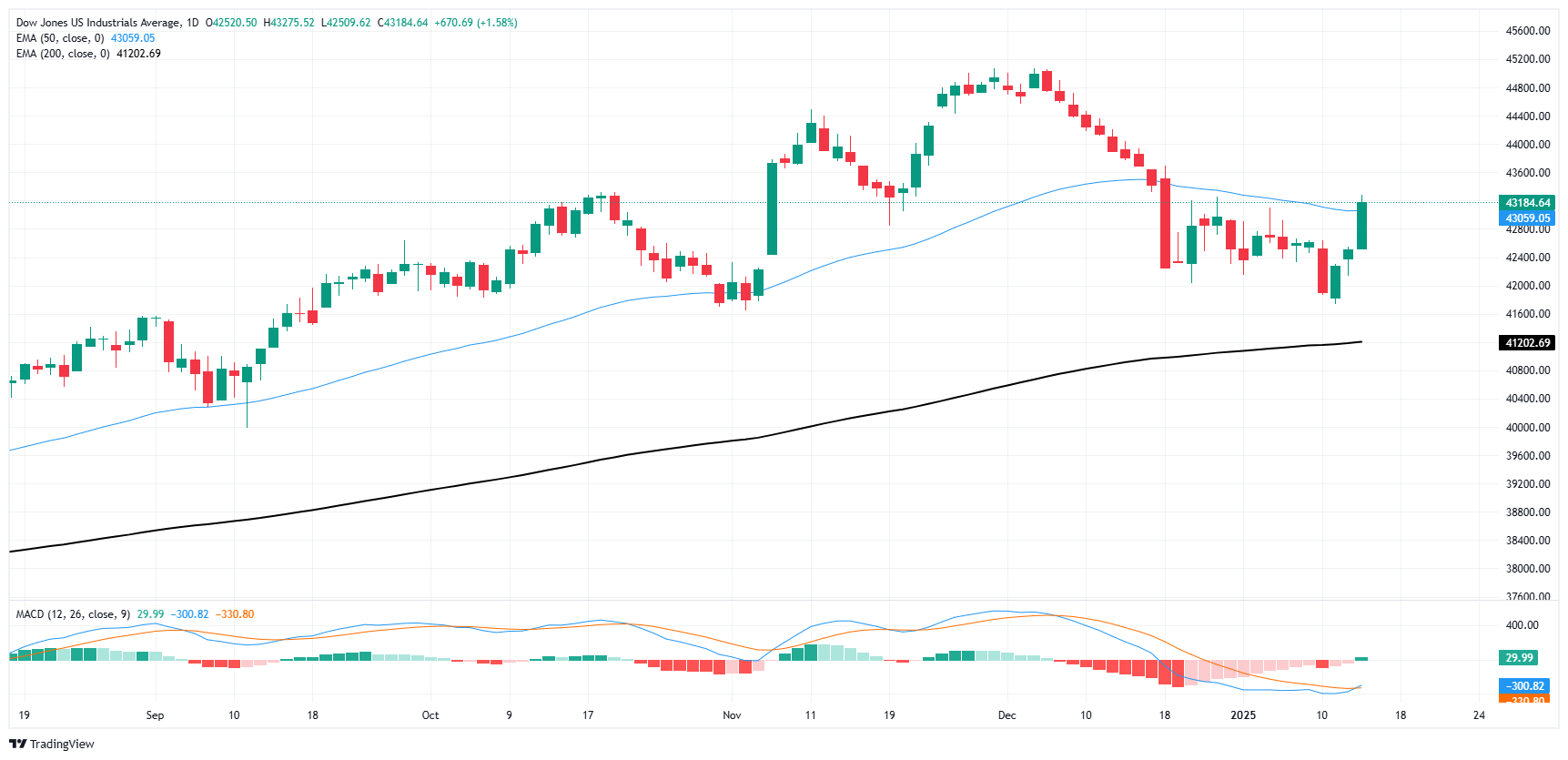
The Dow Jones’ latest bearish weak point could be over as price action pushes back north of the 50-day EMA and reclaims the 43,000 handle. The major equity index pulled back into alarm bell territory just above the 200-day EMA near 41,200, but things may be back to their bullish ways now that the Dow has climbed 3.7% in just three days.
42,000 has proven to be the technical floor holding up bids, at least for the time being. Selling pressure has remained unable to push prices meaningfully back below the key figure, and bidders are coming out of the woodwork to try and push the Dow Jones back into record highs set above 45,000.
Dow Jones daily chart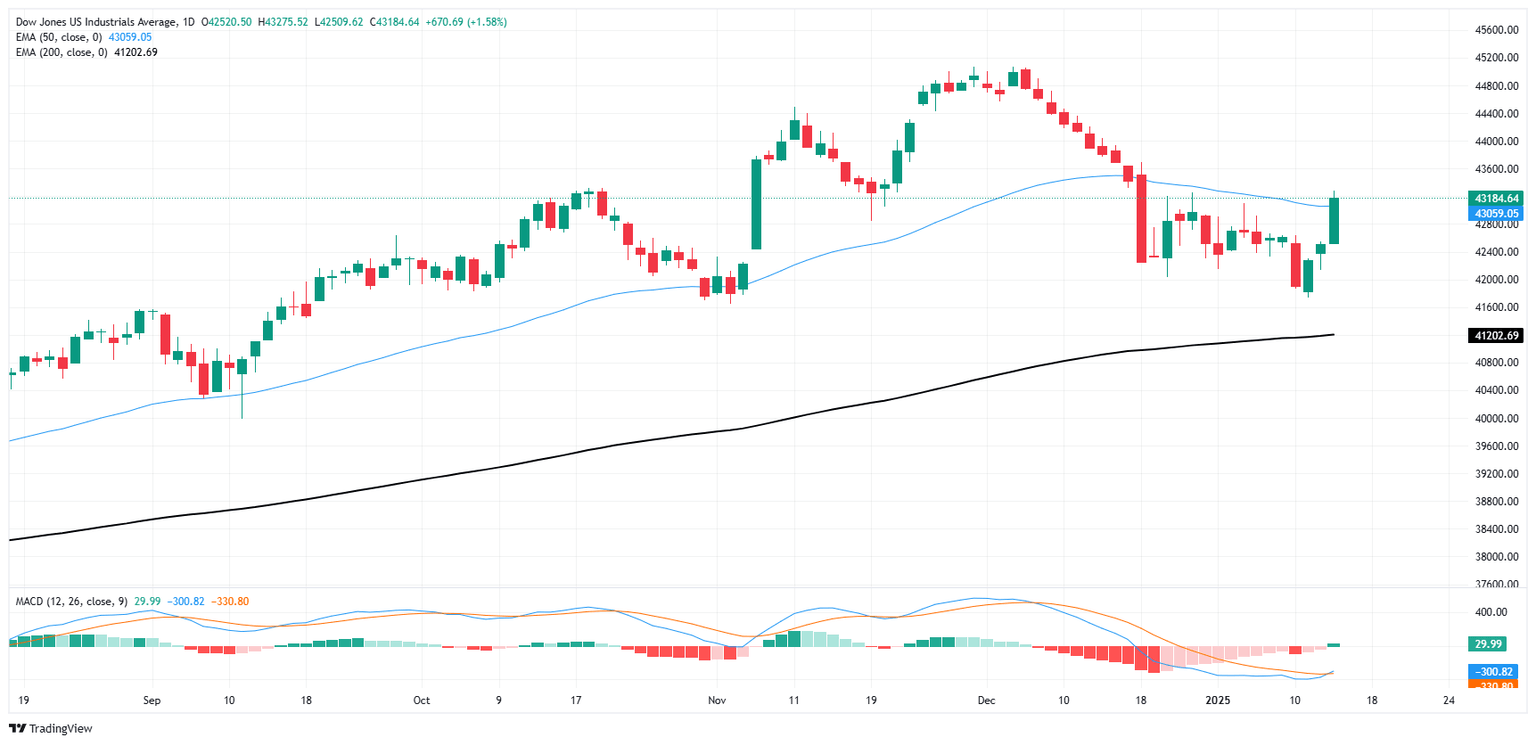
Economic Indicator
Consumer Price Index (YoY)
Inflationary or deflationary tendencies are measured by periodically summing the prices of a basket of representative goods and services and presenting the data as The Consumer Price Index (CPI). CPI data is compiled on a monthly basis and released by the US Department of Labor Statistics. The YoY reading compares the prices of goods in the reference month to the same month a year earlier.The CPI is a key indicator to measure inflation and changes in purchasing trends. Generally speaking, a high reading is seen as bullish for the US Dollar (USD), while a low reading is seen as bearish.
Read more.Last release: Wed Jan 15, 2025 13:30
Frequency: Monthly
Actual: 2.9%
Consensus: 2.9%
Previous: 2.7%
Source: US Bureau of Labor Statistics
The US Federal Reserve has a dual mandate of maintaining price stability and maximum employment. According to such mandate, inflation should be at around 2% YoY and has become the weakest pillar of the central bank’s directive ever since the world suffered a pandemic, which extends to these days. Price pressures keep rising amid supply-chain issues and bottlenecks, with the Consumer Price Index (CPI) hanging at multi-decade highs. The Fed has already taken measures to tame inflation and is expected to maintain an aggressive stance in the foreseeable future.
Author
Joshua Gibson
FXStreet
Joshua joins the FXStreet team as an Economics and Finance double major from Vancouver Island University with twelve years' experience as an independent trader focusing on technical analysis.