Dow Jones Industrial Average squeezes out another 400 point gain on Friday
- The Dow Jones gained another 400 points on Friday.
- After a brief lull, the major index is back into its post-election rally.
- Investors are pivoting out of the usual tech rally into consumer goods.

The Dow Jones Industrial Average (DJIA) has snapped its recent soft patch, extending its midweek bullish pivot into a firm Friday performance. The Dow Jones is on its way to finishing another trading week on the firmly bullish side, up around 1.8% from Monday’s opening bids but still a little shy of last week’s record highs near 44,485.
A firm print in US Purchasing Managers Index (PMI) figures helped to bolster investor sentiment on Friday. November’s Manufacturing PMI exceeded expectations, printing at 48.8 compared to October’s 48.5. The Services PMI component handily outperformed forecasts, coming in at 57.0. Median market forecasts called for a more sedate uptick to 55.3 from the previous month’s 55.0.
Despite the upbeat print in PMI business activity expectations, consumer sentiment surveys threw up a warning flag: the University of Michigan’s (UoM) Consumer Sentiment Index for November declined to 71.8 from the previous month’s 73.0, entirely missing an expected step upwards to 73.7. UoM 5-year Consumer Inflation Expectations also accelerated in November, and surveyed consumers now expect 5-year inflation to reach 3.2%, climbing from the expected hold at 3.1%.
Dow Jones news
The Dow Jones is seeing a wide sweep of bullish momentum on Friday, with all but five of the securities listed on the major index testing higher on the last day of trading for the week. Across the sector space, telecoms and tech companies are on the soft side, with industrials, consumer discretionaries, and financials finding the high side of the boards.
Tech sector investors have decided that Nvidia’s (NVDA) 93% YoY earnings growth in the third quarter wasn’t enough to keep bids on the high end; NVDA is down over 3% on Friday and trading at $142 per share. Boeing rose over 4.5% on Friday, testing into $150 per share as investors pick up the airplane manufacturer and developer with eyes on the company’s backlog of customer orders worth an estimated $500 billion. The company’s ability to execute on those orders has apparently not factored into the equation, with at least two plane models under FAA review. Boeing also has plans on the books for the company to axe 17,000 workers or ten percent of its entire workforce.
Dow Jones price forecast
Dow Jones bulls continue to keep prices elevated and out of harm’s way of any meaningful bearish technical signals. The major equity index is up around 5.8% in November, the index’s best-performing month to-date, and has added a tidy 18% from 2024’s opening bids.
One-sided bullish price action is marching back toward the 44,400 level, with the index’s latest pullback pricing in a soft technical floor near 43,200. Near-term momentum has a hard barrier priced in at the 50-day Exponential Moving Average (EMA) near 42,650.
Dow Jones daily chart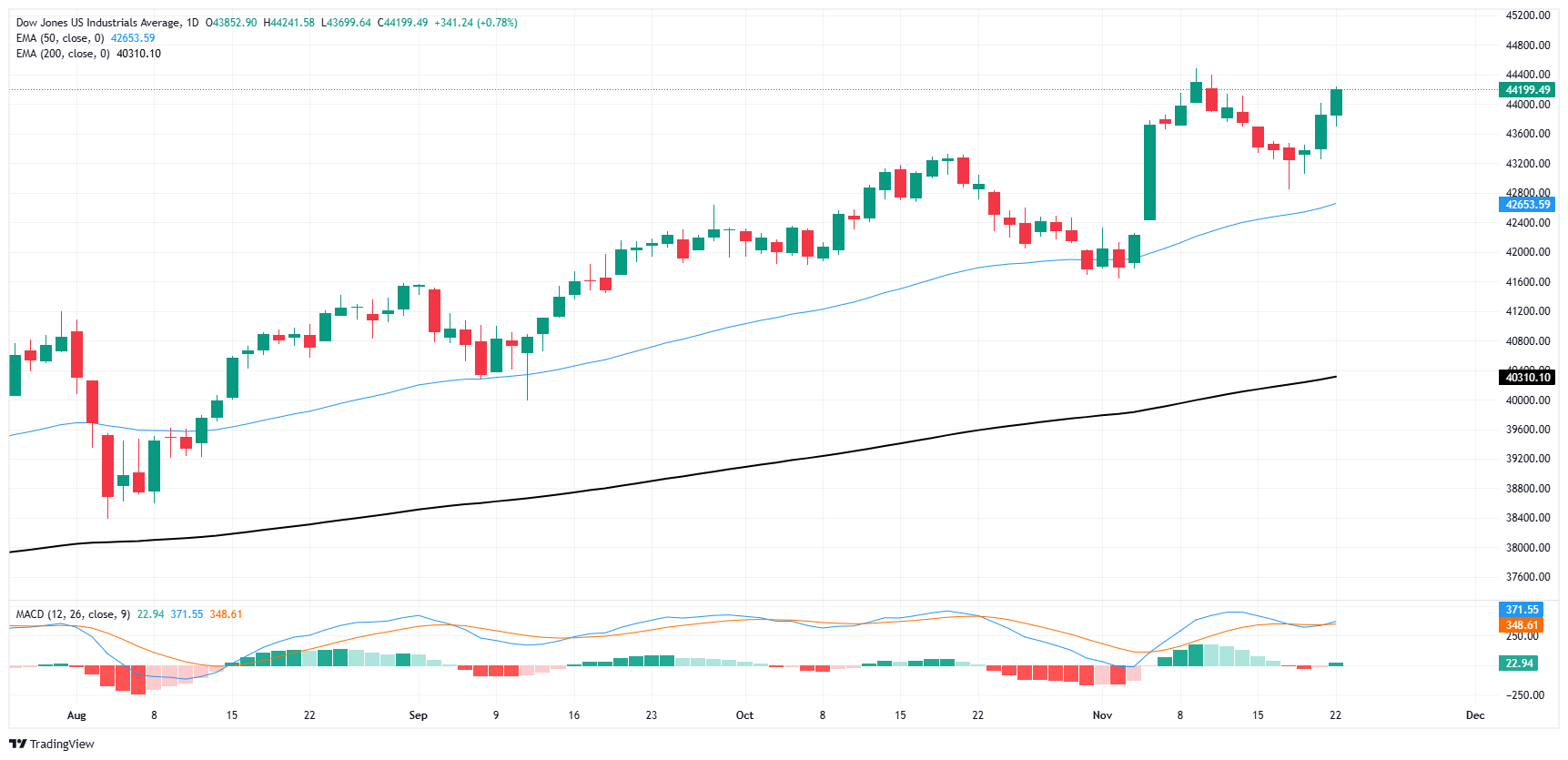
Dow Jones FAQs
The Dow Jones Industrial Average, one of the oldest stock market indices in the world, is compiled of the 30 most traded stocks in the US. The index is price-weighted rather than weighted by capitalization. It is calculated by summing the prices of the constituent stocks and dividing them by a factor, currently 0.152. The index was founded by Charles Dow, who also founded the Wall Street Journal. In later years it has been criticized for not being broadly representative enough because it only tracks 30 conglomerates, unlike broader indices such as the S&P 500.
Many different factors drive the Dow Jones Industrial Average (DJIA). The aggregate performance of the component companies revealed in quarterly company earnings reports is the main one. US and global macroeconomic data also contributes as it impacts on investor sentiment. The level of interest rates, set by the Federal Reserve (Fed), also influences the DJIA as it affects the cost of credit, on which many corporations are heavily reliant. Therefore, inflation can be a major driver as well as other metrics which impact the Fed decisions.
Dow Theory is a method for identifying the primary trend of the stock market developed by Charles Dow. A key step is to compare the direction of the Dow Jones Industrial Average (DJIA) and the Dow Jones Transportation Average (DJTA) and only follow trends where both are moving in the same direction. Volume is a confirmatory criteria. The theory uses elements of peak and trough analysis. Dow’s theory posits three trend phases: accumulation, when smart money starts buying or selling; public participation, when the wider public joins in; and distribution, when the smart money exits.
There are a number of ways to trade the DJIA. One is to use ETFs which allow investors to trade the DJIA as a single security, rather than having to buy shares in all 30 constituent companies. A leading example is the SPDR Dow Jones Industrial Average ETF (DIA). DJIA futures contracts enable traders to speculate on the future value of the index and Options provide the right, but not the obligation, to buy or sell the index at a predetermined price in the future. Mutual funds enable investors to buy a share of a diversified portfolio of DJIA stocks thus providing exposure to the overall index.
Author

Joshua Gibson
FXStreet
Joshua joins the FXStreet team as an Economics and Finance double major from Vancouver Island University with twelve years' experience as an independent trader focusing on technical analysis.