Dow Jones Industrial Average pares losses on Wednesday turnaround
- The Dow Jones rose over 300 points on Wednesday as the index recovered.
- Equities are rebounding from Tuesday’s declines, with indexes sticking close to record highs.
- The recent ‘Fed frenzy’ has abated, with markets confident of a 25 bps cut in November.

The Dow Jones Industrial Average (DJIA) rallied over 300 points on Wednesday as equities pivot around the mid-week inflection point. The Dow Jones is paring away Tuesday’s losses, where the index shed over three-quarters of a percent, keeping price action tight to record highs.
Markets have settled into a holding pattern on Federal Reserve (Fed) rate cuts, with rate traders firmly pricing in 90% odds of a 25 bps rate trim on November 7, with another quarter-point trim firmly priced in for December 18. Investors are exhausted after spending most of 2024 on Fed watch, and Q3 earnings reports have dominated traders’ viewports this week.
The US banking sector posted bumper Q3 earnings this week, dragging multiple indexes to record highs, and a steady stream of warnings about how high interest rates could negatively impact bank profitability has dried up practically overnight. Major players in the tech space, including Amazon (AMZN) and Google (GOOG), are busy inking deals for future nuclear projects. Large-scale companies that deal in data storage and computing farms are looking to provide enough power to server farms being swallowed whole by the amorphous AI sphere.
Costs are rising quickly for the still-budding “AI industry”, a label slapped onto any project that uses large dataset-crunching modeling methods to spit out other recombined, pre-shaped datasets. As energy demand and equivalent power costs soar, the companies selling the shovels in the AI goldrush are looking for ways to deliver cheap, readily available power on a large scale to an industry already grappling with finding value that isn’t direct injections from investors, and future net-positive revenue streams remain elusive.
Dow Jones news
Wednesday is a firm recovery day for the Dow Jones, with two-thirds of the equity index testing into the green. Apple (AAPL) fumbled during the midweek market session, backsliding 1.2% and falling to $231 per share as the tech company took a breather from making recent all-time highs. Intel (INTC) also shed 1.3% to fall below $22.50 per share after it was announced that Qualcomm’s exploratory takeover bid of the chipmaker has been delayed until after the US election in November.
Dow Jones Price forecast
Despite a recent knockback, the Dow Jones continues to test close to record highs. Bullish price action is on pace to take a fresh topside run at the 43,200 level, but intraday bids will first need to firmly recapture the 43,000 handle.
The Dow Jones has climbed over 16% bottom-to-top in 2024, with bullish momentum outrunning the 200-day Exponential Moving Average (EMA) since November of last year. The DJIA has gained nearly 8% in the past two months alone after recovering from a mid-September swing low that pierced the 50-day EMA and tested the 40,000 major price handle.
Dow Jones daily chart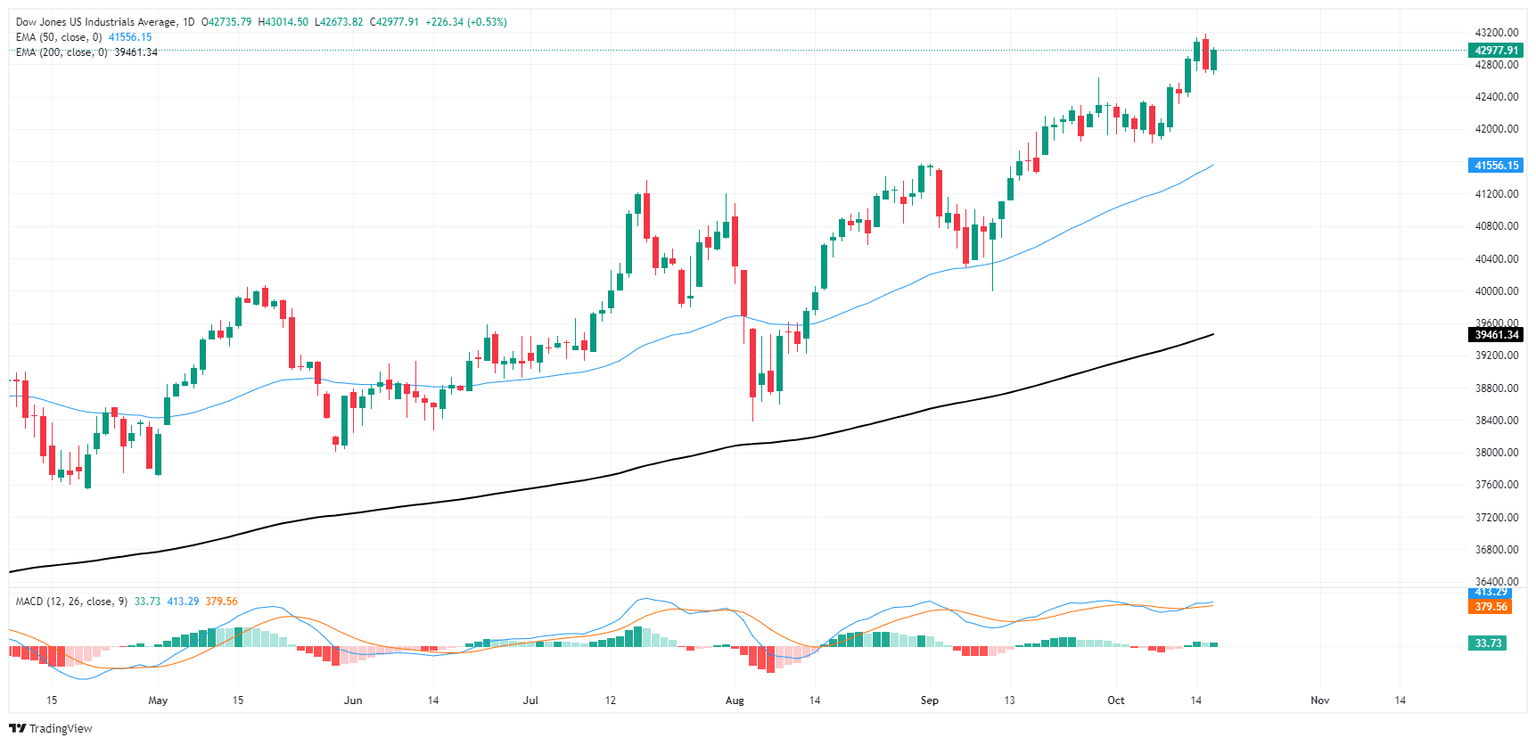
Fed FAQs
Monetary policy in the US is shaped by the Federal Reserve (Fed). The Fed has two mandates: to achieve price stability and foster full employment. Its primary tool to achieve these goals is by adjusting interest rates. When prices are rising too quickly and inflation is above the Fed’s 2% target, it raises interest rates, increasing borrowing costs throughout the economy. This results in a stronger US Dollar (USD) as it makes the US a more attractive place for international investors to park their money. When inflation falls below 2% or the Unemployment Rate is too high, the Fed may lower interest rates to encourage borrowing, which weighs on the Greenback.
The Federal Reserve (Fed) holds eight policy meetings a year, where the Federal Open Market Committee (FOMC) assesses economic conditions and makes monetary policy decisions. The FOMC is attended by twelve Fed officials – the seven members of the Board of Governors, the president of the Federal Reserve Bank of New York, and four of the remaining eleven regional Reserve Bank presidents, who serve one-year terms on a rotating basis.
In extreme situations, the Federal Reserve may resort to a policy named Quantitative Easing (QE). QE is the process by which the Fed substantially increases the flow of credit in a stuck financial system. It is a non-standard policy measure used during crises or when inflation is extremely low. It was the Fed’s weapon of choice during the Great Financial Crisis in 2008. It involves the Fed printing more Dollars and using them to buy high grade bonds from financial institutions. QE usually weakens the US Dollar.
Quantitative tightening (QT) is the reverse process of QE, whereby the Federal Reserve stops buying bonds from financial institutions and does not reinvest the principal from the bonds it holds maturing, to purchase new bonds. It is usually positive for the value of the US Dollar.
Author
Joshua Gibson
FXStreet
Joshua joins the FXStreet team as an Economics and Finance double major from Vancouver Island University with twelve years' experience as an independent trader focusing on technical analysis.