Dow Jones Industrial Average extends further, adds 150 points on Tuesday
- The Dow Jones gained 150 points on Tuesday at its peak.
- The Fed’s latest rate call looms ahead in the midweek.
- Tariff threats from US President Trump hang over the markets.

The Dow Jones Industrial Average (DJIA) rose around 250 points on Tuesday at its highest point, climbing one-half of one percent before settling to a more pedestrian +150 points on the day, and chalking in a fresh eight-week high as investors shrug off fresh volatility in the face of renewed trade war threats from United States (US) President Donald Trump. The Federal Reserve’s (Fed) latest rate call is on the cards for this week. While traders are always on the lookout for signs of future rate cuts from the Fed, market attention has been split between a fresh round of tariffs being threatened by President Trump and the tech sector getting dominated by new Chinese entrants to the space.
US Durable Goods Orders contracted further in December, falling 2.2% versus the expected rebound of 0.8%. However, the figure remains well within recent norms. Durable Goods Orders Excluding Automotive purchases rose 0.3%, falling just shy of forecasts but still recovering from the previous month’s -0.2% contraction. It’s no surprise the pace of vehicle purchasing is slowing: US consumers are saddled with nearly $1.7 trillion in automotive debt, representing nearly a tenth of all consumer debt, including mortgages, with car payments outpacing student loans or credit cards.
US President Donald Trump hit the ground running late Monday, revitalizing his sweeping tariff threats and renewing his promises to impose stiff import fees on a wide range of foreign goods and entire industry sectors. The latest iteration of President Trump’s plans to tax US consumers until foreign businesses move their factories include ambiguous levies on steel, copper, aluminum, various and “other” semiconductors, as well as foreign microprocessors in general.
Convincing all of these sectors to move production to the US is a tall bid as the US is generally cost-prohibitive to construct factories in, and US labor tends to command a level of wages that are multiples above the typical wages found in other countries where industrial goods are produced in large quantities. Import fees are unlikely to have much effect except to drive inflation and suppress consumer spending.
The Fed is slated to deliver its latest rate call on Wednesday. No moves on the fed funds rate is expected this week, but traders will be tuning in for any developments in the warming drama between Fed Chair Jerome Powell and President Trump. The Fed enjoys a high level of autonomy that puts control of interest rates out of reach of the White House, a fact that President Trump has lamented about in the past. Donald Trump’s latest statements that he will “demand” lower interest rates are sure to weigh on Chair Powell’s press conference this week.
Dow Jones news
Despite some thin losses spread around the bottom half of the Dow Jones. Key industrial leaders are gaining ground, outpacing the losers and bolstering the overall equity index. Boeing (BA) rose 6.5% to $186 per share, followed by Salesforce (CRM) which climbed 5.5% to $366 per share.
Dow Jones price forecast
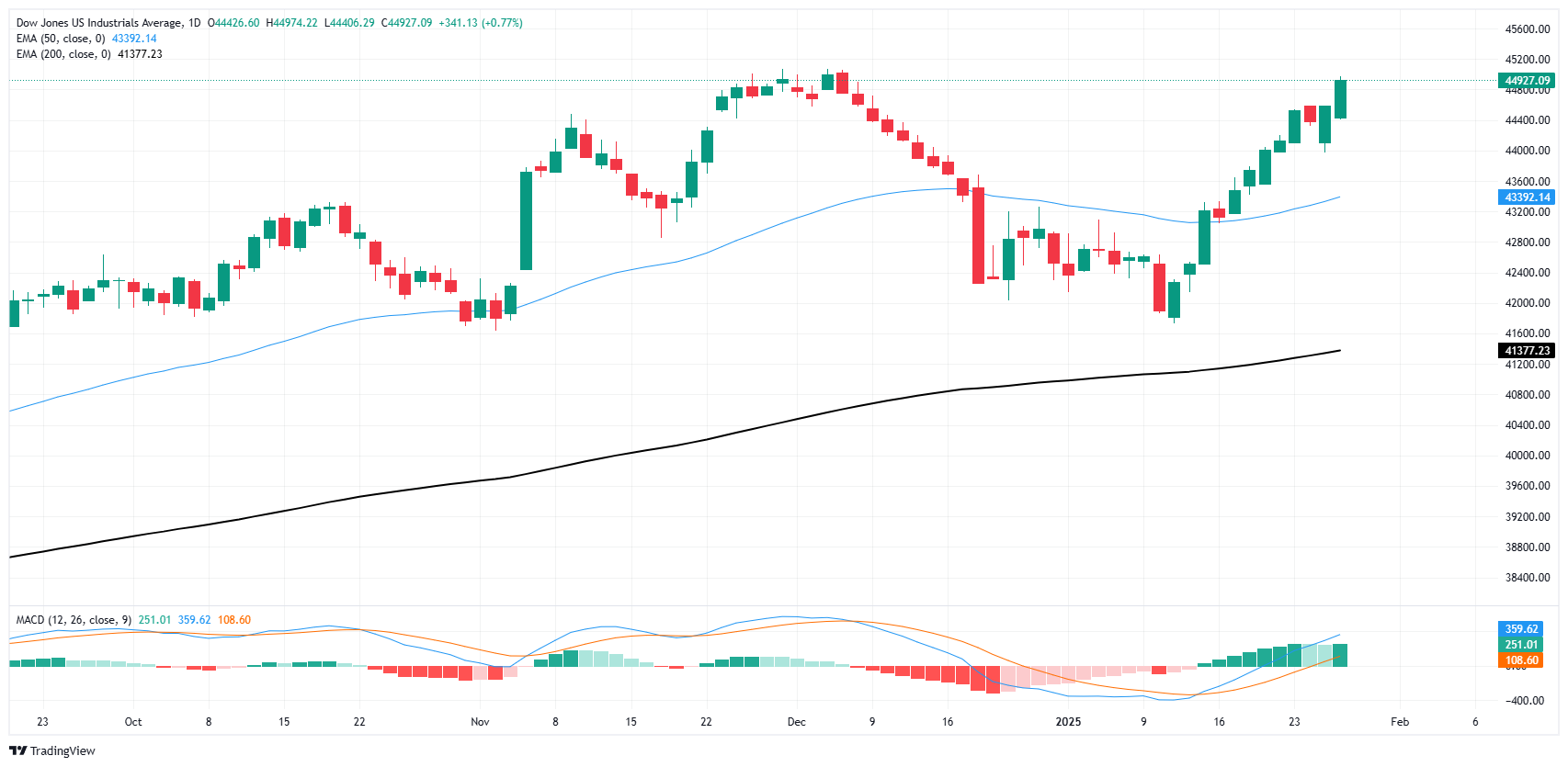
The Dow Jones Industrial Average is well on its way to etching in a third straight positive week, a welcome reprieve for bulls after struggling to recover their footing through a six-week backslide that kicked off at the Dow’s record highs above 45,000 last November. The DJIA is set to break through previous peaks and set new all-time highs.
Dow Jones daily chart
Dow Jones FAQs
The Dow Jones Industrial Average, one of the oldest stock market indices in the world, is compiled of the 30 most traded stocks in the US. The index is price-weighted rather than weighted by capitalization. It is calculated by summing the prices of the constituent stocks and dividing them by a factor, currently 0.152. The index was founded by Charles Dow, who also founded the Wall Street Journal. In later years it has been criticized for not being broadly representative enough because it only tracks 30 conglomerates, unlike broader indices such as the S&P 500.
Many different factors drive the Dow Jones Industrial Average (DJIA). The aggregate performance of the component companies revealed in quarterly company earnings reports is the main one. US and global macroeconomic data also contributes as it impacts on investor sentiment. The level of interest rates, set by the Federal Reserve (Fed), also influences the DJIA as it affects the cost of credit, on which many corporations are heavily reliant. Therefore, inflation can be a major driver as well as other metrics which impact the Fed decisions.
Dow Theory is a method for identifying the primary trend of the stock market developed by Charles Dow. A key step is to compare the direction of the Dow Jones Industrial Average (DJIA) and the Dow Jones Transportation Average (DJTA) and only follow trends where both are moving in the same direction. Volume is a confirmatory criteria. The theory uses elements of peak and trough analysis. Dow’s theory posits three trend phases: accumulation, when smart money starts buying or selling; public participation, when the wider public joins in; and distribution, when the smart money exits.
There are a number of ways to trade the DJIA. One is to use ETFs which allow investors to trade the DJIA as a single security, rather than having to buy shares in all 30 constituent companies. A leading example is the SPDR Dow Jones Industrial Average ETF (DIA). DJIA futures contracts enable traders to speculate on the future value of the index and Options provide the right, but not the obligation, to buy or sell the index at a predetermined price in the future. Mutual funds enable investors to buy a share of a diversified portfolio of DJIA stocks thus providing exposure to the overall index.
Author

Joshua Gibson
FXStreet
Joshua joins the FXStreet team as an Economics and Finance double major from Vancouver Island University with twelve years' experience as an independent trader focusing on technical analysis.
















