Dow Jones Industrial Average stumbles on downbeat NFP Friday
- The Dow Jones fell another 400 points on Friday after NFP jobs data missed the mark.
- US job additions continue to underperform, and downside revisions remain a concern.
- Despite the miss in NFP employment, market bets for a 25 bps cut come out on top.

The Dow Jones Industrial Average (DJIA) shed 400 points on Friday after US Nonfarm Payrolls (NFP) came in below expectations, alongside a downard revision to previous figures. Lopsided jobs growth has dropped further signals that the US economy is slowing down, but not slow enough to spark firmer bets of a double cut from the Federal Reserve (Fed) later this month.
According to the Bureau of Labor Statistics (BLS), US NFP employment rose 142K in August, less than the expected 160K but improved from the previous month, which was also revised lower to just 89K from the initial print of 114K. Despite the overall negative tone in jobs figures, US Average Hourly Earnings rose faster than expected, climbing 3.8% YoY in August, beating the expected 3.7% and rising from the previous period’s 3.6%.
The August NFP jobs report showed a weaker-than-expected pickup in the number of hirings for the month, helping to keep rate cut bets buoyed. However, markets had a hard time drawing a bead on where the overall jobs report landed. The headline number of job additions, despite missing forecasts, was still up from the previous period, but the underlying trend within the jobs report showed most of those gains in employment came from leisure and hospitality, and health care and social assistance.
Manufacturing, retail trade, and information sectors all saw declines in headline employment figures, flashing warning signs that the US economy is indeed heading for a slowdown. The contraction in physical business and production sewered the Dow Jones, an index heavily representing physical manufacturing businesses.
Despite the overall miss in employment figures, and even more warning signs that investors have good reason to be concerned about a looming recession in the quarters to come, markets eased back from bets of a double rate cut on September 18. According to the CME’s FedWatch Tool, rate trades now see 75% odds of an initial 25 bps cut from the Fed this month, with only 25% betting on an initial 50 bps rate trim. Odds have recovered from this week’s previous probabilities of a 40-60 split in favor of a double rate trim after markets decided that Friday’s NFP print, despite not being the greatest, also wasn’t the worst.
Dow Jones news
The Dow Jones was thoroughly softened on Friday, with all but five of the equity board’s listed stocks testing into the low end to wrap up the trading week. McDonald’s (MCD) managed to squeeze out a 1.3% gain to $292.00 per share, with Procter & Gamble (PG) rising one half of one percent to $176.35 per share.
American Express (AXP) fell the hardest on Friday, declining 3.3% to $243.60 per share. The payments and card services company was closely followed by Amazon.com (AMZN), which fell around 3.25% to $ 172.00 per share.
Dow Jones price forecast
Friday’s plunge has put the Dow Jones chart on a collision course with the 50-day Exponential Moving Average (EMA) at 40,283, with the major index chalking in another full percentage point loss off the top. The DJIA has now declined a full 3% in just over a week, after hitting a fresh all-time peak of 41,574 just last week.
Despite near-term losses, the Dow Jones continues to trade well into the high side. Price action would need to fall another 4.65% before reaching the 200-day EMA at 38,434, and bidders are set to defend momentum barriers near the 40,000 major price handle.
Dow Jones daily chart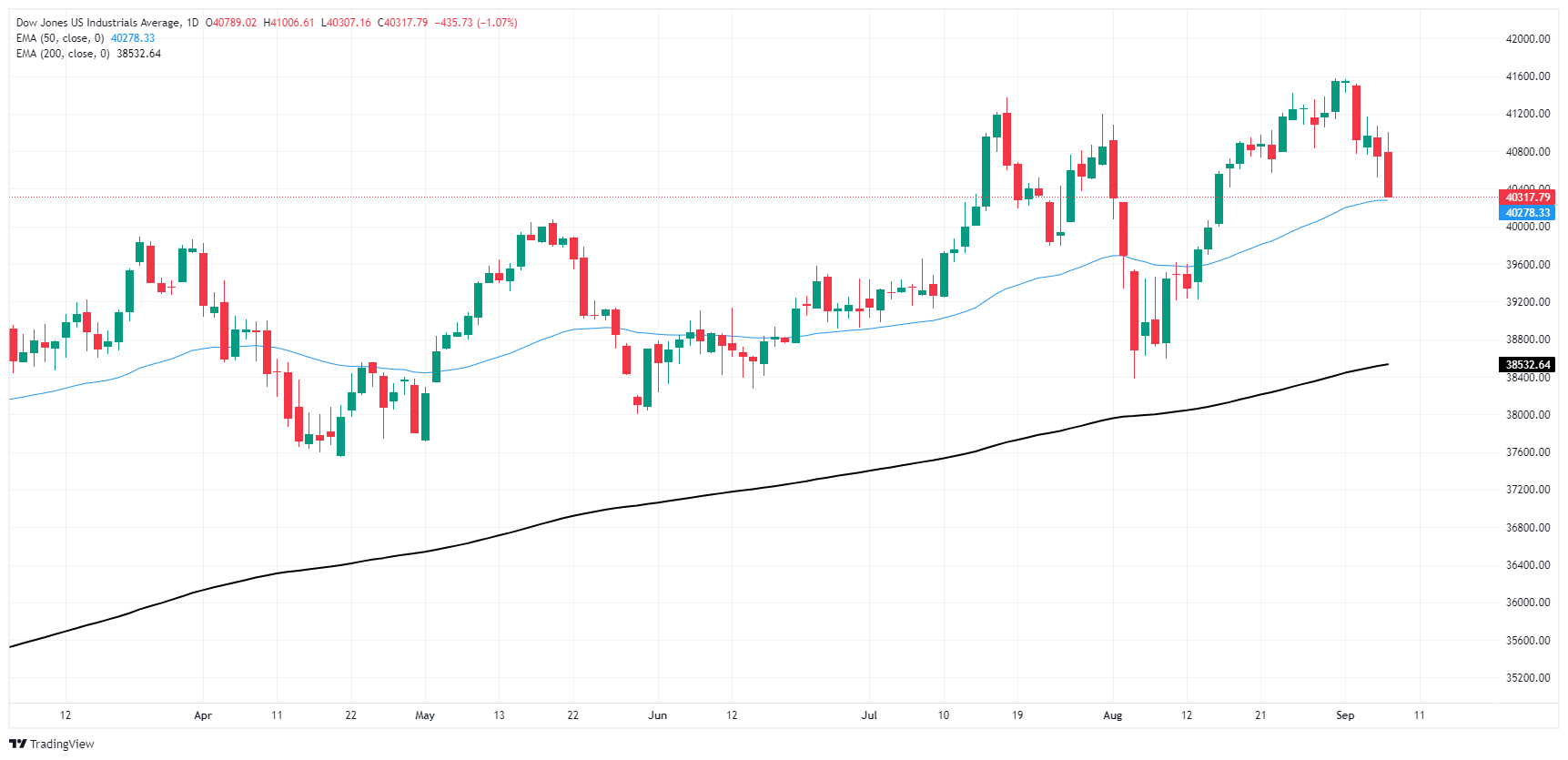
Economic Indicator
Nonfarm Payrolls
The Nonfarm Payrolls release presents the number of new jobs created in the US during the previous month in all non-agricultural businesses; it is released by the US Bureau of Labor Statistics (BLS). The monthly changes in payrolls can be extremely volatile. The number is also subject to strong reviews, which can also trigger volatility in the Forex board. Generally speaking, a high reading is seen as bullish for the US Dollar (USD), while a low reading is seen as bearish, although previous months' reviews and the Unemployment Rate are as relevant as the headline figure. The market's reaction, therefore, depends on how the market assesses all the data contained in the BLS report as a whole.
Read more.Last release: Fri Sep 06, 2024 12:30
Frequency: Monthly
Actual: 142K
Consensus: 160K
Previous: 114K
Source: US Bureau of Labor Statistics
America’s monthly jobs report is considered the most important economic indicator for forex traders. Released on the first Friday following the reported month, the change in the number of positions is closely correlated with the overall performance of the economy and is monitored by policymakers. Full employment is one of the Federal Reserve’s mandates and it considers developments in the labor market when setting its policies, thus impacting currencies. Despite several leading indicators shaping estimates, Nonfarm Payrolls tend to surprise markets and trigger substantial volatility. Actual figures beating the consensus tend to be USD bullish.
Author

Joshua Gibson
FXStreet
Joshua joins the FXStreet team as an Economics and Finance double major from Vancouver Island University with twelve years' experience as an independent trader focusing on technical analysis.