Crude Oil sees earlier OPEC headline fading quick
- Crude Oil still trades substantially lower after several headwinds emerged on Tuesday.
- OPEC is considering to delay its Oil output hike, according to delegates.
- The US Dollar Index trades above 101.00 ahead of the US Jobs Report on Friday.

Crude Oil popped back above $70.00 after headlines around OPEC possibly delaying its production normalization, though sees that attempt stalling with still losses at hand after the 5% drop on Tuesday left Oil trading at its lowest level this year so far. Several headlines that came out on Tuesday were just too much to bear for Oil traders, sending the black fuel in a selloff spin. The headwinds are double-fold, taking place both on the demand side and on the sell side of the equation.
On the demand side, recent Purchasing Managers Index data out of China showed another severe slowdown in its manufacturing sector, which means more sluggish demand for Oil ahead. Meanwhile in Europe, one of Germany’s core companies, Volkswagen, has announced plans to close several factories in its native homeland, a sign on the wall that Europe could be facing a severe recession. On the supply side, OPEC looks to be backtracking on earlier commitments though nothing is guaranteed, while the political impasse in Libya is nearly resolved and might see Libyan Oil heading back to markets quicker than expected.
The US Dollar Index (DXY), which tracks the performance of the US Dollar against a bucket of currencies, is holding ground above 101.00. All eyes are on the data points later this week, with several analysts having pencilled in that the US Jobs Report from Friday might be the deciding factor for the US Federal Reserve to cut interest rates either by 25 basis points or by 50 basis points. This makes Friday’s Nonfarm Payrolls print even more important.
At the time of writing, Crude Oil (WTI) trades at $69.54 and Brent Crude at $73.22
Oil news and market movers: OPEC headline already priced in?
- Bloomberg reports several delegates mentioned that OPEC is considering to delay its Oil output hike of 180,000 barrels per day.
- At 20:30 GMT, the American Petroleum Institute (API) will release its weekly crude oil stockpile change number. In the previous week, there was a drawdown of 3.4 million barrels.
- Bloomberg reports that the issue concerning who should lead the Libyan central bank is set to be resolved soon, opening up the Oil output for the country.
- US Crude exports have found their way to India, with the US trying to push Russia out of its leading role as the main deliverer. According to ship-tracking data, nearly $1 billion worth of crude Oil has been delivered to India from the US, according to Business Standard news.
Oil Technical Analysis: OPEC attempts to support
Crude Oil’s price action on Tuesday must have hurted a lot of parties. However, traders should not have been surprised by this move considering the recent string of headlines and data that pointed to an imbalance between oversupply – and more supply to come online – versus economic softer data with even some recession signals. More downturn could come ahead before a bounce can occur.
On that upside, the lost level at $75.27 will be the first level to head back to if possible. Next up, the double level at $77.55 aligns with both a descending trendline and the 200-day Simple Moving Average (SMA). In case bulls are able to break above it, the 100-day SMA at $78.54 could trigger a rejection.
On the downside, the low from August 5 at $71.17 has been broken. From here, the $68.00 big figure is the first level to watch, followed by $67.11, which is the lowest point from the triple bottom seen back in June 2023.
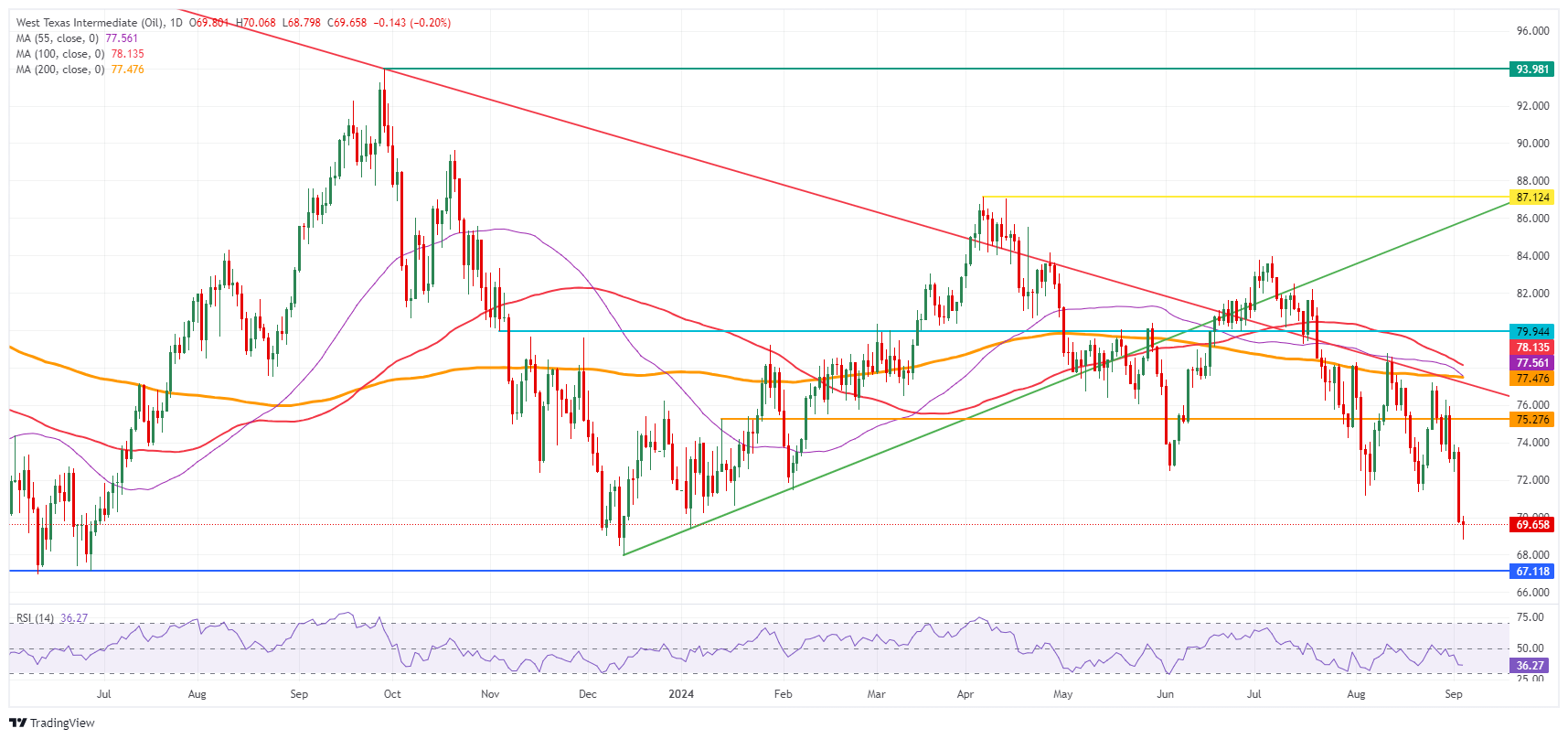
US WTI Crude Oil: Daily Chart
WTI Oil FAQs
WTI Oil is a type of Crude Oil sold on international markets. The WTI stands for West Texas Intermediate, one of three major types including Brent and Dubai Crude. WTI is also referred to as “light” and “sweet” because of its relatively low gravity and sulfur content respectively. It is considered a high quality Oil that is easily refined. It is sourced in the United States and distributed via the Cushing hub, which is considered “The Pipeline Crossroads of the World”. It is a benchmark for the Oil market and WTI price is frequently quoted in the media.
Like all assets, supply and demand are the key drivers of WTI Oil price. As such, global growth can be a driver of increased demand and vice versa for weak global growth. Political instability, wars, and sanctions can disrupt supply and impact prices. The decisions of OPEC, a group of major Oil-producing countries, is another key driver of price. The value of the US Dollar influences the price of WTI Crude Oil, since Oil is predominantly traded in US Dollars, thus a weaker US Dollar can make Oil more affordable and vice versa.
The weekly Oil inventory reports published by the American Petroleum Institute (API) and the Energy Information Agency (EIA) impact the price of WTI Oil. Changes in inventories reflect fluctuating supply and demand. If the data shows a drop in inventories it can indicate increased demand, pushing up Oil price. Higher inventories can reflect increased supply, pushing down prices. API’s report is published every Tuesday and EIA’s the day after. Their results are usually similar, falling within 1% of each other 75% of the time. The EIA data is considered more reliable, since it is a government agency.
OPEC (Organization of the Petroleum Exporting Countries) is a group of 13 Oil-producing nations who collectively decide production quotas for member countries at twice-yearly meetings. Their decisions often impact WTI Oil prices. When OPEC decides to lower quotas, it can tighten supply, pushing up Oil prices. When OPEC increases production, it has the opposite effect. OPEC+ refers to an expanded group that includes ten extra non-OPEC members, the most notable of which is Russia.
Author

Filip Lagaart
FXStreet
Filip Lagaart is a former sales/trader with over 15 years of financial markets expertise under its belt.