Crude Oil sinks on risk OPEC+ will disappoint in its December meeting
- Crude Oil gives up gains from last week with geopolitical tensions fading between Russia and Ukraine faded over the weekend.
- The OPEC+ meeting on December 1 is marked to be pivotal as a delay in production normalization is expected.
- The US Dollar Index retreats after breaking a fresh two-year high last week.

Crude Oil is sliding lower, giving up the $70-marker for more downturn, after a calmer weekend on the geopolitical front and ahead of a holiday-shortened week in the US due to Thanksgiving. The focus for the week, apart from any headlines from Russia-Ukraine or the Middle East, will be on the OPEC+ meeting set to take place on Sunday, December 1.
Meanwhile, the US Dollar Index (DXY), which measures the Greenback’s performance against a basket of currencies, is also taking a step back after its stellar performance last week. Over the weekend, President-elect Donald Trump nominated former hedge fund manager Scott Bessent for the Treasury Secretary position. Markets perceive Bessent as a fiscal hawk, targeting a budget deficit of 3% of GDP by 2028, while indicating that he is backing tariff and tax cut plans.
At the time of writing, Crude Oil (WTI) trades at $69.95 and Brent Crude at $73.55
Oil news and market movers: Distorted week ahead for US Crude data
- With the US Thanksgiving holiday taking place on Thursday, the weekly American Petroleum Institute release (API) will stay on Tuesday, while the weekly stockpile change numbers from the Energy Information Administration (EIA) and the Baker Hughes Oil Rig Count will be released on Wednesday.
- Volatility and low liquidity could be an issue on Thursday and Friday, with the historic pattern from OPEC+ members to communicate their stance or opinions ahead of the December 1 meeting, Bloomberg points out. Any comments could move Oil markets during Thanksgiving and Black Friday.
- Weekly Vortexa data shows that the amount of Crude Oil held around the world on tankers that have been stationary for at least 7 days rose to 74.83 million barrels as of November 22, a 34% increase compared with the previous week at 55.76 million barrels in the week of November 15th, Bloomberg reports.
Oil Technical Analysis: OPEC+ expected to stall decision again
Crude Oil price is set to enter a dangerous phase ahead of one of the last OPEC+ meetings for this year. Not only is this meeting crucial in terms of when in 2025 the production normalization will take place, but in the days running up towards that meeting on Sunday, US markets will be closed due to Thanksgiving and Black Friday. In this context, any market moving comments could see sharp moves with thin liquidity and less-than-normal market participants in place.
On the upside, the 100-day Simple Moving Average (SMA) at $72.67 together with the pivotal level at $71.46 just below, are the two main elements acting as a resistance. The 200-day SMA at $76.42 is still far off, although it could be tested if tensions intensify further. In its rally towards that 200-day SMA, the pivotal level at $75.27 could still slow down any upticks.
On the other side, traders need to look towards $67.12 – a level that held the price in May and June 2023 – to find the first support. In case that breaks, the 2024 year-to-date low emerges at $64.75, followed by $64.38, the low from 2023.
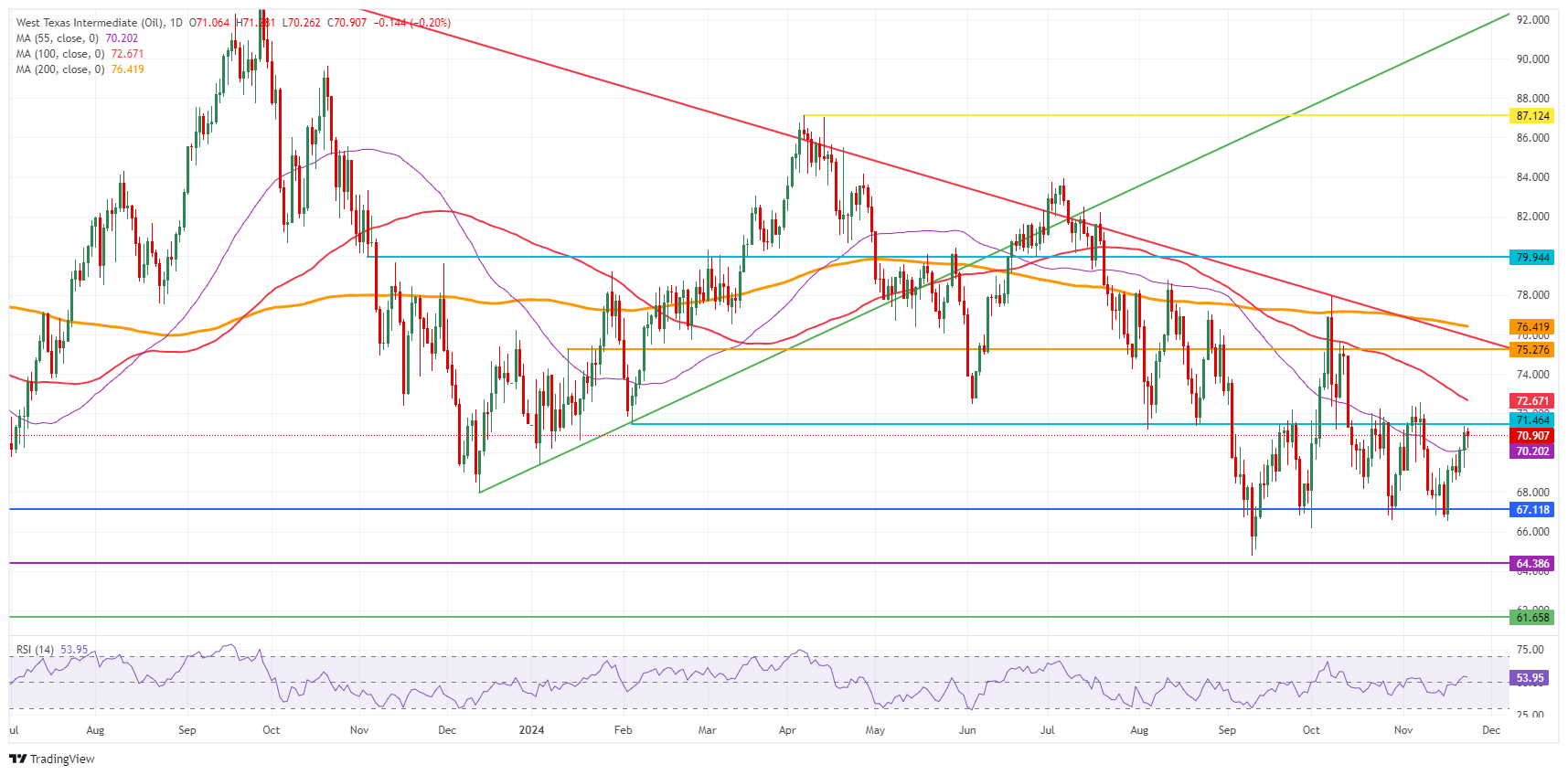
US WTI Crude Oil: Daily Chart
WTI Oil FAQs
WTI Oil is a type of Crude Oil sold on international markets. The WTI stands for West Texas Intermediate, one of three major types including Brent and Dubai Crude. WTI is also referred to as “light” and “sweet” because of its relatively low gravity and sulfur content respectively. It is considered a high quality Oil that is easily refined. It is sourced in the United States and distributed via the Cushing hub, which is considered “The Pipeline Crossroads of the World”. It is a benchmark for the Oil market and WTI price is frequently quoted in the media.
Like all assets, supply and demand are the key drivers of WTI Oil price. As such, global growth can be a driver of increased demand and vice versa for weak global growth. Political instability, wars, and sanctions can disrupt supply and impact prices. The decisions of OPEC, a group of major Oil-producing countries, is another key driver of price. The value of the US Dollar influences the price of WTI Crude Oil, since Oil is predominantly traded in US Dollars, thus a weaker US Dollar can make Oil more affordable and vice versa.
The weekly Oil inventory reports published by the American Petroleum Institute (API) and the Energy Information Agency (EIA) impact the price of WTI Oil. Changes in inventories reflect fluctuating supply and demand. If the data shows a drop in inventories it can indicate increased demand, pushing up Oil price. Higher inventories can reflect increased supply, pushing down prices. API’s report is published every Tuesday and EIA’s the day after. Their results are usually similar, falling within 1% of each other 75% of the time. The EIA data is considered more reliable, since it is a government agency.
OPEC (Organization of the Petroleum Exporting Countries) is a group of 12 Oil-producing nations who collectively decide production quotas for member countries at twice-yearly meetings. Their decisions often impact WTI Oil prices. When OPEC decides to lower quotas, it can tighten supply, pushing up Oil prices. When OPEC increases production, it has the opposite effect. OPEC+ refers to an expanded group that includes ten extra non-OPEC members, the most notable of which is Russia.
Author

Filip Lagaart
FXStreet
Filip Lagaart is a former sales/trader with over 15 years of financial markets expertise under its belt.