Crude Oil back to flat amidst geopolitical headlines from Middle East and Ukraine
- Crude Oil flat amidst markets trying to balance possible US onshore glut against geopolitical risks.
- Headlines risk picks up as well on the 1,000th day of escalations between Russia and Ukraine.
- The US Dollar Index recovers from Monday’s low amid safe-haven inflows.

Crude Oil price trades flat after being on the back foot due to a key gauge on the US Crude market signaling a substantial glut taking place for the first time in nine months. The spread in price between Oil futures contracts for immediate deliveries against those a month later is trading negatively for the first time since February and is an important sign of a bearish market outlook as it suggests sellers need to lower their prices in order to get rid of their inventory by the time the next supply comes in.
The US Dollar Index (DXY) pares back Monday’s losses, driven by headlines of risk in Ukraine and Russia. Russian President Vladimir Putin has signed a decree approving changes to Moscow’s nuclear doctrine, allowing the usage of nuclear weapons in Ukraine should the country target Russian installations within Russian borders. Ukraine, meanwhile, has pressed ahead and has launched its first ATACMS (Army Tactical Missile System) missiles into Russia, Bloomberg reports, citing local sources. This triggered some safe-haven inflows into the US Dollar (USD) and the Japanese Yen (JPY).
At the time of writing, Crude Oil (WTI) trades at $69.04 and Brent Crude at $73.00
Oil news and market movers: Geopolitics driving
- Lebanon and Hamas have both agreed to the US ceasefire deal which is on the table, with talks still ongoing to get the deal ratified by Israel, Reuters reports.
- The International Energy Agency (IEA) has warned that for 2025, a surplus of more than 1 million barrels per day will be taking place, Bloomberg reports.
- Physical prices of WTI Midland at the Magellan East Houston rose to the highest since the end of September after Kazakhstan and Norway shut production for unplanned repairs, Bloomberg reports.
- The American Petroleum Institute (API) is set to release its weekly Crude stockpile change numbers for the week ending November 15. The forecast is for a build of 0.8 million barrels against the drawdown of 0.777 million the previous week.
Oil Technical Analysis: Bearish outlook persists
Crude Oil price is ticking lower on Tuesday, with the previous day’s brief spark stalling ahead of the first cap on the topside at $70.05. While concerns about China persist, threats on US supply arising now in the futures market just add to more bearish news. The risk of more downside is thus greater than the upside when looking at the fundamentals and ignoring the turn of events between Russia and Ukraine.
On the upside, the 55-day Simple Moving Average (SMA) at $70.05 is the first barrier to consider before the hefty technical level at $73.17, which aligns with the 100-day SMA. The 200-day SMA at $76.56 is still quite far off, although it could be tested if tensions intensify further.
On the other side, traders need to look towards $67.12 – a level that held the price in May and June 2023 – to find the first support. In case that breaks, the 2024 year-to-date low emerges at $64.75, followed by $64.38, the low from 2023.
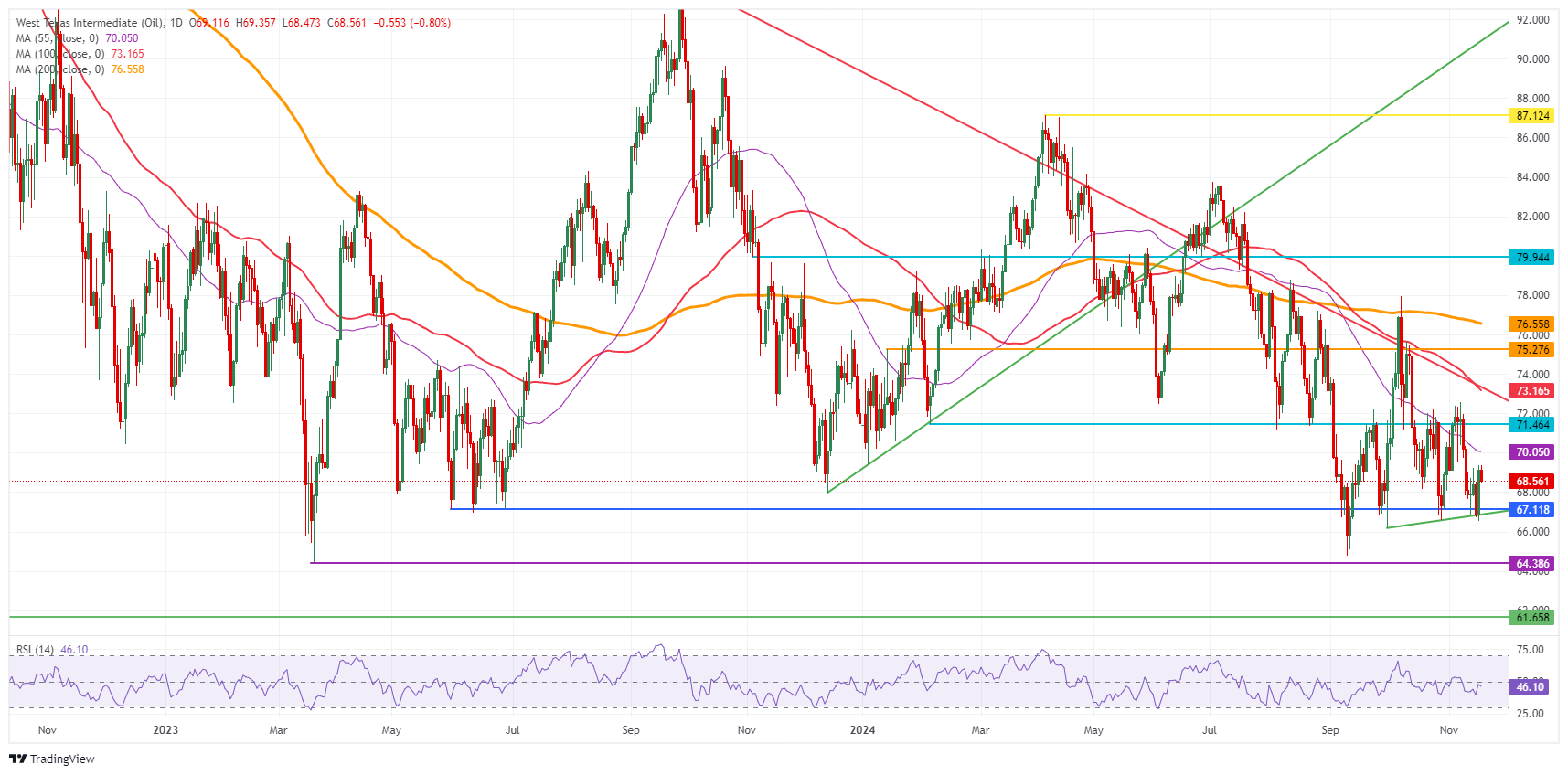
US WTI Crude Oil: Daily Chart
WTI Oil FAQs
WTI Oil is a type of Crude Oil sold on international markets. The WTI stands for West Texas Intermediate, one of three major types including Brent and Dubai Crude. WTI is also referred to as “light” and “sweet” because of its relatively low gravity and sulfur content respectively. It is considered a high quality Oil that is easily refined. It is sourced in the United States and distributed via the Cushing hub, which is considered “The Pipeline Crossroads of the World”. It is a benchmark for the Oil market and WTI price is frequently quoted in the media.
Like all assets, supply and demand are the key drivers of WTI Oil price. As such, global growth can be a driver of increased demand and vice versa for weak global growth. Political instability, wars, and sanctions can disrupt supply and impact prices. The decisions of OPEC, a group of major Oil-producing countries, is another key driver of price. The value of the US Dollar influences the price of WTI Crude Oil, since Oil is predominantly traded in US Dollars, thus a weaker US Dollar can make Oil more affordable and vice versa.
The weekly Oil inventory reports published by the American Petroleum Institute (API) and the Energy Information Agency (EIA) impact the price of WTI Oil. Changes in inventories reflect fluctuating supply and demand. If the data shows a drop in inventories it can indicate increased demand, pushing up Oil price. Higher inventories can reflect increased supply, pushing down prices. API’s report is published every Tuesday and EIA’s the day after. Their results are usually similar, falling within 1% of each other 75% of the time. The EIA data is considered more reliable, since it is a government agency.
OPEC (Organization of the Petroleum Exporting Countries) is a group of 12 Oil-producing nations who collectively decide production quotas for member countries at twice-yearly meetings. Their decisions often impact WTI Oil prices. When OPEC decides to lower quotas, it can tighten supply, pushing up Oil prices. When OPEC increases production, it has the opposite effect. OPEC+ refers to an expanded group that includes ten extra non-OPEC members, the most notable of which is Russia.
Author

Filip Lagaart
FXStreet
Filip Lagaart is a former sales/trader with over 15 years of financial markets expertise under its belt.

















