Crude Oil pops on Kazakh oil field disruption
- Crude Oil adrift with China concerns still at hand.
- The Karachaganak Oil field is reporting a fall in output by 30%.
- The US Dollar Index hit with selling pressure, trading at the lower boundary of September’s bandwidth.

Crude Oil sees some upticks this Monday as headline emerge on Kazakhstan and its main oil field Karachaganak, where oil output has fallen by 30% last week, RTRS reports. Price action this week will largely depend on the US Federal Reserve (Fed), which is set to cut interest rates with markets deeply divided over whether rates will be lowered by only 25 basis points (bps) or by 50 bps. Traders would stem a bigger rate cut as supportive of growth and demand, supporting Crude Oil prices.
The US Dollar Index (DXY), which tracks the performance of the US Dollar (USD) against a basket of currencies, is facing downward pressure as well. With a bigger-than-expected rate cut on the cards, the Greenback loses its power over other currencies as rate differentials with other central banks would get tighter. All eyes will be of Fed Chairman Jerome Powell on Wednesday.
At the time of writing, Crude Oil (WTI) trades at $69.28 and Brent Crude at $71.56.
Oil news and market movers: Brief bullish reaction
- Bloomberg reports that RTRS has issued a statement that the Karachaganak Oil field in Kazakhstan has reduced its output last week by 30% on unforseen disruptions.
- The Commodity Futures Trading Commission (CFTC) has revealed in its weekly report that traders are net bearish Brent futures for the first time since September 2011. Short positions outnumbered long bets by 12,680 lots in the week ended Sept. 10, Bloomberg reports.
- Libya is still in an impasse over who should control its central bank. UN-led talks broke down again with the impasse still in place. This in its turn causes the country’s crude exports to continue to slump, Reuters reports.
- Meanwhile, Houthi rebels claim to have fired hypersonic missiles during their attacks in Israel over the weekend, the New York Times reports. The rare attack is an illustration of how the conflict is picking up in the Middle East.
- A streak of Chinese economic data published on Saturday showed that Industrial Production, Retail Sales and Fixed Asset Investment grew at a slower pace than expected in August. Lower economic activity in China means less demand for Oil.
Oil Technical Analysis: Fed to be pivotal even for Oil
Crude Oil price is being torn between bears and bulls, although not much evidence is in favor of the bulls. Several elements are factored in at the moment (sluggish global demand, disappointing Chinese data, production normalization from OPEC), but one element is still to come and could snap the rud for Crude Oil: the Fed rate decision. A bigger-than-expected rate cut could see Crude Oil rally in the assumption that demand would pick up and lower rates would unfreeze shelved projects and investments that demand Oil to be developed.
The first level on the upside is $70.00. Once there has been a daily close above the level, $71.46 gets back on the table as the first level to look out for. Ultimately, a return to $75.27 is still possible, but would likely come after a seismic shift in current balances.
Support should be very close by at $68.19, which was the triple bottom back in the summer of 2023. The next level further down the line is $64.38, the low from March and May 2023. Should that level face a second test and snap, $61.65 becomes a target, with of course $60.00 as a psychologically big figure just below it, at least tempting to be tested.
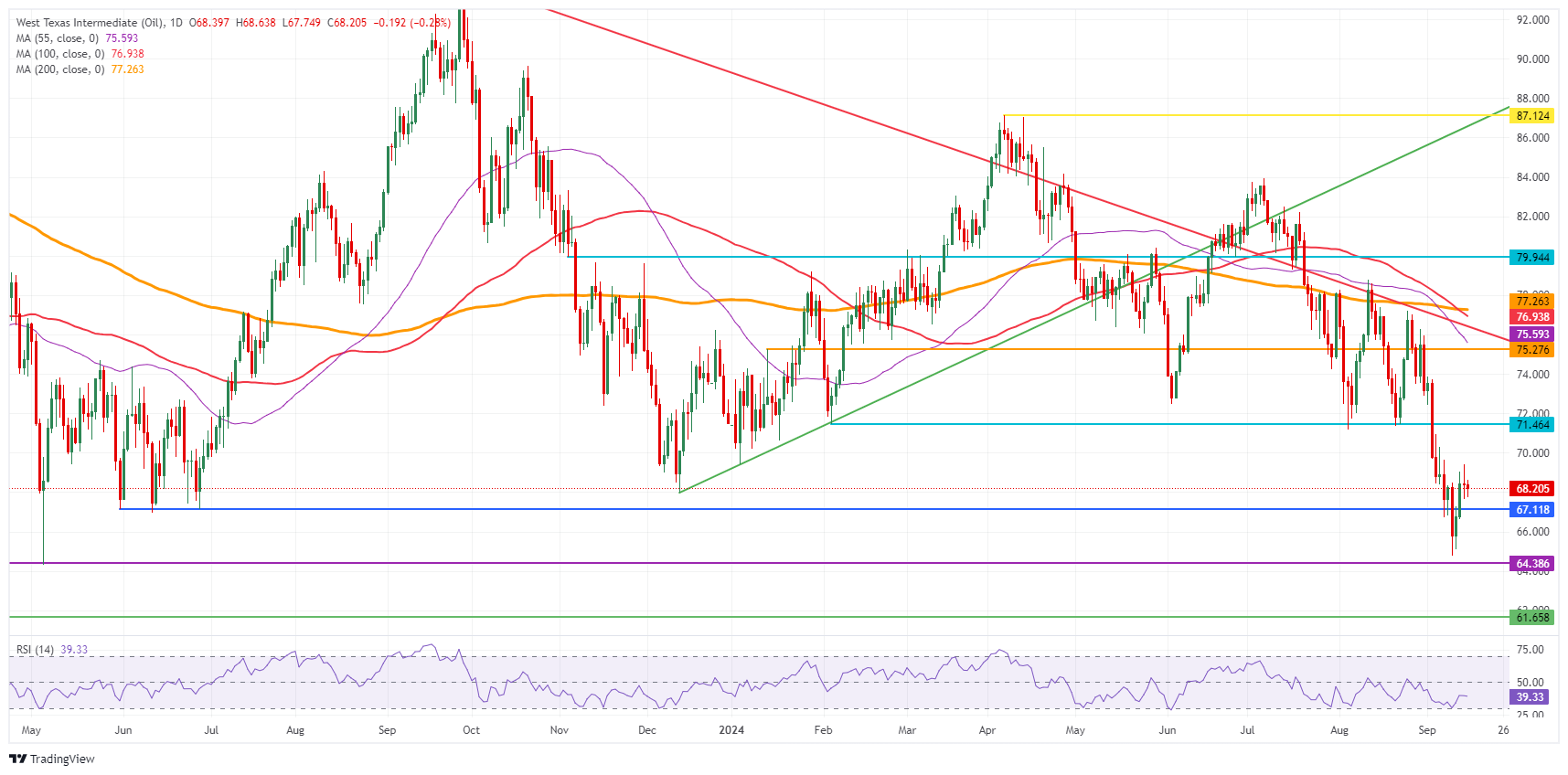
US WTI Crude Oil: Daily Chart
Brent Crude Oil FAQs
Brent Crude Oil is a type of Crude Oil found in the North Sea that is used as a benchmark for international Oil prices. It is considered ‘light’ and ‘sweet’ because of its high gravity and low sulfur content, making it easier to refine into gasoline and other high-value products. Brent Crude Oil serves as a reference price for approximately two-thirds of the world's internationally traded Oil supplies. Its popularity rests on its availability and stability: the North Sea region has well-established infrastructure for Oil production and transportation, ensuring a reliable and consistent supply.
Like all assets supply and demand are the key drivers of Brent Crude Oil price. As such, global growth can be a driver of increased demand and vice versa for weak global growth. Political instability, wars, and sanctions can disrupt supply and impact prices. The decisions of OPEC, a group of major Oil-producing countries, is another key driver of price. The value of the US Dollar influences the price of Brent Crude Oil, since Oil is predominantly traded in US Dollars, thus a weaker US Dollar can make Oil more affordable and vice versa.
The weekly Oil inventory reports published by the American Petroleum Institute (API) and the Energy Information Agency (EIA) impact the price of Brent Crude Oil. Changes in inventories reflect fluctuating supply and demand. If the data shows a drop in inventories it can indicate increased demand, pushing up Oil price. Higher inventories can reflect increased supply, pushing down prices. API’s report is published every Tuesday and EIA’s the day after. Their results are usually similar, falling within 1% of each other 75% of the time. The EIA data is considered more reliable, since it is a government agency.
OPEC (Organization of the Petroleum Exporting Countries) is a group of 13 Oil producing nations who collectively decide production quotas for member countries at twice-yearly meetings. Their decisions often impact Brent Crude Oil prices. When OPEC decides to lower quotas, it can tighten supply, pushing up Oil prices. When OPEC increases production, it has the opposite effect. OPEC+ refers to an expanded group that includes ten extra non-OPEC members, the most notable of which is Russia.
Author

Filip Lagaart
FXStreet
Filip Lagaart is a former sales/trader with over 15 years of financial markets expertise under its belt.