Crude Oil makes its way up to $70 again for a third time this week
- Traders are pre-hedging for a possible suprise comments from OPEC+ as of December 1st.
- OPEC+ ministers are joining on December 1st in person, before Output Policy Meeting scheduled on Thursday.
- The US Dollar Index bounces off the lows with markets concerned on French budget discussions.

Crude Oil is rallying into the US trading session with near 1% gains as nervousness picks up towards OPEC+ and its upcoming events. However, a weekly loss nearly looks inevitable to avoid, while traders await the outcome of the upcoming Organization of the Petroleum Exporting Countries and its allies (OPEC+) meeting on its output policy, which has been delayed to next Thursday. Markets have already priced in a delay in production normalization to the first quarter of 2025.
The US Dollar Index (DXY), which measures the performance of the US Dollar (USD) against a basket of currencies, eases further on Friday with only a handful of US market participants returning to markets after Thanksgiving Thursday. The weakening of the US Dollar comes with the narrowing of the yield gap between the US and Europe due to French yields spiking higher on political uncertainty. French Prime Minister Michel Barnier has until Monday to propose a severely reduced budget, or the far-right National Rally party of Marine Le Pen threatens to topple the French government if demands are unmet.
At the time of writing, Crude Oil (WTI) trades at $69.40 and Brent Crude at $73.13
Oil news and market movers: Headline risk as of Sunday from OPEC+
- Saudi Aramco may reduce the official selling price of Arab Light crude by $0.70 per barrel for January sales to Asia, according to the median estimate from Bloomberg.
- Several OPEC+ ministers will attend the meeting of the Gulf Cooperation Council in Kuwait on Sunday and discuss in person before the Output Policy Meeting scheduled for Thursday.
- The Crude Oil market continues to face uncertainties around weather, demand, and geopolitical developments, said Charu Chanana, chief investment strategist for Saxo Markets Pte in Singapore, Bloomberg reported.
Oil Technical Analysis: Some hedging ahead of OPEC+
Crude Oil prices are still dragging, facing selling pressure and the risk of more downsides, with a constant reminder in articles and media outlets that there is a supply glut still at hand in the Oil landscape. Markets are already pricing in a simple delay of the inevitable, that supply normalization will happen at one point. The only game-changer that could push Oil prices higher would be when OPEC+ considers deepening production cuts and/or extending them for even a year.
On the upside, the pivotal level at $71.46 and the 100-day Simple Moving Average (SMA) at $72.13 are the two main resistances. The 200-day SMA at $76.22 is still far off, although it could be tested if tensions intensify further. In its rally towards that 200-day SMA, the pivotal level at $75.27 could still slow down any upticks.
On the other side, traders need to look towards $67.12 – a level that held the price in May and June 2023 – to find the first support. In case that breaks, the 2024 year-to-date low emerges at $64.75, followed by $64.38, the low from 2023.
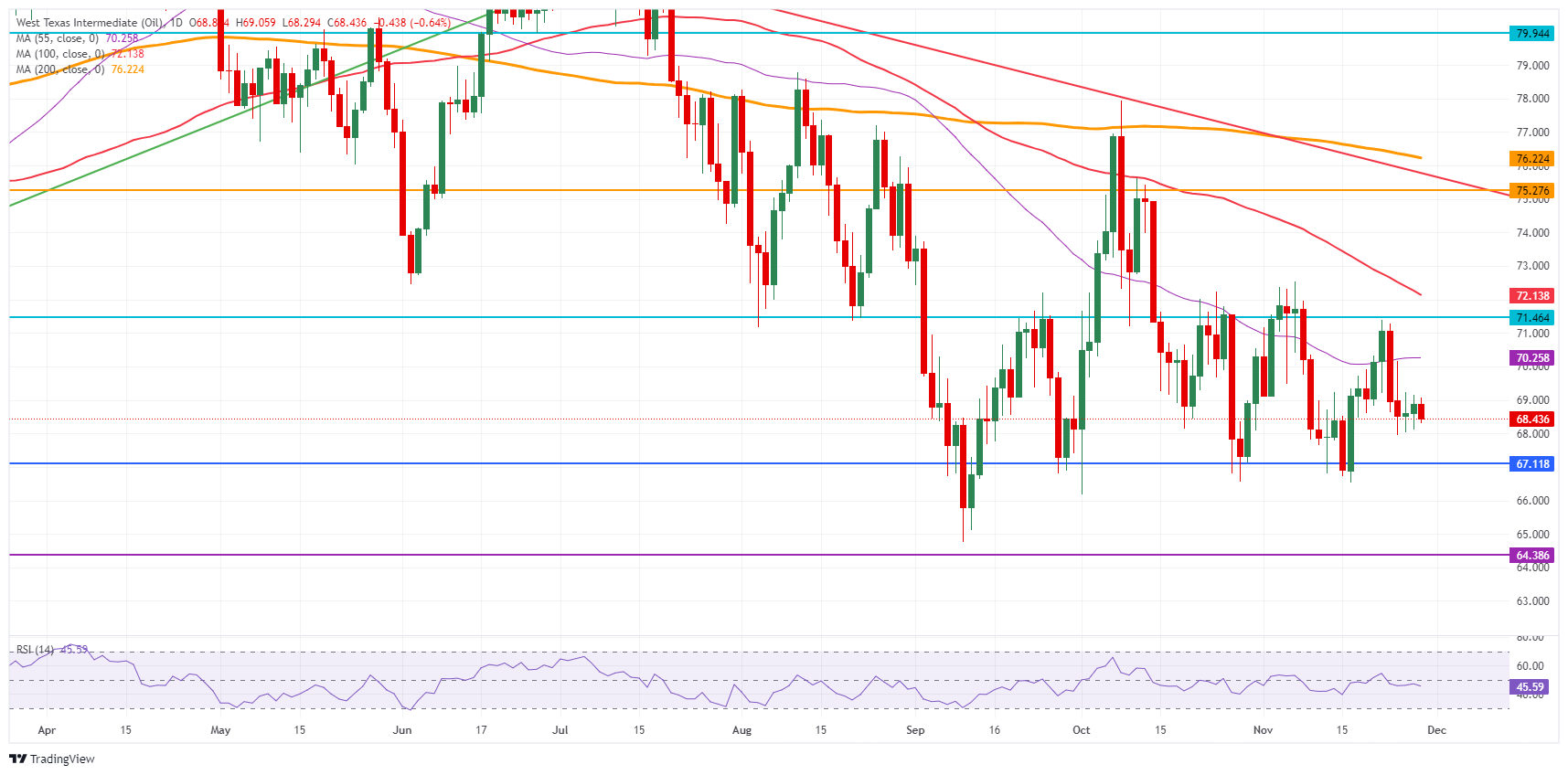
US WTI Crude Oil: Daily Chart
WTI Oil FAQs
WTI Oil is a type of Crude Oil sold on international markets. The WTI stands for West Texas Intermediate, one of three major types including Brent and Dubai Crude. WTI is also referred to as “light” and “sweet” because of its relatively low gravity and sulfur content respectively. It is considered a high quality Oil that is easily refined. It is sourced in the United States and distributed via the Cushing hub, which is considered “The Pipeline Crossroads of the World”. It is a benchmark for the Oil market and WTI price is frequently quoted in the media.
Like all assets, supply and demand are the key drivers of WTI Oil price. As such, global growth can be a driver of increased demand and vice versa for weak global growth. Political instability, wars, and sanctions can disrupt supply and impact prices. The decisions of OPEC, a group of major Oil-producing countries, is another key driver of price. The value of the US Dollar influences the price of WTI Crude Oil, since Oil is predominantly traded in US Dollars, thus a weaker US Dollar can make Oil more affordable and vice versa.
The weekly Oil inventory reports published by the American Petroleum Institute (API) and the Energy Information Agency (EIA) impact the price of WTI Oil. Changes in inventories reflect fluctuating supply and demand. If the data shows a drop in inventories it can indicate increased demand, pushing up Oil price. Higher inventories can reflect increased supply, pushing down prices. API’s report is published every Tuesday and EIA’s the day after. Their results are usually similar, falling within 1% of each other 75% of the time. The EIA data is considered more reliable, since it is a government agency.
OPEC (Organization of the Petroleum Exporting Countries) is a group of 12 Oil-producing nations who collectively decide production quotas for member countries at twice-yearly meetings. Their decisions often impact WTI Oil prices. When OPEC decides to lower quotas, it can tighten supply, pushing up Oil prices. When OPEC increases production, it has the opposite effect. OPEC+ refers to an expanded group that includes ten extra non-OPEC members, the most notable of which is Russia.
Author

Filip Lagaart
FXStreet
Filip Lagaart is a former sales/trader with over 15 years of financial markets expertise under its belt.

















