Canadian Dollar climbs in lopsided Wednesday performance
- Canadian Dollar climbs a third of a percent against Greenback after sour data patch.
- Canada economic data remains thin until Friday’s labor figures.
- US data broadly softens, propping up rate cut hopes.


The Canadian Dollar (CAD) gave a shaky performance on Wednesday. The Loonie was mixed against a basket of major currencies but notably climbed one-third of one percent against the US Dollar (USD) after a raft of data misses from the US. Broad-market rate cut hopes are stepping higher after a sharp drag on US ISM Purchasing Managers Index (PMI) activity figures, and rate markets are pricing in over 70% odds of at least a quarter-point rate trim from the Federal Reserve (Fed) in September.
Canada saw little impact from low-tier trade balance figures on Wednesday. Imports and Exports both declined slightly, leading to a sharper-than-expected contraction in May’s International Merchandise Trade tally. Thursday will bring a notable lull to the action with US markets set to be shuttered for the US Independence Day holiday. Friday will open the floodgates with a fully-stocked US session for the latest US Nonfarm Payrolls (NFP) labor data dump.
Economic Indicator
ISM Services PMI
The Institute for Supply Management (ISM) Services Purchasing Managers Index (PMI), released on a monthly basis, is a leading indicator gauging business activity in the US services sector, which makes up most of the economy. The indicator is obtained from a survey of supply executives across the US based on information they have collected within their respective organizations. Survey responses reflect the change, if any, in the current month compared to the previous month. A reading above 50 indicates that the services economy is generally expanding, a bullish sign for the US Dollar (USD). A reading below 50 signals that services sector activity is generally declining, which is seen as bearish for USD.
Read more.Last release: Wed Jul 03, 2024 14:00
Frequency: Monthly
Actual: 48.8
Consensus: 52.5
Previous: 53.8
Source: Institute for Supply Management
The Institute for Supply Management’s (ISM) Services Purchasing Managers Index (PMI) reveals the current conditions in the US service sector, which has historically been a large GDP contributor. A print above 50 shows expansion in the service sector’s economic activity. Stronger-than-expected readings usually help the USD gather strength against its rivals. In addition to the headline PMI, the Employment Index and the Prices Paid Index numbers are also watched closely by investors as they provide useful insights regarding the state of the labour market and inflation.
Daily digest market movers: Canadian Dollar performance saved by stumbling Greenback
- US ADP Employment Change figures gave their lowest print since January, showing 150K net jobs added in June, below the forecast for 160K and falling back from the previous 157K (revised up from 152K).
- US Initial Jobless Claims for the week ended June 28 also rose faster than expected, coming in at 238K compared to the forecast of 235K and previous 233K. The figure lifted the four-week average to 238.5K from the revised previous figure of 236.25K.
- June’s US ISM PMI activity survey revealed a steepening slowdown in business activity. The survey index dropped sharply to 48.8, the lowest print since June of 2020.
- ISM Services Prices Paid in June declined to 56.3 from 58.1 as industry-level inflation eases.
- Canada’s International Merchandise Trade contracted in May, printing at $-1.93 billion versus the expected recovery to $-1.2 billion from the previous $-1.32 billion (revised down from $-1.05 billion).
- Overall trade activity is slowing in Canada, with May Exports and Imports both declining slightly. Exports fell to $62.45 billion from $64.11 billion, while Imports slid to $64.37 billion from the previous $65.43 billion.
- According to CME’s FedWatch Tool, rate markets are pricing in 72% odds of at least a quarter-point rate trim from the Fed on September 18.
Canadian Dollar PRICE Today
The table below shows the percentage change of Canadian Dollar (CAD) against listed major currencies today. Canadian Dollar was the strongest against the Japanese Yen.
| USD | EUR | GBP | JPY | CAD | AUD | NZD | CHF | |
|---|---|---|---|---|---|---|---|---|
| USD | -0.47% | -0.54% | 0.05% | -0.35% | -0.70% | -0.57% | -0.37% | |
| EUR | 0.47% | -0.07% | 0.52% | 0.12% | -0.24% | -0.07% | 0.10% | |
| GBP | 0.54% | 0.07% | 0.60% | 0.18% | -0.17% | -0.00% | 0.19% | |
| JPY | -0.05% | -0.52% | -0.60% | -0.42% | -0.76% | -0.62% | -0.41% | |
| CAD | 0.35% | -0.12% | -0.18% | 0.42% | -0.35% | -0.20% | -0.00% | |
| AUD | 0.70% | 0.24% | 0.17% | 0.76% | 0.35% | 0.16% | 0.34% | |
| NZD | 0.57% | 0.07% | 0.00% | 0.62% | 0.20% | -0.16% | 0.20% | |
| CHF | 0.37% | -0.10% | -0.19% | 0.41% | 0.00% | -0.34% | -0.20% |
The heat map shows percentage changes of major currencies against each other. The base currency is picked from the left column, while the quote currency is picked from the top row. For example, if you pick the Canadian Dollar from the left column and move along the horizontal line to the US Dollar, the percentage change displayed in the box will represent CAD (base)/USD (quote).
Technical analysis: Wednesday’s Greenback declines a welcome reprieve for CAD bulls
Despite a soft-to-mixed performance, the Canadian Dollar (CAD) found higher ground against the US Dollar and the Japanese Yen (JPY), climbing around one-third of one percent against each. The CAD shed weight against the Australian Dollar (AUD) and the Pound Sterling (GBP), declining one-third of one percent and one-fifth of one percent, respectively.
USD/CAD volatility continues to litter the charts, with the pair declining back into familiar lows near 1.3630. Wednesday’s decline adds to earlier declines after an early week peak just below 1.3760.
A supply zone is baked into the daily chart as candlesticks slump back below the 50-day Exponential Moving Average (EMA) at 1.3677. Buyers will be looking for a chance to re-up on an extended pullback to the 200-day EMA at 1.3588.
USD/CAD hourly chart
USD/CAD daily chart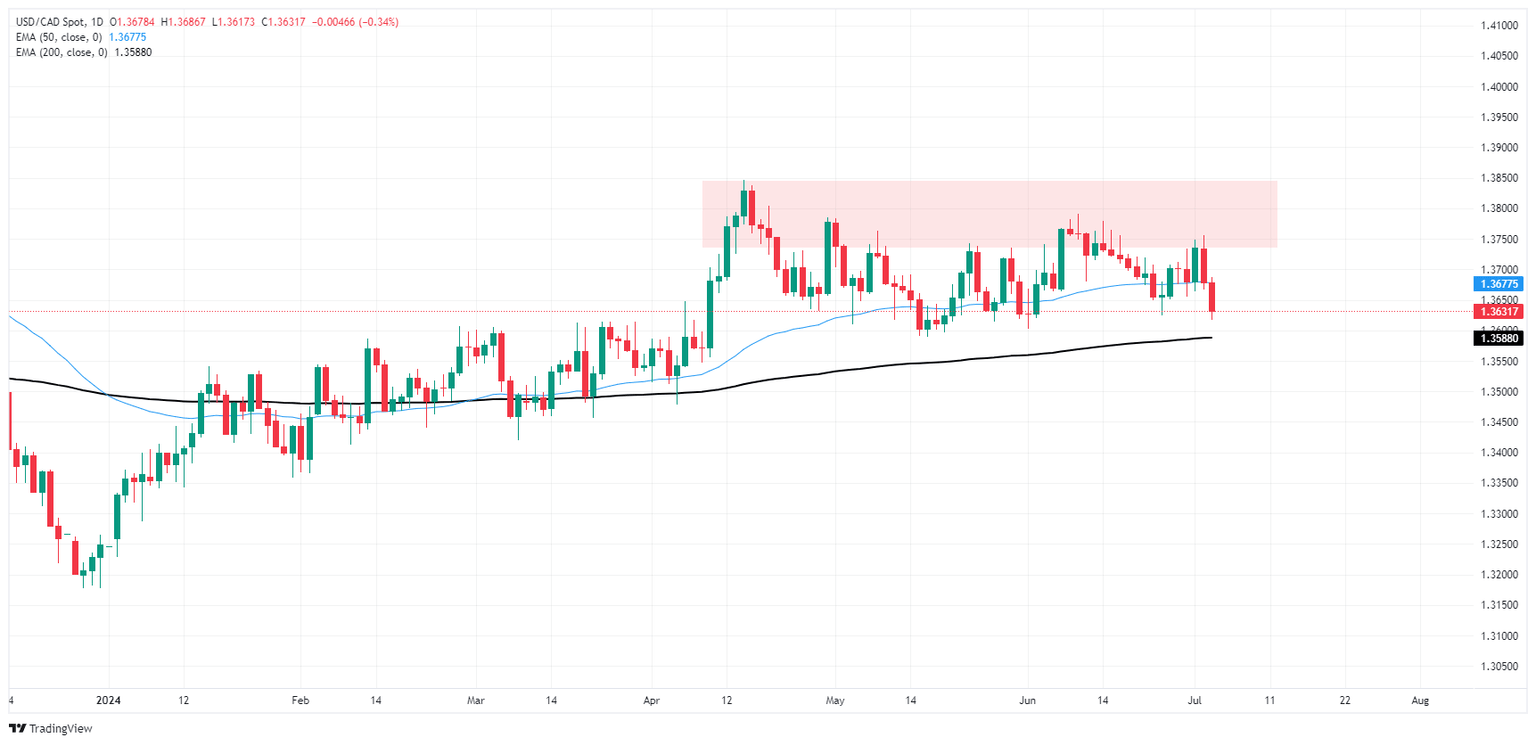
Canadian Dollar FAQs
The key factors driving the Canadian Dollar (CAD) are the level of interest rates set by the Bank of Canada (BoC), the price of Oil, Canada’s largest export, the health of its economy, inflation and the Trade Balance, which is the difference between the value of Canada’s exports versus its imports. Other factors include market sentiment – whether investors are taking on more risky assets (risk-on) or seeking safe-havens (risk-off) – with risk-on being CAD-positive. As its largest trading partner, the health of the US economy is also a key factor influencing the Canadian Dollar.
The Bank of Canada (BoC) has a significant influence on the Canadian Dollar by setting the level of interest rates that banks can lend to one another. This influences the level of interest rates for everyone. The main goal of the BoC is to maintain inflation at 1-3% by adjusting interest rates up or down. Relatively higher interest rates tend to be positive for the CAD. The Bank of Canada can also use quantitative easing and tightening to influence credit conditions, with the former CAD-negative and the latter CAD-positive.
The price of Oil is a key factor impacting the value of the Canadian Dollar. Petroleum is Canada’s biggest export, so Oil price tends to have an immediate impact on the CAD value. Generally, if Oil price rises CAD also goes up, as aggregate demand for the currency increases. The opposite is the case if the price of Oil falls. Higher Oil prices also tend to result in a greater likelihood of a positive Trade Balance, which is also supportive of the CAD.
While inflation had always traditionally been thought of as a negative factor for a currency since it lowers the value of money, the opposite has actually been the case in modern times with the relaxation of cross-border capital controls. Higher inflation tends to lead central banks to put up interest rates which attracts more capital inflows from global investors seeking a lucrative place to keep their money. This increases demand for the local currency, which in Canada’s case is the Canadian Dollar.
Macroeconomic data releases gauge the health of the economy and can have an impact on the Canadian Dollar. Indicators such as GDP, Manufacturing and Services PMIs, employment, and consumer sentiment surveys can all influence the direction of the CAD. A strong economy is good for the Canadian Dollar. Not only does it attract more foreign investment but it may encourage the Bank of Canada to put up interest rates, leading to a stronger currency. If economic data is weak, however, the CAD is likely to fall.
Author
Joshua Gibson
FXStreet
Joshua joins the FXStreet team as an Economics and Finance double major from Vancouver Island University with twelve years' experience as an independent trader focusing on technical analysis.