Canadian inflation rose more than expected in May


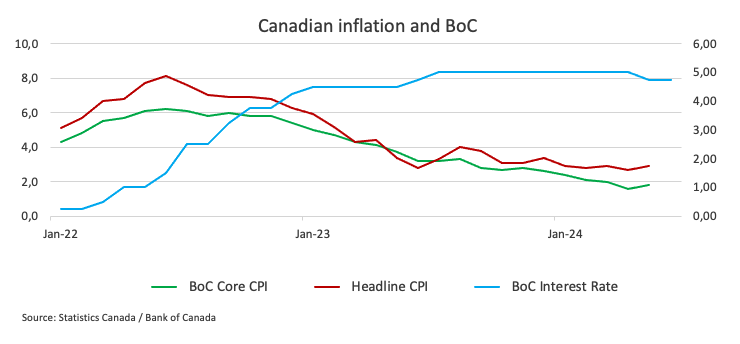
Statistics Canada reported on Tuesday that Canada's inflation, indicated by the annual change in the headline Consumer Price Index (CPI), increased to 2.9% in May from 2.7% in the previous month, surpassing market expectations.
Additionally, the Bank of Canada's core Consumer Price Index saw a yearly increase of 1.8%, up from the 1.6% growth recorded in April.
On a monthly basis, the core CPI, which excludes volatile food and energy prices, rose by 0.6%, and the headline CPI went up by 0.6%.
Market reaction
Following a deep knee-jerk to three-week lows near 1.3620 post-CPI readings, USD/CAD has now returned to the positive territory in the 1.3650-1.3660 band as investors keep digesting the higher-than-estimated inflation figures in Canada during May.
This section below was published as a preview of the Canadian inflation report for May at 06:00 GMT.
- The Canadian Consumer Price Index is set to rise 2.6% YoY in May after April’s 2.7% increase.
- Canada’s CPI inflation data will likely impact the timing of the next Bank of Canada interest rate cut.
- Statistics Canada will publish the CPI inflation data at 12:30 GMT on Tuesday.
Statistics Canada is set to release the top-tier Consumer Price Index (CPI) data for May on Tuesday at 12:30 GMT.
The timing of the Bank of Canada’s (BoC) next interest rate cut will depend on the CPI inflation data, significantly impacting the market’s pricing and the value of the Canadian Dollar.
What to expect from Canada’s inflation rate?
The Canadian CPI is expected to rise at an annual rate of 2.6% in May, a tad slower than a 2.7% increase in April. On a monthly basis, the CPI inflation is seen easing to 0.3% in the same period after April’s 0.5% growth. The core CPI showed no growth over the month in April.
Alongside the CPI data release, the Bank of Canada will publish its closely watched core Consumer Price Index data, which excludes volatile items such as food and energy prices. In May, the annual BoC core CPI inflation is seen steady at 1.6%, while the monthly BoC core CPI is set to rise by 0.2%.
Canada’s inflation is likely to stay below 3.0% for the fifth month in a row, although closing in on the central bank's 2.0% target.
Previewing the Canadian inflation report, analysts at TD Securities (TDS) noted: “We look for headline CPI to rise by 0.3% in May on another large increase for shelter as inflation edges lower to 2.6% YoY.”
“Core inflation measures should hold stable at 2.9%/2.6% for CPI-trim/median, translating to a modest acceleration on a 3M (SAAR) basis, but we do not expect the BoC will be overly concerned by this and see a high bar for this print to derail a July cut,” the TDS analysts said.
Markets are widely pricing in another BoC rate cut at the July 24 policy meeting. However, one additional inflation report is due before the next policy announcement.
TDS Director of Economics, James Orlando, said that “it would probably take a bad reading, either this month or next, to stop the Bank of Canada from cutting."
The central bank's Summary of Deliberations revealed last week that Governor Tiff Macklem and his colleagues thought about waiting until July to lower interest rates but ultimately decided to cut earlier at the June 5 meeting.
Following the policy announcement, Macklem said that “if inflation continues to ease, and our confidence that inflation is headed sustainably to the 2.0% target continues to increase, it is reasonable to expect further cuts to our policy interest rate.”
The BoC joined Sweden's Riksbank and the Swiss National Bank (SNB) in reducing rates, followed by the European Central Bank (ECB), making Canada the first nation amongst the G7 countries to adopt the dovish policy pivot. The central bank lowered key policy rate to 4.75% from 5.0% in June, the first cut in four years.
How could the Canada CPI data affect USD/CAD?
The Canadian Dollar (CAD) has paused its recovery from two-month lows of 1.3792 against the US Dollar (USD) in the lead-up to Tuesday’s CPI showdown. Strong S&P Global preliminary PMI data for June from the United States and risk-aversion continue to underpin the US Dollar at the start of the new week, lending support to the USD/CAD pair.
The Canadian Dollar could regain its recovery momentum if the headline and core CPI figures surprise to the upside and squash expectations of back-to-back interest-rate cuts by the BoC. In such a case, USD/CAD could resume its corrective downside toward the 1.3600 level. Conversely, soft CPI data could boost the BoC’s confidence that inflation is sustainably reaching toward its target, reverberating the market expectations for another rate cut next month. In this scenario, USD/CAD could stage a rebound toward 1.3800, as renewed dovish bets could weigh heavily on the CAD.
Dhwani Mehta, FXStreet’s Senior Analyst, offers key technical levels for trading USD/CAD on Canada’s inflation report: “USD/CAD battles the key confluence zone near 1.3690, where horizontal 21-day Simple Moving Average (SMA) and the 50-day SMA coincide. The 14-day Relative Strength Index (RSI) sits just beneath the 50 level, reflecting buyers’ caution.”
“Acceptance above the 21-day SMA and 50-day SMA confluence at 1.3690 could drive USD/CAD back toward the previous week’s high of 1.3765. Further up, the 1.3800 round level will be on buyers’ radars, close to two-month highs of 1.3792. On the downside, a daily closing below the static support near 1.3665 will reopen the door for a test of the 100-day SMA at 1.3619. The next relevant cushion is seen at the 200-day SMA at 1.3586,” Dhwani adds.
Canadian Dollar PRICE Today
The table below shows the percentage change of Canadian Dollar (CAD) against listed major currencies today. Canadian Dollar was the strongest against the Euro.
| USD | EUR | GBP | JPY | CAD | AUD | NZD | CHF | |
|---|---|---|---|---|---|---|---|---|
| USD | 0.23% | 0.04% | -0.03% | -0.11% | 0.05% | -0.02% | 0.08% | |
| EUR | -0.23% | -0.20% | -0.29% | -0.35% | -0.19% | -0.21% | -0.16% | |
| GBP | -0.04% | 0.20% | -0.10% | -0.14% | 0.02% | -0.02% | 0.06% | |
| JPY | 0.03% | 0.29% | 0.10% | -0.07% | 0.10% | 0.04% | 0.14% | |
| CAD | 0.11% | 0.35% | 0.14% | 0.07% | 0.15% | 0.13% | 0.21% | |
| AUD | -0.05% | 0.19% | -0.02% | -0.10% | -0.15% | -0.02% | 0.04% | |
| NZD | 0.02% | 0.21% | 0.02% | -0.04% | -0.13% | 0.02% | 0.07% | |
| CHF | -0.08% | 0.16% | -0.06% | -0.14% | -0.21% | -0.04% | -0.07% |
The heat map shows percentage changes of major currencies against each other. The base currency is picked from the left column, while the quote currency is picked from the top row. For example, if you pick the Canadian Dollar from the left column and move along the horizontal line to the US Dollar, the percentage change displayed in the box will represent CAD (base)/USD (quote).
Author
FXStreet Team
FXStreet
Composed of a group of economic journalists and FX experts, the FXStreet content team produces and oversees all content published on FXStreet. It provides a purely journalistic approach to the Forex market.